
Flavor profile
Taste & aroma
Salty, refreshing, neutral - Distinctly salty, with a slight refreshing acidity - reminiscent of sea water or a quality low-salt cucumber. Fresh, neutral aroma.
It is distinctly salty, with a slight refreshing sourness - reminiscent of sea water or a high-quality low-salt cucumber. The salt accent is clean, without bitterness and without a vegetable "grassy" note
Fresh, neutral, marine - a slight coolness when raised to the nose, without spicy or sharp notes.
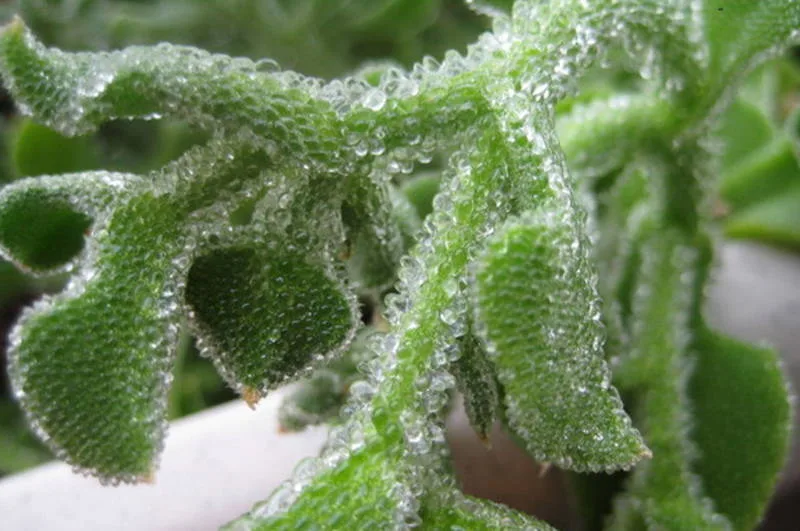
Juicy, Dense, Fleshy - the stem is dense and holds its shape. But the main thing is the bubbles on the surface
Why flavor may vary batch to batch
The salty taste of Ice Plant is formed due to the accumulation of sodium ions and maleic acid in the cells-vesicles (the same ones that form the "crystal" appearance). At cultivation with the addition of sea salt to the water (0.5–1 g/l) salinity increases—it is one of the few crops where salt irrigation improves flavor. Without the addition of salt, the taste is softer and more tender.
Culinary use
How to use
Ice Plant is a great culinary accent. Add fresh at the end of cooking or directly on the plate.
Sashimi or ceviche
a few sprigs of crystal grass next to or directly on the fish replace the salt and provide a textural contrast to the tender fish
Oysters
put a stem of crystal grass in the shell next to the oyster: a soleno-sea duo without any additional ingredients
Tuna or beef tartare
crystal grass on top instead of salt and decor. It looks impressive, and no additional spices are needed
Salad without dressing
add to neutral greens and avocados: crystal grass infuses the salad with bubble juice as you toss it
A cold snack on crackers
cream cheese, capers, crystal grass: three ingredients - a ready-made restaurant canape
Cocktail "Margarita"
instead of a salt rim. The guest bites the stem and gets salt right inside the drink. The effect is memorable
Perfect pairings
This is the most natural combination: the sea saltiness of crystal grass emphasizes the taste of seafood better than milled salt
The neutral background emphasizes the saltiness of the crystal grass without competing with it
Replaces the salty edge of the glass in cocktails - sea saltiness is natural and appropriate
- Do not add to hot dishes: the blisters burst prematurely from the heat, the juice flows out, and the main effect disappears. Crystal grass is exclusively raw.
- Do not press when packing: the bubbles are fragile. If the greens are pressed, they will burst while still in the container, the leaf will "flow" and it will no longer be possible to decorate the dish.
- Do not salt the dish additionally: crystal grass is already salty. Additional salt will make the dish oversalted. First try, then decide.
- Do not mix with acidic dressings: vinegar or lemon juice will break up the blisters as well as heat. If acid is needed, add minimally and at the last moment.
Home storage
How to store
Ice Plant keeps longer than most microgreens. Follow simple rules to keep it fresh for up to 3 weeks.
Don't cut more than you plan to eat right away. Store in refrigerator at +4...+6°C. No watering needed — natural moisture is enough.
Place in an open container or plate, cover with a damp paper towel. Don't seal — without air, greens yellow faster.
Don't wash until ready to eat. Wet greens spoil much faster. Rinse just before serving.
Nutrients & health
Benefits & composition
Ice Plant is valued for its rich vitamin-mineral composition and bioactive compounds typical of microgreens.
Like most microgreens, ice plant contains a concentrated amount of nutrients relative to its weight — many times more than the mature plant.
| Protein | 1.5 g — building material for cells |
|---|---|
| Calories | ~16 kcal |
| Vitamins | A |
| Minerals | Sodium |
- To people who limit sodium intake on the recommendation of the doctor, it is worth considering crystal grass as a source of salt in the dish - and not to add salt additionally.
- As a general rule, crystal grass is used in small amounts (as an accent ingredient), so its effect on daily sodium intake is usually negligible.
This information is general in nature and is not medical advice. Composition data: USDA FoodData Central.
Worth knowing
natural sodium
Crystal grass is a source of natural sodium in the composition of cellular juice - this distinguishes it from ordinary table salt, which is added from the outside. Research into whether the form of sodium significantly affects its assimilation is ongoing, so it is too early to talk about a fundamental difference for health.
beta-carotene
It contains beta-carotene, a pigment characteristic of fleshy plants from sunny regions where crystal grass grows naturally (Mediterranean, South Africa). As part of a varied diet, it is an interesting source of this antioxidant.
moisture
Due to its very high moisture content (~92–95%), crystal grass is a good thirst quencher when consumed in its natural form.
Antioxidants and biologically active substances
Microgreens are a concentrated source of antioxidants — compounds that are being studied in the context of protecting cells from oxidative stress. Regular consumption of a variety of microgreens is part of a balanced plant-based diet.
Similar crops
Similar by taste microgreens
If you are looking to complement or replace Ice Plant:
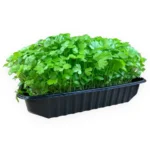
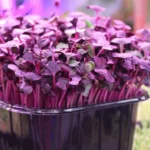
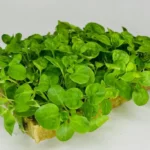
Ice Plant: how to grow — step-by-step guide
Growing parameters, agronomy, common mistakesGrowing parameters
Dust-like (like fine sand), microscopic
Watering
- Moisturize 1 time a day light watering
- Ice Plant stores water in cells-vesicles - does not need frequent watering
- Keep the substrate moderately moist, but not wet
- A sign of lack: crystal vesicles decrease in size → moisturize carefully
Storage
| Uncut in tray | Fridge +4...+6°C | up to 3 weeks |
|---|---|---|
| Cut in container | Refrigerator | up to 7 days |
| Room temperature | 1–2 days |
Harvest
The leaf is covered with distinct transparent blisters, the size of the plant is 3–5 cm. The first real leaf has opened, the stem is dense and fleshy. If the blisters are still not visible or they are very small, give another 3-5 days.
With scissors, very carefully - the plant is fragile. Cut with individual twigs or small bunches, do not pull. Avoid touching the leaves too much: the bubbles will burst from mechanical pressure.
Do not wash before packing - water washes the salt from the surface of the blisters. If washing is necessary (for example, the substrate got on the greenery), carefully immerse it in cold water for a second and immediately let it drain. Do not rub or spin.
Seasonal adjustments
- Blisters: at a temperature above +24°C, the leaves become thinner, the blisters are less pronounced
- Vegetation: optimum +18...+20°C - move to a cooler part of the room
- Greenhouse mode: reduce to 3–4 days, ventilate more often to avoid mold in the heat
- Watering: the succulent accumulates water - in the heat, water a little more often, but without overflowing
- Collection: wait for clear bubbles - they form more slowly in the heat, do not rush to cut
- Heating: below +18°C, growth slows down sharply - room heating or a thermostat is mandatory at +23...+25°C in the greenhouse phase
- Greenhouse mode: extend to 6-7 days covered, then slowly remove over 3 days
- Cycle: can be extended to 35+ days — wait for distinct blisters, take your time
Water pH and EC
Optimum range for Crystal Grass (Ice Plant): 6.0–7.5. Ice Plant tolerates neutral and slightly alkaline environments well. As a halophyte (salt-tolerant plant), it is tolerant of various conditions.
Optimal range: 0.8–1.5 mS/cm. Ice Plant is relatively tolerant to elevated EC (up to 3.0 mS/cm - the natural environment of halophytes). But for microgreens, we recommend moderate values.
Experienced grower tips
Vermiculite is the only assistant for even sowing
Sawdust seeds cannot be distributed evenly by hand. Always mix with fine vermiculite before sowing - this is standard practice for all microseed crops.
Gradual film removal
Do not remove the film suddenly after germination: a sudden transition from 100% to room humidity "shocks" the tender seedlings. A few hours without a film per day - and in 2-3 days the plants adapt without stress.
More light = more bubbles
Bright lighting (an LED lamp at a distance of 20–25 cm or a direct window sill) stimulates the formation of idioblasts. Dim lighting gives normal growth, but the bubbles will be small and the effect less impressive.
Sell live tray - always
Cut crystal grass is vulnerable to mechanical damage during transportation. A live tray removes the problem: the buyer cuts himself before serving, the bubbles are intact, the satisfaction is maximum. Position it as an advantage, not an inconvenience.
Crystal grass is a culture made to order, not in a permanent assortment
A long cycle (20–30 days), a specific client (restaurants, food enthusiasts), delicate logistics — all this makes it unprofitable for mass production. Grow to a specific order and set an appropriate price.
Agronomy notes and common mistakes
- Sowing: No soaking. Medium-high density. Small seeds - uniform sowing.
- Clamp: Without clamping.
- Temperature: +20...+26°C. Ice Plant is heat-loving — it grows very slowly below +18°C.
- Watering: 1 time a day or every other day. Excess moisture for Ice Plant is more dangerous than drying out.
- Ventilation: moderate There are no special requirements.
- Using a clamp → Seeds pressed into the substrate, zero or minimal germination → Only film or greenhouse cap - no weight
- Watering with a strong stream after sowing → Seeds washed into piles, uneven emergence → Only fogger or pre-moistening from below
- Covering seeds with substrate → The seeds did not germinate → Sow only superficially - not a gram of soil on top
- Too high temperature during vegetation (>24°С) → Small bubbles, thin leaf, weak salty taste → Reduce to +18...+20°С — coolness forms dense leaves and distinct bubbles
- Overflow (succulent in the swamp) → Root rot, plants fall and turn black at the base → Water infrequently, the substrate should dry out between waterings
- Cut without blisters (too early) → Ordinary greens without a wow effect → Wait for distinct bubbles — another 3–5 days, take your time
- Soft packaging or storage pressure → The bubbles burst, the sheet "flows", the product appearance is lost → Rigid container with an air gap
Variety selection
Crystal grass
Mesembryanthemum crystallinum
The only species grown for microgreens. The unique crystal-like protrusions on the leaves are the main value.
Aizoon canary
Aizoon canariense
Similar culture with slightly smaller crystals. It is less common, but gives a similar decorative effect.
Що далі?
More crops in the catalog
Explore similar and contrasting flavors — from basil to amaranth