
Flavor profile
Taste & aroma
Sea, salty, mushroom - salty, with notes of mushrooms, algae and light metallicity. The aroma of a fresh sea breeze.
salty, with notes of mushrooms, algae and light metallicity. It's not "like an oyster" - it's identical
Fresh sea breeze - iodine, algae, wet pebbles. It is felt even before the leaf is in the mouth. It is part of the gastronomic experience that begins at the moment of serving.
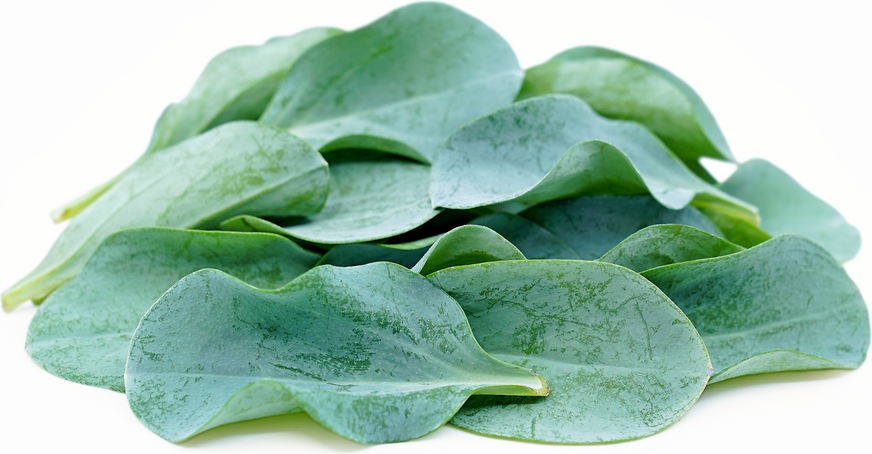
Fleshy, juicy, slightly crunchy - a succulent-type leaf with a waxy silver coating. Dense and more "bodied" than most microgreens
Ripening and optimal harvest time
2–3 real leaves of 1–2 cm in size, the taste is the purest and most "marine".
Leaves 2–3 cm, more juice and saltiness, fuller aroma.
The plant outgrows the format of microgreens, the taste becomes more grassy.
Why flavor may vary batch to batch
The mineral composition of the substrate and water directly affects the "sea-like" taste. A plant that grows in natural conditions on coastal rocks has maximum intensity. Indoors, the taste is somewhat softer, but quite recognizable. Some growers add sea salt or seaweed to the substrate to enhance the effect—with mixed results.
Culinary use
How to use
Oyster Leaf is a great culinary accent. Add fresh at the end of cooking or directly on the plate.
"Vegan Oyster"
serve the leaf on an oyster spoon with a drop of lemon juice and a pinch of sea salt - the effect is guaranteed for any guest
Salmon tartare
2-3 leaves on top instead of microgreens that have nothing to do with the sea - taste unity and visual contrast of a silver leaf on a pink tartare
Scallops or sea bass
one leaf per portion as a final accent — the cook saves money, the guest gets a wow
Bloody Mary cocktail
replace the stalk of celery with a sprig of oyster leaf - the sea note emphasizes the tomato flavor
Tasting set
serve the leaf first in the tasting as an "acquaintance with the taste of the sea" — it warms up the taste buds and prepares for the following dishes
Vegan menu
replaces the oyster in a vegan interpretation of seafood - the only plant that can do it convincingly
Perfect pairings
One leaf per comb — and the dish acquires depth
Classic: oyster leaf on a spoon with crème fraîche and a drop of lemon
"Bloody Mary", gin and tonic with cucumber, oyster shot - oyster leaf as a garnish gives a sea note to cocktails where it is appropriate
- Do not serve with intense competing flavors - garlic, hot peppers, strong sauces will destroy the unique marine profile
- Do not heat - during heat treatment, the taste of the sea disappears, a neutral grassy note remains
- Do not use as a salad base in large quantities - one plant costs as much as a whole serving of microgreens, and the flavor is too intense for large quantities
- Do not cut in advance - after cutting, the leaf withers faster than most microgreens; serve raw or cut minutes before serving
Home storage
How to store
Oyster leaves store much better raw than cut, which is why most chefs get them in pots or trays.
Keep at +12...+16°C — a cool windowsill, cellar or bottom shelf of the refrigerator. Do not water excessively: the plant is of the succulent type, it stores water in the leaves. Under the right conditions, it lives for weeks.
Place in a closed container with slightly damp paper at the bottom at +4...+6°C. The term is only 3-5 days, the quality drops quickly. The leaf becomes dull and loses its crispy texture.
Don't wash until ready to eat. Wet greens spoil much faster. Rinse just before serving.
Pro tip: Only sell live in a pot or tray is the only correct strategy for this crop. The price of a live tray is much higher than that of cut greens, and the logistics are simpler. The chef holds a pot in the kitchen and cuts a leaf at a time.
Nutrients & health
Benefits & composition
Oyster Leaf is valued for its rich vitamin-mineral composition and bioactive compounds typical of microgreens.
Like most microgreens, oyster leaf contains a concentrated amount of nutrients relative to its weight — many times more than the mature plant.
| Protein | 2.0 g — building material for cells |
|---|---|
| Calories | ~20 kcal |
| Vitamins | A |
| Minerals | Zinc, Iodine, Magnesium, Potassium |
- For people with iodine or shellfish allergies: Although oyster leaf is a plant, its flavor and mineral profile is close to seafood — if you're sensitive to iodine, start with one leaf
- People with thyroid diseases: due to the iodine content during active therapy, you should consult a doctor about additional sources of iodine in the diet
This information is general in nature and is not medical advice. Composition data: USDA FoodData Central.
Worth knowing
Zinc and iodine
micronutrients that we usually look for in seafood. Oyster leaves are a plant-based source of these elements—an interesting alternative for those who don't eat fish or shellfish. Zinc is traditionally associated with the support of immunity, iodine with the work of the thyroid gland.
Mineral profile
plants are formed thanks to the natural growth environment — coastal rocks saturated with sea minerals. That is why a plant grown indoors has a slightly different composition compared to a wild plant.
Use in microdoses
1–3 leaves per serving means that the absolute contribution of nutrients to the daily norm is small. The main value of this culture is gastronomic, not nutritional.
Antioxidants and biologically active substances
Microgreens are a concentrated source of antioxidants — compounds that are being studied in the context of protecting cells from oxidative stress. Regular consumption of a variety of microgreens is part of a balanced plant-based diet.
Oyster Leaf: how to grow — step-by-step guide
Growing parameters, agronomy, common mistakesGrowing parameters
Black, hard, expensive
Step-by-step guide
Stratification is a mandatory preparatory stage
Oyster leaf (Mertensia maritima) is a perennial coastal plant of northern latitudes. In nature, seeds overwinter under snow before germinating in spring. Without simulating this process, germination may be 10–20% — in fact, most seeds simply will not wake up.
What is stratification:
Cold treatment of seeds in a humid environment for 2–4 weeks before sowing.
How to conduct:
- Moisten a small piece of paper towel or vermiculite
- Spread the seeds evenly, cover with a wet layer on top
- Place in a sealed bag or container
- Store in the refrigerator at +2...+4°C for 2–4 weeks
- Check every 5-7 days - maintain humidity, remove grains with signs of mold
- After stratification, sow immediately, do not store
If there is no time for complete stratification, even 10 days in the refrigerator significantly increases germination compared to unstratified seeds. Incomplete stratification is better than its complete absence.
Substrate preparation
Oyster leaf is fundamentally different from most microgreens in its substrate requirements. Its root system is rod-shaped and very sensitive to stagnant moisture.
What fits:
- Peat with perlite in a ratio of 2:1 provides moisture retention and drainage at the same time
- Agrocotton - if good drainage is ensured and the substrate does not retain excess water
What is not suitable:
- Coconut mat without perlite is too dense and accumulates moisture
- Any substrate without drainage holes in the tray
Before sowing, moisten the substrate moderately - it should be moist, but when squeezed by hand, water should not flow out.
Sowing
- Spread stratified seeds evenly over the surface of the substrate
- The norm of 1–2 g is liquid sowing, the seeds should not touch each other
- Lightly press each seed into the surface of the substrate - do not cover on top
- Spray with a fine mist from a spray bottle
- Cover with film or a transparent lid
Why liquid sowing: oyster leaf grows slowly and long. With dense sowing, plants begin to compete for resources already in the 3rd week, and it is impossible to remove the excess without damaging the neighbors.
Darkness and greenhouse effect — 5–14 days
After stratification, the seeds germinate much more evenly, but still slowly and unevenly. Wait for the first steps on the 5th-7th day, full ones on the 10th-14th.
Temperature under the dome: +15...+18°C is the key feature of the oyster leaf. Unlike most heat-loving crops, this plant germinates and grows in the cool. At +22°C and above, it becomes stressed, stops growing or dies from root rot.
What is normal:
- Very slow, uneven stairs
- Some of the seeds germinate 10-14 days after the first wave - this is the norm
- Small, tiny sprouts - the plant is in no hurry
What is not normal:
- Soft dark spots on seedlings → rot from overmoistening. This is the most common cause of party loss
- No seedlings after 14 days → either the stratification was insufficient or the temperature is too high
Watering: minimum. It is better to underfill than overfill — this rule for oyster leaves is absolute. Check the humidity of the substrate once every 2-3 days and moisten only if the top layer is clearly dry.
Vegetation in the light — 20–40 days
Remove the dome gradually when the first green leaves appear. A sudden change in conditions is a stress for an already slow plant.
Temperature is the most critical parameter:
- Optimum: +15...+18°C during the entire cycle
- At +20°C, the plant grows, but more slowly and with a higher risk of rotting
- At +24°C and above, the plant is sick. In a standard warm farm (+22...+25°C), the oyster leaf does not survive
If you do not have the opportunity to keep a separate cool zone - this culture is not available to you.
Lighting:
- Moderate - 2000-3000 lux is enough
- Direct bright light or strong phytolamps close together are harmful
- A natural scattered windowsill on the north or east side is good
Watering:
- Only the bottom through the pallet, very careful
- It is better not to water - the plant stores water in its juicy leaves
- A sign of excess: the leaves become watery and transparent, the base of the stem darkens
- A sign of deficiency: the leaves shrivel slightly - but do not rush to water, check the substrate
Ventilation: moderate With a long cycle in a cool room, mold on the substrate is a real threat. Provide a weak constant air movement.
Place the tray of oyster leaves on the bottom shelf of the rack or in the coolest part of the farm—usually the lowest point where cool air accumulates. A difference of 3-4°C compared to the top shelf can be decisive.
Watering
- Water it 1-2 times a day (in the morning - necessarily, in the evening - if necessary)
- Lower watering through a pallet is better
- Oyster leaf is a cool culture: at +16°C, it needs less watering
- A sign of lack: gray-green leaves curl slightly and fade → pour through a tray
Storage
| Uncut in tray | Fridge +4...+6°C | up to 3 weeks |
|---|---|---|
| Cut in container | Refrigerator | up to 7 days |
| Room temperature | 1–2 days |
Harvest
- The leaves reached the size of 2–3 cm
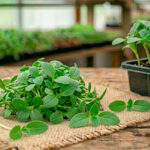
- Acquired a characteristic silver-blue shade with a wax coating
- When touched - juicy, dense, elastic
- The taste when tasting is pronounced marine
Most often, they are sold alive in pots or trays - the chef cuts a fresh leaf just before serving. This preserves the maximum quality and allows you to set a much higher price.
With scissors, cutting individual leaves, not the whole tray at once. The plant, when carefully cut, can grow new leaves - it is the only crop in microgreens with this potential.
Seasonal adjustments
- Cultivation is practically impossible without a separate cool zone - air conditioner, refrigerator or cool cellar with a temperature of +15...+18°C
- Air conditioner: if it is possible to keep the zone at +15...+18°C - it is possible to grow, but isolation from warm areas of the farm is required
- Watering: the risk of root rot is higher in warm weather - water even more carefully, minimum doses only through a pallet
- Stratification spend strictly in the refrigerator - there is no natural cold in the summer
- Expect: significantly lower germination and a higher percentage of losses compared to the cool season
- Perfect season for oyster leaves: natural coolness without air conditioning — optimal conditions for normal growth and maximum sea taste
- Stratification can be held on a balcony or windowsill at +2...+4°C instead of a refrigerator
- Expect: maximum similarity, even growth and the most pronounced marine taste of the leaves
Water pH and EC
The optimal range for Oyster leaf: 6.0–7.5. Oyster leaf tolerates neutral and slightly alkaline environments well. Wide pH tolerance.
Optimal range: 1.0–1.8 mS/cm. Moderate mineralization is ideal. The marine taste of an oyster leaf is a genetic feature, not a result of the mineral composition of the water.
Experienced grower tips
Stratification is not a formality
The difference between unstratified seed (10-20% germination) and stratified seed (60-80%) is the difference between loss and profit. Never skip this step, even if you are in a hurry.
The bottom shelf of the rack is a place for an oyster sheet
Cold air descends. The bottom shelf in any room is 2–5°C cooler than the top shelf. For a culture that needs +15...+18°C in a warm room, this difference can be decisive.
A pot instead of a tray
Oyster leaf is actually a mini-plant, not a microgreen in the classical sense. Growing in a small pot with good drainage gives better results than a standard tray. The pot is easier to control in terms of humidity and more convenient to transport to the restaurant.
Negotiate the price before sowing
Oyster sheet is the only culture where the price of talking to the chef before sowing is not a recommendation, but a requirement. Two months of growing and $20-$50 worth of seed per tray is an investment that has a confirmed buyer before the start.
A neat cut along the leaf lengthens the tray
Unlike all other microgreens, oyster leaf can grow new ones if individual leaves are carefully cut. Don't cut it all at once—a restaurant chef will cut 2-3 leaves per serving, and one tray can last for weeks.
Agronomy notes and common mistakes
- Sowing: No soaking. Stratification is mandatory - 2-4 weeks in the refrigerator before sowing. Liquid sowing 1–2 g, the seeds should not touch each other.
- Clamp: Not needed. Film or dome to retain moisture for 5–14 days.
- Temperature: +15...+18°C during the entire cycle is a critical parameter. At +22°C and above, the plant is stressed and dies from root rot.
- Watering: the minimum lower one through the pallet — it is better to underfill than to overfill. A succulent plant stores water in its leaves.
- Ventilation: moderate constant circulation - with a long cycle, mold on the substrate is a real threat.
- Sowing without stratification → Similarity 10–20%, most seeds do not germinate → Be sure to 2–4 weeks in the refrigerator before sowing
- Temperature too high (+22°C+) → Plant stops, root rot → Keep strictly +15...+18°C throughout the cycle
- Overwetting → Soft dark spots, root rot → It is better not to pour; bottom watering is minimal
- Growing without an order → Spend 2 months, there is no buyer → Sow only under a confirmed contract
- Keeping it clipped → Leaf wilts in 1–2 days, loses its appearance → Sell live, cut before serving
- Dense sowing → Competition in the 3rd week, weak plants → Rate of 1–2 g, liquid sowing
- Bright direct lighting → The leaves are pale, the plant is depressed → Diffused moderate light, not under a powerful lamp up close
Variety selection
Merte Pennyworth
Mertensia maritima standard
The only type for microgreens. Unique sea (oyster) taste, decorative blue-green leaves.
Pulmonary medicine
Pulmonaria saccharata
Similar taste and appearance. Less common, but gives a comparable marine accent in dishes.
Що далі?
More crops in the catalog
Explore similar and contrasting flavors — from basil to amaranth