
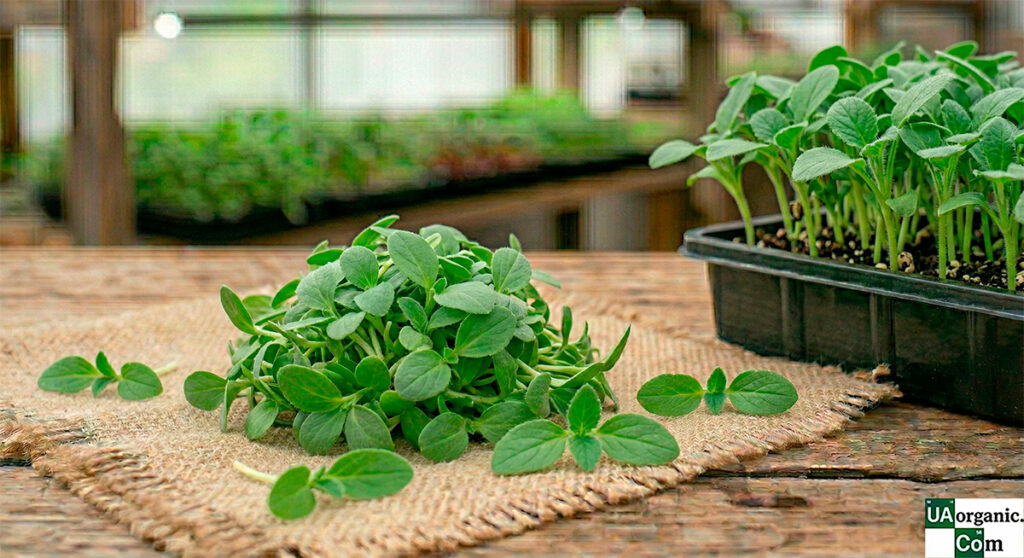
Flavor profile
Taste & aroma
Cucumber, fresh, refreshing - suitable for those who are usually skeptical of greens as an ingredient. Fresh, grassy aroma.
suitable for those who are usually skeptical of greens as an ingredient
Fresh, grassy, similar to the aroma of a freshly cut cucumber. Not intense - it is perceived as a background freshness, and not as a pronounced green smell.
A fleshy, juicy cotyledon with a slight crunch at the first bite. The stem is dense, edible
Ripening and optimal harvest time
The cotyledons are large and juicy, the taste is at its peak, the texture is delicate.
The first real leaf appears, the taste is still clean, but the texture becomes denser.
The stem hardens, hairs appear on the surface, the appearance of the product deteriorates.
Why flavor may vary batch to batch
The intensity of the cucumber aroma depends on the growing temperature. At cool cultivation (+16...+18°C) the taste is more expressive and fresh. At warm (+22°C and above) the leaves become more tender, but the aroma weakens. Lighting also affects: in bright light, the leaves are juicier and more fragrant.
Culinary use
How to use
Borage is a great culinary accent. Add fresh at the end of cooking or directly on the plate.
Olivier or Greek salad
add borage instead of or together with sliced cucumber - the taste is preserved, but the dish does not "float" from excess moisture
Sandwich with red fish
toast, cream cheese, salmon and a few stems of borage on top — minimum ingredients, maximum flavor balance
Okroshka or cold soup
finely chopped borage instead of cucumber or together with it - freshness and flavor without a lot of liquid from the vegetable
Gazpacho
add as a finishing decoration to the plate before serving, not to the blender - the leaves will retain texture and freshness
Gin and tonic or lemonade
several whole stems in a glass - looks neat and conveys the cucumber aroma of the drink
Canapes with herring or pate
borago on the basis of toast or crisps is a taste addition and decoration at the same time
Perfect pairings
Borago replaces cucumber where freshness is needed without excess moisture from chopped vegetables
The cucumber aroma of borago is especially well revealed in sandwiches and canapés with soft cheeses
A few stems in a glass convey the cucumber aroma of the drink and look neat without cutting vegetables
- Do not add to hot dishes - the temperature causes the leaves to lose their texture and taste, turning into a shapeless mass
- Do not keep in the field for more than 12-13 days - the stem hardens, characteristic hairs appear on the surface, it becomes uncomfortable to eat
- Don't substitute borage where you want a crunchy texture—the juiciness is there, but not the crunch of a fresh cucumber
Home storage
How to store
Borage keeps longer than most microgreens. Follow simple rules to keep it fresh for up to 10–12 days.
One of the most undemanding cultures in storage. Keep at +4...+6°C — the tray can be kept in the refrigerator for up to 10–12 days without loss of quality. Cut as needed.
Hermetic container at +4...+6°C. Term — up to 7–10 days: Borago is much lighter than most microgreens due to the dense, juicy structure of the leaves. Do not wash before use - moisture in the package accelerates decomposition. ---
Don't wash until ready to eat. Wet greens spoil much faster. Rinse just before serving.
Pro tip: **Practical hint for the grower:** Borago is one of the most convenient crops to grow in a live tray. A long storage period in the refrigerator reduces risks for the customer and gives a comfortable margin of time for sale. Position as a "cucumber substitute in winter" is a concrete and clear argument for the buyer.
Nutrients & health
Benefits & composition
Borage is valued for its rich vitamin-mineral composition and bioactive compounds typical of microgreens.
Like most microgreens, borage contains a concentrated amount of nutrients relative to its weight — many times more than the mature plant.
| Protein | 1.8 g — building material for cells |
|---|---|
| Calories | ~22 kcal |
| Vitamins | C |
| Minerals | Potassium, Calcium, Magnesium, Iron |
- People with allergies to plants of the Boraginaceae family (blueberry, honeysuckle) should be careful - related plants can cause a cross-reaction.
- Borage contains small amounts of pyrrolizidine alkaloids, substances that are the subject of scientific research regarding long-term use in large quantities. In normal cooking portions, this is not a problem for healthy adults.
- Pregnant women are recommended to consume in moderation and without overindulgence in large quantities.
This information is general in nature and is not medical advice. Composition data: USDA FoodData Central.
Worth knowing
Borago is the source
Borage is a source of vitamin C and potassium, and also contains GLA, a fatty acid traditionally included in the diet as part of a varied diet. GLA is found in only a few plant sources, making borage an interesting addition to the diet for those following a plant-based diet.
Culture has a moderate
The culture has a moderate calorie content and a high water content — it is suitable as part of a light and balanced diet.
Antioxidants and biologically active substances
Microgreens are a concentrated source of antioxidants — compounds that are being studied in the context of protecting cells from oxidative stress. Regular consumption of a variety of microgreens is part of a balanced plant-based diet.
Antioxidants and biologically active substances
Microgreens are a concentrated source of antioxidants — compounds that are being studied in the context of protecting cells from oxidative stress. Regular consumption of a variety of microgreens is part of a balanced plant-based diet.
Similar crops
Similar by taste microgreens
If you are looking to complement or replace Borage:
Borage: how to grow — step-by-step guide
Growing parameters, agronomy, common mistakesGrowing parameters
Large, hard, ribbed
Step-by-step guide
Seed preparation
Borago is not soaked. The seeds are large and hard - they germinate well without preliminary treatment with proper moistening of the substrate and sufficient pressure.
Sowing
- Moisten the substrate evenly - it must be well moist so that the hard shell of the seed begins to soften from the first day.
- Spread the seeds evenly over the surface. Borago is a large seed, it is important that it lies in one layer without overlapping one another. Loose seeding with clumps will give uneven seedlings.
Before sowing, you can also slightly moisten the seeds themselves - sprinkle them in a bowl and scatter them immediately. The wet shell has better contact with the substrate and begins to soften faster.
Clamp — 2 kg
Clamp for borago mandatory and is a key stage of the entire cycle. The logic is simple: a sprout breaking through physical resistance from the bottom up leaves a hard seed coat ("helmet") pressed against the substrate. Without clamping, the sprout comes out together with the shell on the head — and the batch turns into a massive "cascopad" that will have to be removed manually.
Standard weight: 2 kg. Less - does not provide the necessary resistance. More — the risk of damage to sprouts during active growth.
Darkness (Blackout) — 4–6 days
In the dark under pressure, sprouts actively grow upwards and shed their shells. Conditions:
- Complete darkness: put a second box on top or move to a dark place
- Abundant watering: Borago is a powerful plant with a thick stem and consumes a lot of water. The substrate should not dry out
- Check once a day: add water to the pan as needed
A sign of readiness: the sprouts confidently raised the clamp, most of the shells remained in the substrate, the height of the sprouts is 4–6 cm.
If after 5–6 days some of the sprouts still wear a "helmet" - do not remove them by hand right away. Give it another day under the clamp with additional watering: often the moisture helps the sprout shed its sheath on its own.
Vegetation in the light — 5–7 days
We remove the clamp and transfer the boxes to the light. Borago turns green quickly - chlorophyll accumulates actively. At this stage, the main task is not to overdo it.
Watering: abundant, bottom or through the pallet. Borago is a crop with large leaves and high water consumption. A dry substrate causes flabby leaves and loss of marketability faster than in most cultures.
Do not delay the collection: as soon as the cotyledons have fully opened and become bright green, it's time to cut. The appearance of the first real leaf means that the optimal moment is already behind.
Watering
- Water it 1-2 times a day (in the morning - mandatory)
- Bottom watering through a pallet is a priority: large hairy leaves with top watering are prone to mold
- Borago is a large-seeded crop, an active water user
- A sign of lack: large tender leaves wither slightly, become matte → pour through a tray
Storage
| Uncut in tray | Fridge +4...+6°C | up to 3 weeks |
|---|---|---|
| Cut in container | Refrigerator | up to 7 days |
| Room temperature | 1–2 days |
Harvest
- Cotyledons are large, juicy, bright green, oval in shape
- As soon as the first true leaf begins to emerge, it is a signal to cut immediately
- The surface of the "carpet" is even and thick, without yellow spots
With a sharp knife under the root or above the substrate - depending on the substrate. On agrocotton, it is more convenient to cut under the root, so as not to pull the fibers of the substrate together with the greens.
Rinse in cold water before serving. Borago is resistant to washing due to the dense structure of the leaves - it does not wrinkle and does not darken as quickly as basil. Dry with a paper towel.
Seasonal adjustments
- Soaking: reduce by 2–3 hours from the standard - the seeds are active in the heat
- Ventilation: open more often in the blackout phase to avoid excess moisture
- Watering: increase the frequency - the substrate dries faster at a higher temperature
- Expect: shortening of the cycle by 2–3 days, a more tender stem
- Soaking: increase by 2-3 hours from the standard - cold water is absorbed more slowly
- Placement: keep the trays in a warmer place (next to the battery, but not close to it)
- Watering: use water at room temperature—cold slows growth
- Expect: lengthening the cycle by 2-4 days, denser and more fragrant result
Water pH and EC
The optimal range for Borago (Cucumber): 6.0–7.0. Borago grows optimally in a neutral environment. Undemanding to pH - tolerates ordinary tap water well.
Optimal range: 1.0–1.8 mS/cm. Moderate mineralization is ideal. Large leaves of borage absorb minerals well - a high EC (>2.0) can give a slightly bitter cucumber taste.
Experienced grower tips
Crimp weight control is quality control
Two kilograms is a proven norm. Less - and the "helmets" will remain. But uniformity is more important than the amount of weight: if the clamp lies unevenly, part of the box will remain without the necessary pressure. Check that the load covers the entire area evenly.
Abundant watering is not scary
Borago does not rot from excess moisture as easily as small seeds. Culture is powerful and drinks a lot. It is better to overfill than underfill — especially under pressure, when there is no access to the substrate.
Villi on the stem are the norm, not a deficiency
Over time, the borage stem becomes covered with stiff hairs — this is a natural feature of the Borago genus. But in a properly collected, young microgreen, the villi are not yet pronounced and do not interfere. Overripe greens are another matter.
A live tray is the best sales format
Borago keeps in the tray much longer than most crops. The customer gets the convenience (cuts as needed), you get a lower percentage of returns due to loss of quality.
Positioning "cucumber substitute in winter" works
Especially for restaurants and catering, where the seasonality and stability of the quality of cucumbers is a painful topic. A specific flavor argument sells better than general words about "freshness of microgreens".
Agronomy notes and common mistakes
- Sowing: Soaked (4–6 hours) borage — in one dense layer. Big seed - even distribution.
- Clamp: Medium press (1.5 kg), 2 days. Important for embedding large seeds into the substrate.
- Temperature: +18...+24°C. A moderate temperature is ideal.
- Watering: 1-2 times a day, ONLY the bottom. The hairy surface of the leaves is a trap for mold during overhead watering.
- Ventilation: It is important. Large leaves of borage without ventilation are a risk of fungal lesions.
- Lack of clamping → Most of the sprouts come out with a "helmet" on their heads, the lot is unpresentable → To remove manually is time-consuming. For the next batch, a clamp of 2 kg is mandatory
- Insufficient clamping weight → Part of the sprouts still carries the shell, the result is uneven → Increase to 2 kg, check the evenness of the weight distribution in the box
- Insufficient watering at the start → The seed cannot penetrate the hard shell, the sprouts are thin and uneven → The substrate must be well moistened from the beginning, check daily
- Exposure to light → The stem hardens, villi appear on the surface, the taste deteriorates → Cut immediately when the cotyledons are fully opened, do not wait for a real leaf
- Uneven sowing → Dense areas with "mush" and empty places in the box → The seeds are large - time for uniform scattering is justified, haste gives a bad result
Variety selection
Medicinal cucumber
Borago officinalis blue
Standard selection. Cucumber taste, tender juicy leaves, decorative blue flowers.
White-flowered cucumber
Borago officinalis Alba
White flowers and identical taste. It is less common, but the difference is minimal for microgreens.
Що далі?
More crops in the catalog
Explore similar and contrasting flavors — from basil to amaranth