
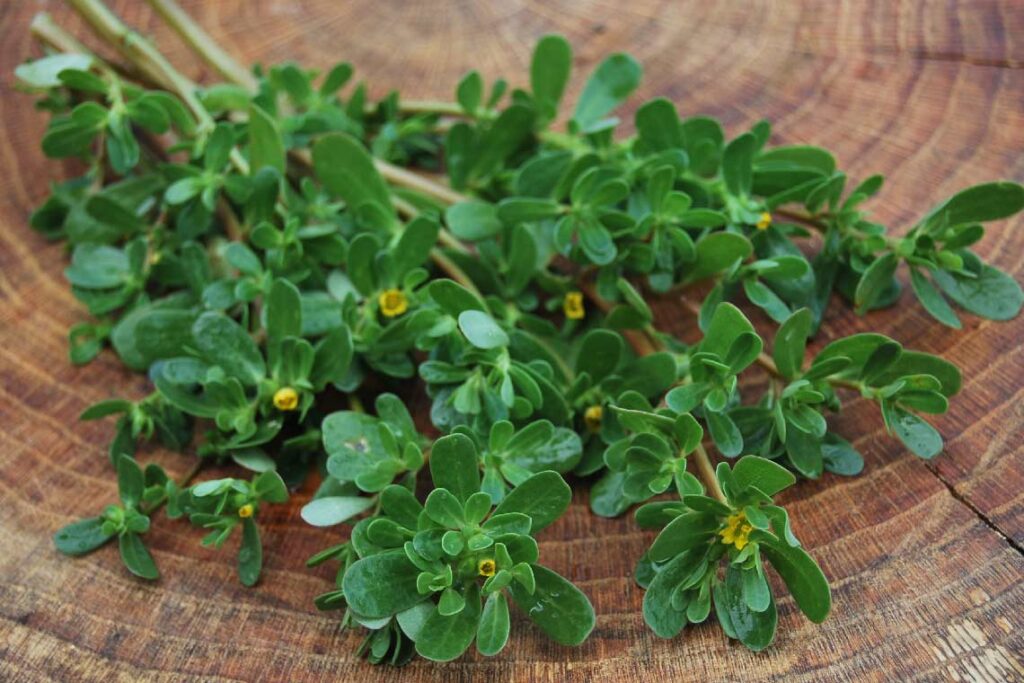
Flavor profile
Taste & aroma
Tender, sour, salty - about like young sorrel, but much softer and without astringency. Neutral, fresh aroma.
approximately like young sorrel, but much softer and without astringency. There is a light lemon undertone, especially if cut in the morning: the malic acid content is higher in the morning, giving a more noticeable acidity
Neutral, fresh, without a note - purslane has almost no smell, which is an advantage where texture and color are needed without a dominant aroma.
Juicy, fleshy, unique - rounded leaves burst in the mouth, each one carries a supply of moisture, this succulent texture has no analogues among microgreens
Ripening and optimal harvest time
The cotyledons have barely opened, the leaves are tender, the taste is delicate and mild.
Juiciness is maximum, sourness is well expressed, pink stems are bright.
The stems become coarser, the texture becomes less delicate, the first real leaves appear with a more expressive taste.
Why flavor may vary batch to batch
Malic acid, which gives purslane its acidity, accumulates differently depending on the time of cutting (more in the morning, less in the evening) and growing temperature. At a higher temperature (+22–24°C), the acidity is brighter, at a cool temperature, the taste becomes softer and more neutral.
Culinary use
How to use
Purslane is a great culinary accent. Add fresh at the end of cooking or directly on the plate.
Greek salad with purslane
instead of lettuce, use purslane - it is juicier and holds its shape better next to tomatoes and feta
Salmon or tuna tartare
purslane on top instead of capers — the same sourness and freshness, but with volume and decorativeness
Omelet or scrambled eggs
place purslane leaves inside or sprinkle on top after serving - the juiciness and sourness contrast with the creamy egg
Warm salad with bulgur and pomegranate
purslane, bulgur, pomegranate seeds, a little mint and lemon dressing - a simple and spectacular option
Cold soup (gazpacho or okroshka)
a few sprigs of purslane inside or when serving - the juiciness and sourness fit in organically
Pizza or focaccia
spread fresh purslane on top of freshly baked pizza - the heat will slightly wilt the leaves and reveal the acidity
Perfect pairings
The saltiness of the cheese accentuates the mild acidity of the purslane, a classic Mediterranean pairing
Purslane acid cuts fat and becomes a natural substitute for lemon juice
The juicy texture of purslane refreshes heavy cereal and legume dishes
- Do not subject to long-term heat treatment - when partially cooked, purslane becomes slimy, like okra. Either eat completely raw or simmer very briefly (30-60 seconds) at the end of cooking
- Do not combine with other very acidic ingredients (sauerkraut, a lot of lemon) - the acidic notes will interrupt each other
- Do not store cut at room temperature - juicy leaves quickly wither and become slippery
Home storage
How to store
Purslane keeps longer than most microgreens. Follow simple rules to keep it fresh for up to 10–12 days.
Keep at +4...+6°C in the refrigerator. Do not fill the substrate - purslane is a succulent and tolerates a slight lack of moisture better than overmoistening. Cut before serving. The term in the tray is up to 10–12 days.
In a tightly closed container at +4...+6°C. Due to the succulent structure of the leaves, purslane lasts better than most microgreens - up to 6-8 days with proper storage. Place a paper towel in the container to avoid excess condensation.
Don't wash until ready to eat. Wet greens spoil much faster. Rinse just before serving.
Pro tip: Purslane holds up better than most microgreens due to the succulent structure of the leaves. Sale by live tray is a good option: the customer cuts it himself before consumption and gets maximum freshness.
Nutrients & health
Benefits & composition
Purslane is valued for its rich vitamin-mineral composition and bioactive compounds typical of microgreens.
Like most microgreens, purslane contains a concentrated amount of nutrients relative to its weight — many times more than the mature plant.
| Protein | 2 г g — building material for cells |
|---|---|
| Calories | ~20 kcal |
| Vitamins | A |
| Minerals | Potassium, Magnesium, Calcium |
- Purslane contains oxalic acid (oxalate) - like spinach or beetroot. People prone to the formation of kidney stones should consume in moderation and not combine with other foods with a high content of oxalates
- Pregnant women should consult a doctor: traditionally, purslane is included in the list of plants that are not recommended in large quantities during pregnancy
This information is general in nature and is not medical advice. Composition data: USDA FoodData Central.
Worth knowing
Omega-3 fatty acids (ALA)
Purslane contains higher amounts than most leafy greens — about 5 to 7 times more than spinach. These are exceptional indicators for a plant source. Purslane is one of the few land plants that also contains trace amounts of EPA, a form of omega-3 normally found only in fish and algae.
Vitamin E (alpha-tocopherol)
present in a higher concentration than in spinach. It is a fat-soluble antioxidant traditionally associated with the health of cell membranes.
Betaine
plant pigments that give purslane stems a pink and reddish hue. They are antioxidants.
Very low calorie
(~20 kcal per 100 g) together with a juicy texture makes purslane an interesting addition to the diet for those who monitor their calorie intake.
Similar crops
Similar by taste microgreens
If you are looking to complement or replace Purslane:


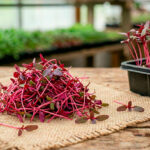
Purslane: how to grow — step-by-step guide
Growing parameters, agronomy, common mistakesGrowing parameters
Very small, black, shiny. Number of seeds: ~977,000/450 g
Step-by-step guide
Seed preparation
Purslane seeds are extremely small and black - smaller than poppy seeds. Soaking is not necessary and technically impossible: the grains will stick together in a lump.
The main feature of this culture: purslane — positively photoblastic seed. This means that it needs access to light for germination. A standard long blackout (3–5 days) suppresses or completely stops germination. This is the main difference between purslane and most microgreens — and the source of the most common beginner's mistake.
Sowing
- Moisten the substrate - evenly, without puddles
- Spread the seeds evenly over the entire surface - due to their small size, it requires attention and calm movements
- Lightly and carefully press with the palm of your hand or the flat bottom of the second tray - without pressure, only to contact the seeds with the substrate
- Spray the surface with a spray gun
Mix the seeds with a small amount of dry sand or vermiculite (1:4 or 1:5) before sowing. This greatly facilitates the uniform distribution of small seeds on the surface.
Instead of blackout, there is a transparent coating
Purslane needs moisture, but not darkness. Instead of a dull clamp or a dark blackout tray, use:
- A transparent film or a transparent dome — preserves moisture and allows light to pass through
- A clear lid tray with a small gap is the best option
Place the tray in a warm place (+22...+26°C) with access to diffused light or near a light installation.
A short blackout is permissible: 12-24 hours after sowing for uniform moistening of the substrate and better contact of the seeds with the surface - but no more.
If there is no transparent dome, place the tray near the window and cover with cling film (it lets in enough diffused light to initiate germination).
Germination — 5–7 days
The first shoots appear on the 5-7th day. Purslane sprouts more slowly than radishes or mustard, and may produce uneven sprouts - this is normal.
What is normal:
- Wavy stairs, not all at the same time
- Thin, barely noticeable stems for the first 3-4 days
What is NOT normal:
- Absence of any sprouts on the 7th day → most likely, the seeds were in the dark for too long or the temperature was below +18°C
- Mold in places of compaction → too dense seeding or excess moisture
Temperature: +22...+26°C for germination is a must. At +18°C and below, seedlings appear late or do not appear at all.
Watering: minimum. Small seeds are easily "washed away" by excess moisture or cease to have contact with the substrate during overflow.
Vegetation in the light — 8–13 days (from sowing)
After the appearance of stable stairs - remove the cover and expose to full lighting.
Lighting: bright Purslane is a sun-loving plant, and in low light the stems stretch out, become pale and watery. LED phytolamps, 14–16 hours a day or direct windowsill.
Temperature: +18...+24°C during the entire cycle.
Watering: moderate, preferably lower through the pallet. As a succulent, purslane tolerates a slight lack of moisture well, but reacts poorly to overwatering - the roots rot.
Ventilation: important With dense sowing and high humidity, purslane is prone to mold in the lower tier.
Watering
- Bottom watering (through a pallet) is optimal: purslane-succulent accumulates water in the leaves and does not like excessive surface moisture
- Water it 1 time in 1-2 days — focus on the condition of the substrate from above, not on the schedule
- After the emergence of seedlings, minimize watering - the stems are tender, excess moisture triggers root rot
- Overwatering is more dangerous than drying out: the succulent structure of the leaves allows you to tolerate 1-2 days without watering more easily than most crops
Storage
| Uncut in tray | Fridge +4...+6°C | up to 3 weeks |
|---|---|---|
| Cut in container | Refrigerator | up to 7 days |
| Room temperature | 1–2 days |
Harvest
- The cotyledons are fully opened, the leaves are round and juicy
- The height is 3–5 cm, the stems are pink or reddish
- If desired, it can be harvested earlier - already at a height of 2–3 cm, purslane cotyledons are edible and tasty even at an early stage
Scissors or a sharp knife above the substrate level. Juicy leaves are very delicate - minimal pressure when cutting.
Only immediately before serving or shipping.
An interesting feature: if you leave the roots in the substrate after cutting and continue to water, purslane can give regrowth. The quality of the second harvest is usually lower, but when sold live tray, this can be an additional advantage for the customer.
Seasonal adjustments
- Ideal season: +22...+26°C is a natural optimum, the cycle is shortened to 9–10 days
- Drying: at +26°C, monitor the humidity of the substrate twice a day — small seeds and a thin layer of the substrate dry out imperceptibly
- Sour: when warm, malic acid accumulates more actively - the taste is more pronounced, collect in the morning for maximum acidity
- Lighting: use a natural window sill - the bright summer sun enhances the juiciness and pink pigmentation of the stems
- Storage: after collecting, immediately put it in the refrigerator - at +25°C, the cut purslane will wither within a few hours
- A thermometer is mandatory: at +16°C and below, purslane does not go down - the thermal mat maintains the substrate at +22...+24°C even in a cold room
- Lighting: compensate for the short winter day with phytolamps (2–4 p.m.) — without bright light, the stems stretch out and fade
- Cycle: extends to 12–14 days; in winter, the taste is milder and less sour due to the lower concentration of malic acid
Water pH and EC
Optimal range for Purslane: 6.0–7.0. Purslane is unpretentious to pH. Normal tap water is fine. Substrate temperature and lighting are more important.
Optimal range: 0.8–1.5 mS/cm. Normal tap water is fine. High EC (>2.0) may inhibit the germination of small seeds due to osmotic stress.
Experienced grower tips
Remember photoblasticity — once and for all
Purslane and darkness are a bad combination. If you are used to putting all microgreens under a blackout tray for 4-5 days, this rule does not apply to purslane. Clear coating or a maximum of one day in the dark.
Sand or vermiculite for even seeding
Purslane seeds are so small that it is almost impossible to evenly distribute them "into points". Mix with inert material 1:4 - sowing becomes controlled and even.
Collect in the morning for a brighter sourness
Malic acid is concentrated in the leaves in the first half of the day. If your market or customer appreciates a pronounced sour taste, cut in the morning. If you need softer greens - in the evening.
A heating mat is not a luxury, but a necessity
Purslane cannot be grown in winter without heating the substrate. This is a hard rule for this culture. Buy one heat mat and use it purposefully for purslane in the cold season.
Decorative potential - use during presentation
Pink and reddish stems on a green background are one of the most beautiful microgreens. Show a potential restaurant customer a live tray, next to a plate of feta and tomatoes - it sells better than any description.
Do not overwater - purslane is not spinach
The habit of watering microgreens every day is harmful here. As a succulent, purslane stores water in its leaves and can go 1-2 days without watering more easily than most crops. A key guideline: the substrate between waterings should dry out slightly on top.
Agronomy notes and common mistakes
- Temperature: +22...+26°C is mandatory throughout the cycle. At +18°C and below, seedlings are delayed or do not appear at all
- Lighting: the maximum Purslane is a sun-loving plant: in low light, the stems stretch out, turn pale, become watery
- Blackouts: only 12–24 h after sowing — photoblastic seeds, prolonged darkness blocks germination
- Substrate: coconut or agrocotton; without peat - peat inhibits the germination of small seeds
- Sowing: mix the seeds with sand or vermiculite 1:4 for even distribution
- Prolonged blackout (3–5 days) → No steps or few steps → Remember: purslane is photoblastic. A maximum of 24 hours in the dark
- Temperature too low (<18°C) → Shoots appear very late or do not appear at all → Warmth +22...+26°C is a must
- Dense sowing → Mold in the lower tier → Adhere to the norm of 2–3 g, uniform distribution
- Excess moisture → Rotting of roots, falling of stems → Water moderately, it is better to water from the bottom through a pallet
- Weak lighting after germination → Pale, elongated, watery stems without juiciness → Bright light, 14–16 h, LED or sunny windowsill
- Peat substrate → Weak germination, stunted growth → Use coconut, agrocotton or peat-free soil
Variety selection
Gruner Red
Green leaves on bright red stems. Very decorative, the color contrast is expressive. The most popular in the restaurant segment precisely because of its appearance.
Goldberg
Bigger and lighter leaves, milder taste. Suitable for those who need more neutral greens with a juicy texture without accentuated acidity.
Що далі?
More crops in the catalog
Explore similar and contrasting flavors — from basil to amaranth