
Flavor profile
Taste & aroma
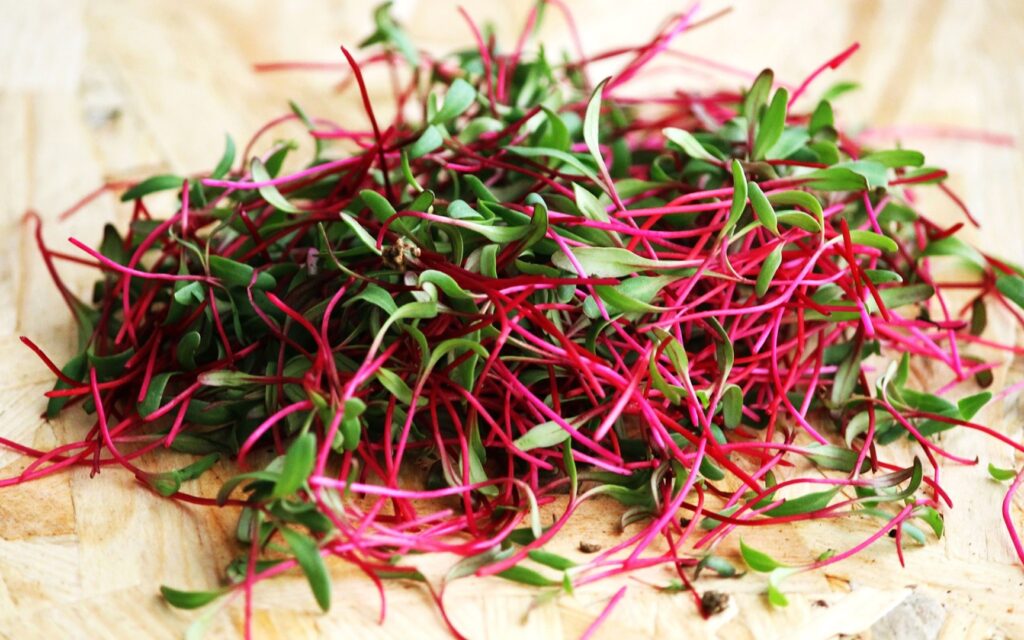
Sweet, earthy, rich - like freshly boiled or baked beets, but without sharpness and with more tenderness. A subtle, fresh aroma.
like freshly boiled or baked beets, but without sharpness and with greater tenderness. The taste is immediately recognizable
Thin, fresh - moist earth and young root crops. Not intense, but characteristic. When the stem is cut, the aroma intensifies.
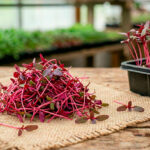
Juicy, elastic stem of bright crimson color is the main element of serving. The leaves are delicate, thin
Ripening and optimal harvest time
The cotyledons are opened, the color is forming, the taste is clean and sweet, the earthiness is barely perceptible.
The first pair of real leaves, the color as saturated as possible, the taste and earthiness at its peak — the optimal moment.
The leaves become harder, the earthiness increases, the stem becomes coarser.
Why flavor may vary batch to batch
The saturation of the maroon color depends on the intensity of the lighting. In low light, Bull's Blood grows green with a red stem - the decorative value is significantly reduced. The brighter the lighting during the growing season, the darker and more uniform the color of the leaves.
Culinary use
How to use
Beet (Bull's Blood) is a great culinary accent. Add fresh at the end of cooking or directly on the plate.
Hummus
sprinkle on top - maroon greens on a beige base look impressive and provide a taste contrast to the chickpea flavor
Salad with arugula and feta
beets add sweetness and color, arugula adds spiciness, feta adds saltiness. A classic balance of three elements
Beef tartare
stems of Bull's Blood nearby — and the presentation acquires a depth of color without unnecessary elements
Pumpkin or beet cream soup
several stalks on top - the color resonates with the dish, the taste is enhanced
Green smoothie
a few stems give a rosy tinge and sugar-free sweetness
Avocado toast
burgundy stems on green avocado — a contrast of colors that immediately attracts attention
Perfect pairings
The sweetness of the beets and the saltiness of the cheese is a classic balance that looks especially impressive on toast and in salads
Bull's Blood's earthy, sweet profile is a classic pairing with rich, dark roast meats
Beets color the drink or soup in a rich pink color and add natural sweetness without sugar
- Do not add to hot dishes - the temperature immediately darkens the leaves and loses their decorative appearance
- Do not combine with very acidic dressings in large quantities - acid discolors anthocyanins, the color becomes dull
- Do not expect neutrality - the earthy taste of beets is distinct, and where it is inappropriate, it is better to choose another culture
Home storage
How to store
Beet (Bull's Blood) keeps longer than most microgreens. Follow simple rules to keep it fresh for up to 10–12 days.
Keep at +2...+5°C in the refrigerator. The term is up to 10–12 days. Beetroot is well stored due to the dense structure of the stem. Slice as needed just before serving.
Hermetic container at +2...+5°C. The term is up to 8–10 days. Beets do not wither as quickly as leafy greens - the dense juicy stem keeps turgor for a long time. Do not wash before use. After washing, the stem may slightly color the water - this is a natural pigment, not a sign of spoilage. ---
Don't wash until ready to eat. Wet greens spoil much faster. Rinse just before serving.
Pro tip: **Practical hint for the grower:** Bull's Blood is a product for the restaurant and premium segments. Positioned as "microgreens with the strongest color effect" is a concrete and proven argument for chefs. A long cycle and more complex agricultural machinery justify a higher selling price.
Nutrients & health
Benefits & composition
Beet (Bull's Blood) is valued for its rich vitamin-mineral composition and bioactive compounds typical of microgreens.
Like most microgreens, beet (bull's blood) contains a concentrated amount of nutrients relative to its weight — many times more than the mature plant.
| Protein | 2.2 g — building material for cells |
|---|---|
| Calories | ~35 kcal |
| Minerals | Iron, Magnesium, Potassium |
- People with high blood sugar should consider that beets contain natural sugars. In the format of microgreens, they are much less than in an adult root crop, but it is not worth consuming in large quantities.
- In some people, beetroot can cause a temporary pinkish color to the urine (beturia), which is a harmless reaction to betacyanin and not a symptom of a disease.
This information is general in nature and is not medical advice. Composition data: USDA FoodData Central.
Worth knowing
Bull's Blood is
Bull's Blood is a source of folic acid (B9) and iron, nutrients that are traditionally included in the diet during increased physical activity and during certain physiological periods.
Betacyanin is an item
Betacyanin is the subject of scientific research as an antioxidant compound. It is stable in a neutral and slightly alkaline environment, but it discolors in an acidic environment - that is why acidic dressings change the color of beets on a plate.
Culture fits as
Culture is suitable as part of a varied diet for those who focus on a plant-based diet with a rich micronutrient profile.
Antioxidants and biologically active substances
Microgreens are a concentrated source of antioxidants — compounds that are being studied in the context of protecting cells from oxidative stress. Regular consumption of a variety of microgreens is part of a balanced plant-based diet.
Similar crops
Similar by taste microgreens
If you are looking to complement or replace Beet (Bull's Blood):
Beet (Bull's Blood): how to grow — step-by-step guide
Growing parameters, agronomy, common mistakesGrowing parameters
Fruit (globules), hard, multi-germinal
Step-by-step guide
Seed preparation — soaking for 12–24 hours
Beet seeds are not ordinary seeds, but co-fruits: a dry, hard shell containing 2-4 seeds. Without soaking, the sheath is almost impermeable - sprouts will appear in 10+ days or not at all.
How to soak:
- Cover the seeds with water at room temperature in a ratio of 1:3 (seed:water).
- Soak for 12-24 hours. It is advisable to change the water every 6-8 hours or use bubbling (aeration) - this washes out the growth inhibitors that the beet releases into the water.
- Before sowing rinse the seeds well under running water. The water after soaking turns burgundy - these are natural pigments and growth inhibitors, they must be washed off.
If the water is still very dark after 12 hours of soaking, drain it, wash the seeds and fill with fresh water for another 6-8 hours. The better the inhibitors are washed, the more uniform and faster the stairs.
Sowing
- Moisten the substrate evenly - it should be well wet.
- Distribute the soaked seeds in one layer. The beetroots are large - if they lie on top of each other, moisture accumulates between them and mold develops. Beets contain sugars, which are a nutrient medium for fungi.
- Lightly spray the surface with water from a spray bottle after sowing.
Beet seeds often carry mold spores on their surface. Preventive treatment before sowing - soak the seeds for 30 minutes in a weak solution of hydrogen peroxide (3%, diluted 1:10) or phytosporin, then rinse. This significantly reduces the risk of mold in the first days.
Clamp — 1–2 kg
A clamp for beets is not just fixing the root. This is a mechanism for combating "helmets": a sprout that breaks through the resistance of heavy pressure against a hard substrate (coconut, peat) leaves a hard shell pressed down. Without sufficient pressure or on a soft substrate, the shell comes out together with the sprout and clamps the cotyledons.
Rate: 1–2 kg. An even distribution of weight throughout the box is a prerequisite.
Darkness (Blackout) — 5–6 days
Beetroot sprouts more slowly and unevenly than most crops - this is a feature of multigerminating seeds. From one glomerulus, 2–3 sprouts can emerge with a difference of 1–2 days.
Conditions:
- Complete darkness: cover with a second box or move to a dark place
- Temperature: +18...+22°C
- High humidity: abundant watering at the bottom. The hard shell softens only with constant moisture — a dry substrate guarantees "helmets"
- Ventilate once a day: beets are prone to mold due to the sugar content of the seeds
Fighting with "helmets": if after 5–6 days some of the sprouts still have a shell, do not rush to bring them out into the light. Sprinkle water liberally on top and let it sit for another 12-24 hours under the press in the dark. Moisture softens the shell. If the helmets remain after that, carefully spray again before exposing them to light; some can be removed by hand, but it is laborious.
A sign of readiness: most of the sprouts have shed their sheath, height 4–6 cm.
Vegetation in the light — 8–12 days
Beets gain color gradually — the first days the cotyledons can be green with a pink stem, and only then darken.
Lighting: intensive, 16 hours a day. The brighter the light, the darker and more uniform the burgundy color. In low light, Bull's Blood remains green with a red stem.
Watering: abundant, lower. Beet actively drinks water - drying out of the substrate gives it a sluggish appearance and accelerates aging.
Irregular growth: due to the multigermination of the seeds, the box looks uneven - some sprouts are higher, others are lower. This is normal for beets, not a sign of problems.
Watering
- Water it 1-2 times a day (in the morning - necessarily, in the evening - if necessary)
- Bottom watering through a pallet is critical: top watering causes stem rot
- Beetroot is a slow germinator: the substrate should be moderately moist, not wet, for the first 3-4 days
- A sign of lack: red stems become matte, leaves slightly droop → water through a tray
Storage
| Uncut in tray | Fridge +4...+6°C | up to 3 weeks |
|---|---|---|
| Cut in container | Refrigerator | up to 7 days |
| Room temperature | 1–2 days |
Harvest
- Long elongated cotyledons of rich burgundy color
- The stem is bright crimson, elastic
- Height 6–8 cm
- The first pair of true leaves have appeared or are just beginning to emerge
With a sharp knife under the root - keeping the length of the beautiful raspberry stem as much as possible. The stem itself is the main decorative element of Bull's Blood.
Rinse in cold water before serving. The water after washing may turn slightly pink - this is natural betacyanin, not a sign of spoilage. Dry with a paper towel.
Seasonal adjustments
- Soaking: reduce to 12-14 hours instead of 18. Beets do not need long soaking in warm water
- Blackouts: reduce to 4-5 days and ventilate more often - moist heat provokes mold
- Watering: increase the frequency - the substrate dries faster
- Vegetation: watch more carefully, the cycle may be shortened by 2-3 days
- Expect: a more delicate stem, at a temperature above +26°C the color may be less saturated
- Soaking: increase to 20-24 hours - cold water is absorbed much more slowly
- Placement: keep the trays in a warmer place - away from cold windows and floors
- Expect: prolongation of the cycle by 4–6 days, but the maximum saturated color and dense stem
Water pH and EC
The optimal range for beets: 6.0–7.5. Beetroot tolerates neutral and slightly alkaline environments - a wider range than most crucifers. At pH 7.5–8.0, no particular problems arise.
Optimal range: 1.0–2.0 mS/cm. A moderate consumer of minerals. The deep red color of the stems is independent of EC - it is anthocyanins, not minerals.
Experienced grower tips
Bubbling when soaking is a noticeable difference
An aquarium compressor with a spray, lowered into a container with soaked seeds for 12-24 hours, accelerates the washing out of inhibitors and oxygen saturation. Stairs after bubbling are more uniform and faster.
The coconut is denser - there are fewer helmets
The harder the substrate, the more resistance the sprout feels when breaking through - and the more likely the shell will remain at the bottom. Soft agrocotton gives a higher percentage of helmets than dense coconut or peat.
A generous sprinkling before taking to the light is a standard procedure
Even if most of the helmets have already been dropped, spray the top of the box just before transferring to the light. Moisture softens the remaining shells and they often come off by themselves during the first day of vegetation.
Irregular height is not a defect, but a feature
Buyers, especially restaurant customers, perceive the uneven height of the beet as "natural" and "handmade". Do not try to match it - serve as is.
Bull's Blood + chard = the perfect beet mix
Similar agricultural technology and cycle, different shade of color - Swiss chard produces a bright crimson leg with a green leaf, Bull's Blood - a dark burgundy monochrome. Together they look more impressive than each culture separately.
Agronomy notes and common mistakes
- Sowing: Soaked (12 hours) beet balls in one even layer. Large "seeds" take up more space than they look.
- Clamp: 1.5–2 kg, 2–3 days. Firm clamping is critical — the glomeruli have close contact with the substrate.
- Temperature: +18...+22°C. At +24°C and above, there is a risk of mold on large glomeruli; at +16°C — slowly but steadily.
- Watering: 1-2 times a day, ONLY the bottom. Water on beet stalks is a guarantee of stem rot.
- Ventilation: Very important: large balls without ventilation and with overhead watering are ideal conditions for mold.
- Sowing dry seeds → Seedlings after 10+ days, sparse and uneven → Soaking for 12–24 h with rinsing is mandatory
- Poor rinsing after soaking → Slow and uneven germination due to growth inhibitors → Wash seeds under running water before sowing; change the water when soaking
- Seeds in two layers → Mold between the glomeruli for 2–3 days → Distribute strictly in one layer, the norm of 12 g does not involve layering
- Lack of mold prevention → Mildew on seeds or substrate from the first day → Treat seeds with peroxide or phytosporin before sowing
- Insufficient clamp or soft substrate → Most sprouts carry a "helmet" → Press 1–2 kg on a solid substrate (coconut, peat); with residual helmets — abundant spraying and another 12–24 hours in the dark
- Weak lighting → Green leaves with red stem instead of maroon → Increase intensity, 16 h/day
- Dry substrate under pressure → Small number of seedlings, the hard shell does not soften → Abundant watering of the bottom from the first day, monitor daily
Variety selection
Table beet
Detroit, Bordeaux, Red Globe
A classic choice. Bright red stem, pronounced earthy taste with a slight sweetness.
Swiss chard (beetroot)
Eldorado, Rainbow Chard
A rainbow of colors — yellow, orange, pink stem. The taste is milder than that of table beet.
Що далі?
More crops in the catalog
Explore similar and contrasting flavors — from basil to amaranth