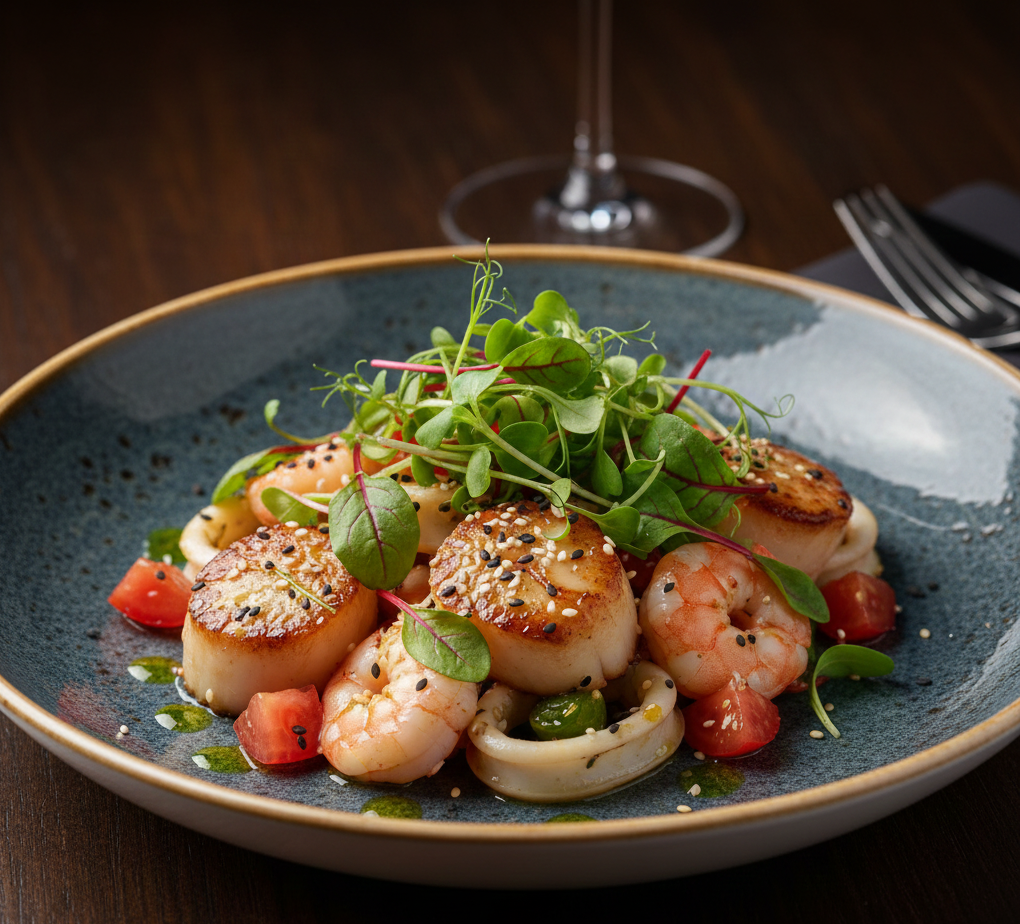
Warm Seafood Salad with Chard Microgreens and Ponzu
Squid or shrimp seared at maximum heat with tomato concasse and ponzu sauce, finished with chard microgreens —…

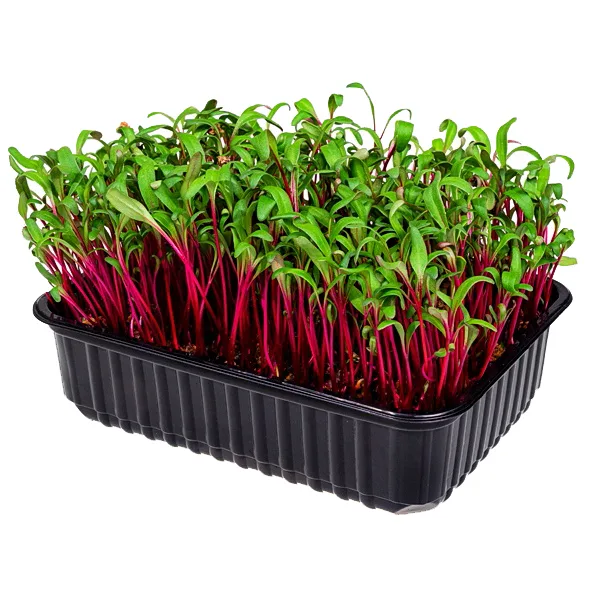
Beta vulgaris var. cicla
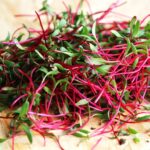
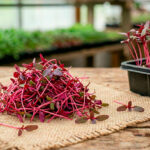
Bright crimson, red or yellow legs and delicate silky leaves - chard is appreciated primarily with the eyes. These are the prettiest microgreens on the shelf, and restaurants know it. The taste is a noble relative of the beet: sweet, with a soft earthy tone, but without the heavy earthiness of Bull's Blood. Mangold takes the best from the beetroot and leaves everything extra.
Flavor profile
Sweet, earthy, tender - like a very young beetroot or tender spinach. A fresh, moist fragrance.
like very young beets or tender spinach. Less intense and less "rooty" than Bull's Blood
Fresh, moist, garden. Not sharp, not spicy. A light beet aroma, which is felt only when cutting the stem.
Crisp juicy stem and very tender, silky leaf. The most beautiful element is the bright crimson or red stem itself
Ripening and optimal harvest time
The cotyledons are open, the stem is gaining color, the taste is fresh and sweet.
The first pair of real leaves, the color of the stem is as bright as possible, the optimal moment of collection.
The leaves harden, the earthiness intensifies, the stem begins to coarsen.
Why flavor may vary batch to batch
The brightness of the stem depends on the intensity of lighting and temperature changes. Cool nights make the color more intense, just as the autumn chill intensifies the color of the leaves on the trees. At a constant warm temperature (+22°C and above), the color becomes duller.
Culinary use
Chard is a great culinary accent. Add fresh at the end of cooking or directly on the plate.
raspberry stalks of chard on green avocado and white bread - three colors that guarantee a spectacular presentation
chard adds sweetness and a color accent, arugula adds spiciness, feta adds saltiness. Classic balance
several stems on top are a bright crimson accent on an orange or red background
instead of parsley, chard on top looks much more impressive and gives a light sweet taste instead of herbal
the bright stem under the yellow yolk is a classic of color contrast in a modern presentation
chard between pieces of meat and cheese instead of ordinary greens - looks much more expensive
Perfect pairings
The sweetness of the chard complements the saltiness of the cheese without competing
Colorful chard stems among arugula, iceberg or spinach provide an immediate color accent
The bright stem looks spectacular on the neutral white and cream tones of the dish
Home storage
Chard keeps longer than most microgreens. Follow simple rules to keep it fresh for up to 10–12 days.
Keep at +4...+6°C in the refrigerator. The term is up to 10–12 days. The cold preserves and even enhances the brightness of the stem - a batch that has been in the refrigerator for a day often looks brighter.
Hermetic container at +4...+6°C. The term is up to 8–10 days. The dense structure of the stem keeps the turgor well - chard does not wither as quickly as leafy greens. Do not wash before use. After washing, dry carefully - the water may be slightly colored by the pigment of the stem. ---
Don't wash until ready to eat. Wet greens spoil much faster. Rinse just before serving.
Pro tip: **Practical hint for the grower:** Swiss chard is the crop with the strongest visual effect with relatively simple farming techniques. The main difficulty is "helmets", but with the right humidity at the end of the blackout, it is solved systematically. Position for the restaurant segment as "the prettiest serving microgreen."
Nutrients & health
Chard is valued for its rich vitamin-mineral composition and bioactive compounds typical of microgreens.
Like most microgreens, chard contains a concentrated amount of nutrients relative to its weight — many times more than the mature plant.
| Protein | 1.8 g — building material for cells |
|---|---|
| Calories | ~19 kcal |
| Vitamins | K |
| Minerals | Iron, Magnesium, Potassium |
This information is general in nature and is not medical advice. Composition data: USDA FoodData Central.
Worth knowing
Chard is one
Swiss chard is one of the richest plant sources of vitamin K, a nutrient traditionally included in the diet to support bone tissue and normal blood clotting. Iron and magnesium complement the culture profile as part of a varied diet.
Betalains stems —
Stem betalains are the same pigments as in beets, but in a lower concentration. They are stable in a neutral environment and change color when in contact with acid or alkali.
Antioxidants and biologically active substances
Microgreens are a concentrated source of antioxidants — compounds that are being studied in the context of protecting cells from oxidative stress. Regular consumption of a variety of microgreens is part of a balanced plant-based diet.
Antioxidants and biologically active substances
Microgreens are a concentrated source of antioxidants — compounds that are being studied in the context of protecting cells from oxidative stress. Regular consumption of a variety of microgreens is part of a balanced plant-based diet.
Similar crops
If you are looking to complement or replace Chard:
Large, subfruit (globules), hard cork shell
Step-by-step guide
Chard seeds are an accessory fruit (globules), just like beets. 2–4 sprouts grow from one glomerulus. The hard cork shell is the main cause of "helmets".
Soaking according to the table of norms is not required, but when sowing abundant moistening of the seeds from the sprayer is mandatory immediately after decomposition. The shell should begin to soften from the first minute. If there is time, a short soaking for 4–6 hours before sowing significantly reduces the percentage of "hard hats".
Bull's Blood Chard and Beet is a natural commercial mix. The same agricultural technology, the same cycle. Swiss chard gives a bright crimson leg with a green leaf, beetroot - a dark burgundy monochrome. Together, they look much more impressive and are sold as a "beet mix" more expensively than each culture separately.
The clamp for chard performs a double function: it fixes the glomeruli in the substrate and mechanically helps the sprout to shed its hard shell when breaking through the loose material. Even distribution of weight throughout the box is mandatory.
Swiss chard sprouts unevenly due to the multigermination of seeds — different embryos in one glomerulus can emerge with a difference of 1–2 days. This is the norm.
Conditions:
Fighting with "helmets": in the last 24 hours of the blackout, significantly increase the humidity. Spray on top several times, cover with a film or a plastic bag over the clamp - create a "greenhouse effect". Spray again liberally before taking out into the light. If there are helmets left, give another 12 hours in these conditions.
A sign of readiness: most of the sprouts have shed their sheath, height 4–5 cm.
Swiss chard gains color gradually. In the first days, the stem may be pale pink - saturation comes by the 4-5th day of vegetation.
Lighting: standard, 16 hours a day. Intense light enhances the brightness of the stem. In low light, the color remains pale.
Temperature: +18...+22°C. Cool conditions give a more saturated color. At a temperature above +24°C, the stem turns pale and stretches.
Watering: lower. Water on the leaves can cause spotting — just because of the pallet.
The uneven height of the sprouts is not a deficiency. 2–4 sprouts of different sizes grow from one glomerulus. This gives chard a natural "wildness" and organic look that restaurants often value as authenticity.
Watering
Storage
| Uncut in tray | Fridge +4...+6°C | up to 3 weeks |
|---|---|---|
| Cut in container | Refrigerator | up to 7 days |
| Room temperature | 1–2 days |
Harvest
Sharp knife under the root. Keep the maximum length of the stem - it is the main decorative and taste element.
Rinse in cold water before serving. The water after washing may be slightly stained with pigment - this is normal. Dry with a paper towel without excessive pressure.
Seasonal adjustments
The optimal range for chard: 6.0–7.5. Swiss chard, like beetroot (a close relative), tolerates neutral and slightly alkaline environments well. A wide range of pH tolerance is an advantage for beginners.
Optimal range: 1.0–2.0 mS/cm. Modest consumer. The rich colors of chard stems (red, yellow, white) are genetics, not EC or pH.
Experienced grower tips
The "greenhouse effect" at the end of the blackout is a systemic solution to the helmet problem
Do not wait until helmets appear in the light. In the last 12-24 hours of darkness, cover the box with a film over the clamp and spray liberally - the moist, warm environment softens the shells, and most will come off on their own.
Chard + beet = commercial beet mix
Two cultures, the same agricultural technology. Swiss chard is brighter and has a green leaf, beets are darker and monochrome. Together - more effective, and sold more expensively.
Coolness improves color
If it is possible to lower the growing temperature to +16...+18°C at least in the second half of the growing season, the color of the stem will become brighter and more stable. It is especially relevant in summer.
Uneven height is normal and even beautiful
Do not try to align sprouts of different heights - this is a natural feature of multi-sprouting seeds. Restaurant chefs often appreciate this "organic unevenness" as a sign of a natural product.
Sell stem forward
When showing chard, always show the stem, not the leaf. It is the bright crimson or red leg that is the main selling point. A photo in a tray with a visible stem sells significantly better than a photo from above.
Variety selection
Swiss chard is green
Victoria, Green silver
Neutral taste, even germination. Suitable for mixes as a base.
Rainbow chard
Rainbow Chard, Rhubarb Chard
Bright multi-colored stem - red, yellow, orange. Decorative effect with the same taste.
Що далі?
More crops in the catalog
Explore similar and contrasting flavors — from basil to amaranth
Squid or shrimp seared at maximum heat with tomato concasse and ponzu sauce, finished with chard microgreens —…