
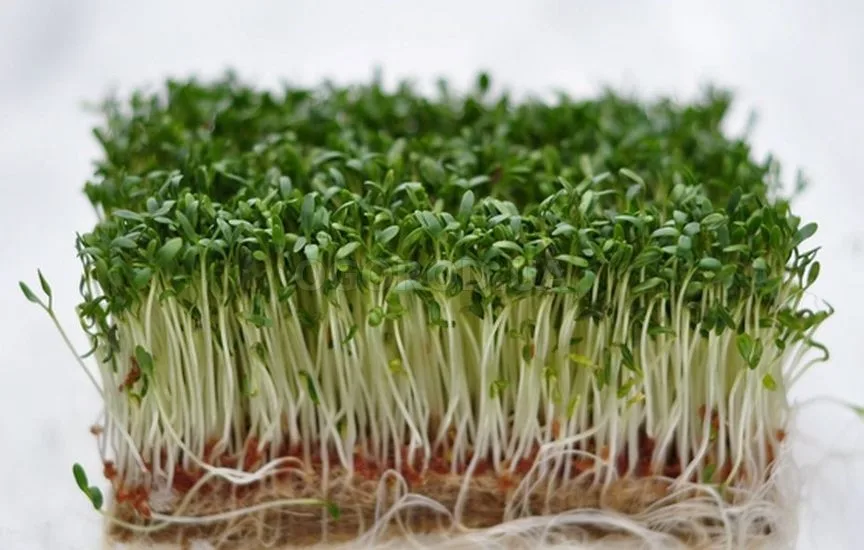
Flavor profile
Taste & aroma
Spicy, bitter, nutty - rather "warm" and enveloping. Expressive, spicy aroma.
rather "warm" and enveloping. Mustard is important: it balances fatty and heavy dishes, but it also limits the dosage
Expressive, spicy, maple-curry - reminiscent of a mixture of curry and maple syrup, it is felt immediately upon opening the package and persists even after cutting.
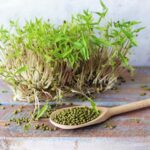
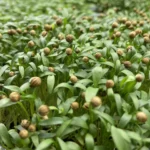
Gentle, Soft, Juicy — characteristic of leguminous microgreens. The stem is dense, the cotyledons are fleshy
Why flavor may vary batch to batch
The bitter taste of fenugreek depends on the content of saponins in the seeds. At soaking seeds for 8–12 hours part of the bitterness goes into the water — the bitterness of the sprouts decreases. At cool cultivation (+16...+18°C) sprouts are denser and maintain a balance between bitterness and maple-nut flavor. At warm (+24°C and above) bitterness intensifies.
Culinary use
How to use
Fenugreek is a great culinary accent. Add fresh at the end of cooking or directly on the plate.
Mushroom cream soup
a few sprigs of fenugreek instead of croutons: a nutty-mushroom duo without any additional ingredients
Pilaf or rice with chicken
a handful of microfennel on top after serving. Curry flavor without powder, fresh crispy texture instead of dry spices
Baked potatoes with butter
fenugreek on top instead of dill or parsley. Unexpectedly deep flavor from simple ingredients
Dal or lentil soup
throw in a plate before serving. Legume + legume = organic pair
Grilled beef or lamb
several twigs for restaurant serving. It looks elegant, the taste is accentuated
Salad mix
a small amount of fenugreek as a "signature" note in a mix of neutral greens
Perfect pairings
The nutty-mushroom flavor of fenugreek enhances the mushroom character of the dish, rather than competing with it
Fenugreek and legumes are a natural pair with a common "family" taste
Shambhala is traditionally used in Central Asian and Middle Eastern cuisine precisely with meat - it "opens" fatty meat and removes heaviness
- Do not add to dishes with pronounced sweetness: fenugreek and sweet dressings, fruit or honey sauces give an unpleasant conflict of tastes.
- Do not use in large portions as a main salad: bitter in excess interrupts everything else. This is an accent, not a base.
- Do not offer to children without warning: children usually do not like specific spicy bitters. It is better to offer something more neutral.
- Do not add to delicate fish dishes: the strong aroma of fenugreek interrupts the delicate taste of the fish. It may still work with fatty fish, but not with delicate fish.
Home storage
How to store
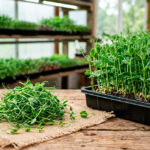
Fenugreek keeps longer than most microgreens. Follow simple rules to keep it fresh for up to 3 weeks.
Don't cut more than you plan to eat right away. Store in refrigerator at +4...+6°C. No watering needed — natural moisture is enough.
Place in an open container or plate, cover with a damp paper towel. Don't seal — without air, greens yellow faster.
Don't wash until ready to eat. Wet greens spoil much faster. Rinse just before serving.
Nutrients & health
Benefits & composition
Fenugreek is valued for its rich vitamin-mineral composition and bioactive compounds typical of microgreens.
Like most microgreens, fenugreek contains a concentrated amount of nutrients relative to its weight — many times more than the mature plant.
| Protein | 4 g — building material for cells |
|---|---|
| Calories | ~45 kcal |
| Fiber | ~3–4 g |
- Fenugreek is traditionally considered undesirable during pregnancy in large quantities: saponins and some alkaloids can stimulate uterine tone. In small culinary quantities (a few twigs in a dish), the risk is minimal, but it is better to check with a doctor.
- To people who do not like bitter taste, fenugreek can be uncomfortable even in small doses — this is an individual sensitivity to alkaloids.
- The specific aroma of fenugreek transmitted through sweat and breast milk is a well-known and researched feature. People sensitive to this should take into account.
This information is general in nature and is not medical advice. Composition data: USDA FoodData Central.
Worth knowing
of iron
Fenugreek is a significant source of iron among plant foods, along with spinach and nettle. For those who follow a plant-based diet, this is an interesting addition to the diet.
trigonelline
The characteristic aroma of Shambhala is associated with trigonelline, an alkaloid that is actively researched in the context of its influence on metabolism. It is trigonelline that gives fenugreek that specific "curry with maple syrup" smell.
vegetable protein and fiber
Fenugreek is a source of vegetable protein and fiber, which makes it an interesting addition to dishes made from legumes or cereals. Like all legumes, it contains a full range of amino acids.
Antioxidants and biologically active substances
Microgreens are a concentrated source of antioxidants — compounds that are being studied in the context of protecting cells from oxidative stress. Regular consumption of a variety of microgreens is part of a balanced plant-based diet.
Fenugreek: how to grow — step-by-step guide
Growing parameters, agronomy, common mistakesGrowing parameters
Medium, hard, bean (pebble form)
Watering
- Water it 1-2 times a day (in the morning - necessarily, in the evening - at a warm temperature)
- Bottom or top watering is equally acceptable
- Fenugreek is a heat-loving and active user of water at +24°C and above
- A sign of lack: the leaves curl slightly, the maple-brown aroma weakens → water
Storage
| Uncut in tray | Fridge +4...+6°C | up to 3 weeks |
|---|---|---|
| Cut in container | Refrigerator | up to 7 days |
| Room temperature | 1–2 days |
Harvest
The cotyledons have just opened, the greens are bright, the height is 6–8 cm - cut. Do not wait for the first real leaf. This is the most important rule of fenugreek: to wait means to get bitter greens.
A knife or scissors slightly above the substrate. The stem in the root zone can be tough - cut 1-2 cm above the surface of the substrate. Cut with confidence, fenugreek does not require jewelry accuracy.
Rinse in cold water, stirring slightly. Dry on a towel. The smell persists even after washing, which is normal. Pack immediately.
Seasonal adjustments
- Soaking: reduce by 2–3 hours from the standard - the seeds are active in the heat
- Ventilation: open more often in the blackout phase to avoid excess moisture
- Watering: increase the frequency - the substrate dries faster at a higher temperature
- Expect: shortening of the cycle by 2–3 days, a more tender stem
- Soaking: increase by 2-3 hours from the standard - cold water is absorbed more slowly
- Placement: keep the trays in a warmer place (next to the battery, but not close to it)
- Watering: use water at room temperature—cold slows growth
- Expect: lengthening the cycle by 2-4 days, denser and more fragrant result
Water pH and EC
The optimal range for Fenugreek (Shambala): 6.0–7.5. Fenugreek tolerates neutral and weakly alkaline environments well. A wide range of tolerances is convenient for beginners.
Optimal range: 1.0–2.0 mS/cm. Moderate mineralization is ideal. The mucous membrane of the seed can interact with mineral salts in very hard water.
Experienced grower tips
The collection calendar is not "by eye", but with a date
Mark the sowing date on the tray and count from it. Fenugreek on the 9th day is optimal. On the 11th, it is already bitter. If selling to multiple customers, plan delivery so that no more than 10 days pass between sowing and consumption.
The smell is not your problem, but a feature of the product
Warn new customers: "fennel smells like curry when growing, it's physiology, not spoilage." The client who was prepared is satisfied. The client without warning - calls with questions.
Store separately from neutral greens
The aroma of fenugreek is easily transmitted to neighboring crops in the refrigerator or on a shelf. A separate container is a must.
Combine with neutral cultures in the mix
Fenugreek as 10-15% in a salad mix is a "signature" without dominance. Chefs appreciate mixes where there is a complex accent on a neutral background. Fenugreek + corn salad + spinach = ready restaurant mix.
Fenugreek is well suited for "trial" trays
A stable start, a minimum of problems during cultivation, an expressive character is a good option for a client who wants to try "something unusual" without much risk.
Agronomy notes and common mistakes
- Sowing: Soaked (4–6 hours) fenugreek — in an even layer, densely.
- Clamp: Medium pressure (1–1.5 kg), 1–2 days.
- Temperature: +20...+26°C. Fenugreek is a real thermophile. Growth slows down below +18°C.
- Watering: 1-2 times a day. At warm temperatures, fenugreek drinks actively.
- Ventilation: It is important. Fenugreek is a mucus consumer; without ventilation is prone to mold matrix.
- Sowing without soaking → "Torn" uneven seedlings, 50% of seeds do not germinate → Soaking for 8–12 hours is mandatory
- Panic due to smell during growth → Grover throws away the tray, thinking everything is spoiled → Smell carefully: spicy = normal, sour/rotten = problem
- Regrowth (cut after the first leaf) → Strong bitterness, customer dissatisfied → Cut strictly at the stage of newly opened cotyledons — window 1–2 days
- Weak grip → Grains are pushed up → 1–2 kg all blackout
- An excess of fenugreek in the client's dish → Complaints about bitterness → Explain the dosage when selling: this is a spice, not a salad
Variety selection
Common fenugreek
Shambhala, Methi
Standard selection. Bitter-nut aroma, characteristic yellow-green color, even germination.
Large-seeded varieties
Kasuri Methi, Trigonella
A somewhat larger output of mass and smoother stairs. The taste and aroma are identical - the characteristic bitterness remains.
Що далі?
More crops in the catalog
Explore similar and contrasting flavors — from basil to amaranth