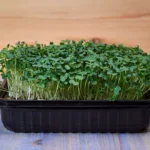
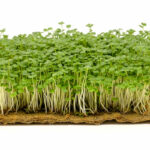
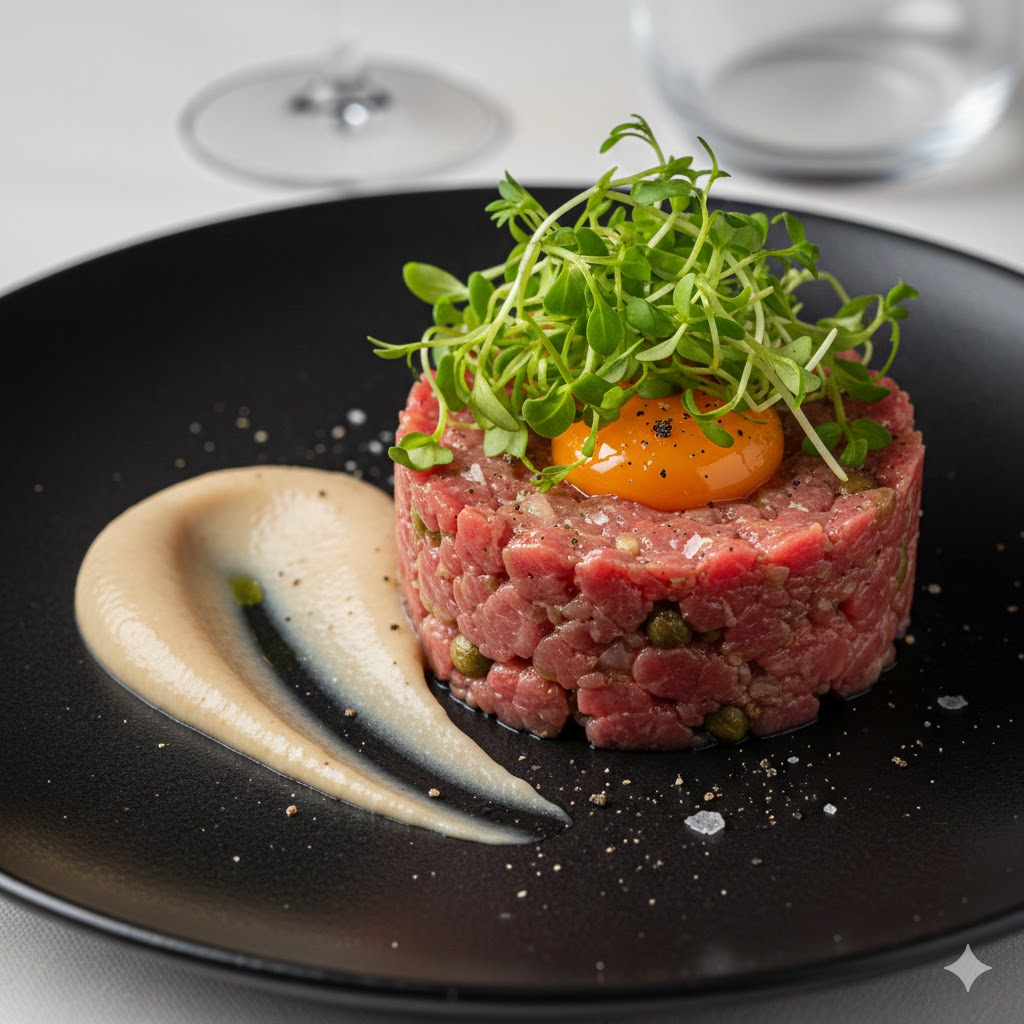
Veal Tartare with Roasted Pear Cream and Mustard Microgreens
Hand-cut veal tartare with capers and shallot, served with silky roasted pear cream and a generous crown of…

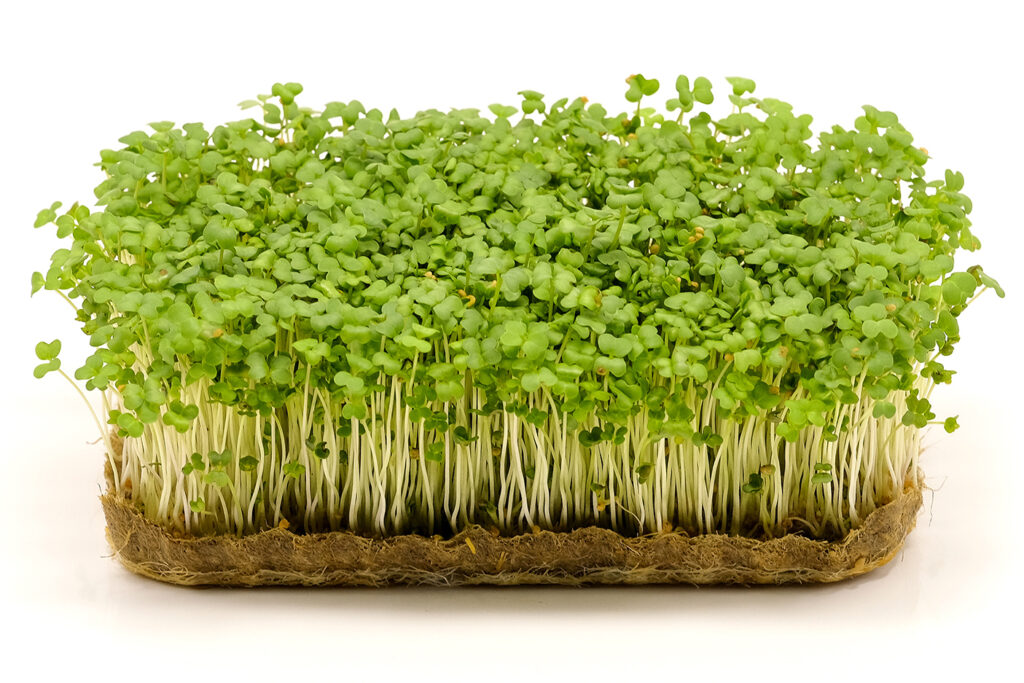
Sinapis alba / Brassica juncea
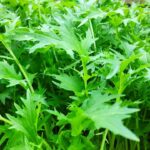
Spicy that does not burn, but refreshes. Green mustard microgreens reproduce the same spicy character as the ready-made sauce, but in the form of fresh, crispy leaves - without vinegar, without salt, without preservatives. A few stalks on a sandwich does more than a spoonful of store-bought mustard and still looks real.
Flavor profile
Burning, refreshing, spicy - with the same character as wasabi or horseradish, but softer and with a longer duration. Spicy aroma.
with the same character as wasabi or horseradish, but softer and longer lasting. Sharpness does not strike instantly, but builds up gradually and just as gradually releases
Spicy, with characteristic notes of mustard oils. It is already felt when slicing — not sharp, but expressive. Under intense lighting, the aroma and pungency intensify: the more light the plant receives, the more "evil" the greens will be.
Tender, juicy cotyledons with a thin stem. There is a crunch, but not as dense as radishes — more like a springy juiciness
Ripening and optimal harvest time
The cotyledons are opened, the pungency is mild, the texture is delicate, the optimal moment for delicate use.
Spicy at its peak, stem still juicy—the best moment for most applications.
A real leaf appears, the sharpness becomes sharper, the stem becomes stringy, the marketable appearance deteriorates.
Why flavor may vary batch to batch
The intensity of pungent mustard oils (isothiocyanates) depends on the lighting and growing temperature. With bright light and a temperature of +18...+22°C, mustard grows sharper. In low light or in heat above +24°C — softer and elongated. This is important to consider when positioning parties.
Culinary use
Mustard is a great culinary accent. Add fresh at the end of cooking or directly on the plate.
a handful of green mustard instead of or together with the usual mustard - the same sharpness, but with crunch and freshness
between the cutlet and the bun — spiciness and texture at the same time, without the need to spread the sauce
several stalks side by side on a plate instead of mustard sauce — a taste contrast and a minimalist design
green mustard as part of the side dish emphasizes the beef taste and gives the necessary piquancy
finely chopped microgreens instead of or with horseradish — fresh spiciness without harshness
a classic, where the spiciness of the mustard balances the saltiness of the fish
Perfect pairings
Fresh microgreens here are more accurate in dosage than canned sauce
Replaces or complements mustard sauce - fresh microgreens are more accurate in dosage
Mustard is a classic spice for heavy meat with a dark browning
Home storage
Mustard keeps longer than most microgreens. Follow simple rules to keep it fresh for up to 10–12 days.
Keep at +4...+6°C in the refrigerator. The term is up to 10–12 days. The cold restrains the spiciness somewhat - if the greens seem too hot, a few hours in the refrigerator will soften the taste.
Place in an open container or plate, cover with a damp paper towel. Don't seal — without air, greens yellow faster.
Don't wash until ready to eat. Wet greens spoil much faster. Rinse just before serving.
Pro tip: **Practical Grower Hint:** Mustard is a crop with one of the best speed/yield ratios. In 7-10 days with minimal investments, you get 40-60 g from the box. It is convenient to include in the basic assortment next to arugula and radish as a "spicy element" of mix sets.
Nutrients & health
Mustard is valued for its rich vitamin-mineral composition and bioactive compounds typical of microgreens.
Like most microgreens, mustard contains a concentrated amount of nutrients relative to its weight — many times more than the mature plant.
| Protein | 2.8 g — building material for cells |
|---|---|
| Calories | ~32 kcal |
| Vitamins | A, C, K, E |
| Minerals | Calcium, Magnesium, Iron |
This information is general in nature and is not medical advice. Composition data: USDA FoodData Central.
Worth knowing
Mustard is one
Mustard is one of the richest plant sources of vitamin A in the form of beta-carotene, the pigment responsible for the yellowish-green color of the leaves. The culture also contains vitamins C, K and E.
Isothiocyanates providing
Isothiocyanates, which provide the piquancy of mustard, are traditionally regarded as natural antibacterial compounds. This explains the enduring cultural tradition of serving mustard with heavy, fatty foods — not just as a flavor accent, but as part of a balanced meal.
Culture fits as
Culture is suitable as part of a varied diet for those who focus on active and rich nutrition.
Antioxidants and biologically active substances
Microgreens are a concentrated source of antioxidants — compounds that are being studied in the context of protecting cells from oxidative stress. Regular consumption of a variety of microgreens is part of a balanced plant-based diet.
Similar crops
If you are looking to complement or replace Mustard:
Small, round, yellow or black
Step-by-step guide
Mustard is not soaked. The seeds are small and germinate quickly when the substrate is properly moistened.
Mustard is a "sprinter". If you organize conveyor cultivation, it perfectly fills the "windows" between longer crops: while sunflowers or peas grow for 12-14 days, mustard has time to give two revolutions.
Clamping is needed so that fine roots quickly grow into the substrate. Without clamping, part of the sprouts remains "hanging" above the surface and gives unstable, strongly elongated stems.
Rate: 0.5–1 kg. Heavier pressure is not required for this culture.
Conditions:
Important: on the 2nd-3rd day, the roots are covered with thick white fluff - root hairs. This is not mold. Check: spray with water - the root hairs will stick to the root and become invisible. The mold will remain "cotton wool" on the surface.
A sign of readiness: the sprouts have raised the clamp, the height is 3–4 cm.
Mustard turns green quickly and grows aggressively - in a few days it fills the entire box with a dense carpet.
Lighting: standard An important nuance: more intense light gives sharper greens. If customers complain of excessive burning, try to reduce the intensity or shorten the time under the lamp.
Watering: moderate, lower. Mustard drinks actively, but overflow during the vegetation stage provokes lodging — the stems rot at the base and fall. The pallet should not be filled to the brim.
Temperature: not higher than +24°C. In the heat, the stem stretches out, becomes long and thin, turgor decreases - such a product quickly withers after cutting.
Watering
Storage
| Uncut in tray | Fridge +4...+6°C | up to 3 weeks |
|---|---|---|
| Cut in container | Refrigerator | up to 7 days |
| Room temperature | 1–2 days |
Harvest
It is better to cut the mustard sooner rather than later. Over-aged greens become too sharp, fibrous and spoil quickly.
Sharp knife under the root. The cut is clean and dry.
Rinse in cold water just before serving. Mustard tolerates washing well. Dry with a paper towel or in a salad spinner.
Seasonal adjustments
The optimal range for Mustard green: 6.0–7.0. Mustard is unpretentious to pH and grows well even in a slightly alkaline environment. The burning level of essential oils does not depend on the pH of the water.
Optimal range: 1.0–2.0 mS/cm. Modest consumer. Regular tap water is perfect. High mineralization has practically no effect on the taste of mustard.
Experienced grower tips
Sharpness is regulated by lighting
If you want a softer mustard, reduce the intensity or shorten the time under the lamp. If you want "worse" - keep it closer to the source. It is a convenient tool for working with different customer segments.
The fastest rotation in the assortment
7-10 days is a record cycle for most crops. With proper planning, mustard gives 3-4 turns per month from one place on the shelf.
Mustard + arugula + radish = basic spicy mix
Three crops with close harvest times and similar agricultural techniques. Sown in one day - reaped in one day. The mix sells better than each culture separately.
Root hairs are a stable "scarecrow" for beginners
If you sell live trays or teach customers to grow at home - warn about white fluff in advance. This will reduce the number of distress calls and increase trust.
Do not overcook at room temperature
Cut mustard at +20°C becomes noticeably sharper in a few hours. If you are shipping to events or to a restaurant, remember to keep it cold until serving.
Variety selection
Yellow mustard
Rocket, Prima, Sinapovna
The most common choice. Mild burning, even germination, stable germination.
Brown mustard
Sarepta, Brassica juncea, Vityaz
More intense bitterness and burning than yellow. For those who want a more expressive spicy profile.
Що далі?
More crops in the catalog
Explore similar and contrasting flavors — from basil to amaranth
Hand-cut veal tartare with capers and shallot, served with silky roasted pear cream and a generous crown of…
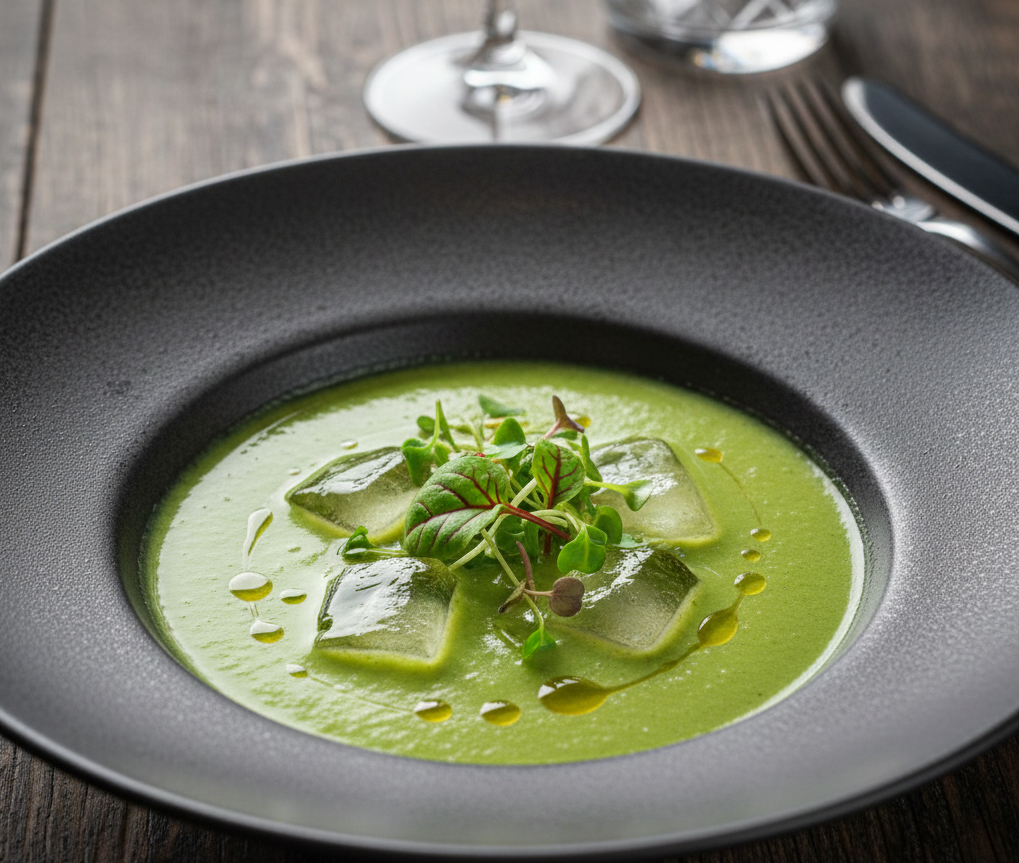
A chilled green gazpacho made from cucumber, green pepper, mustard microgreens, and sorrel with a creamy almond base.…