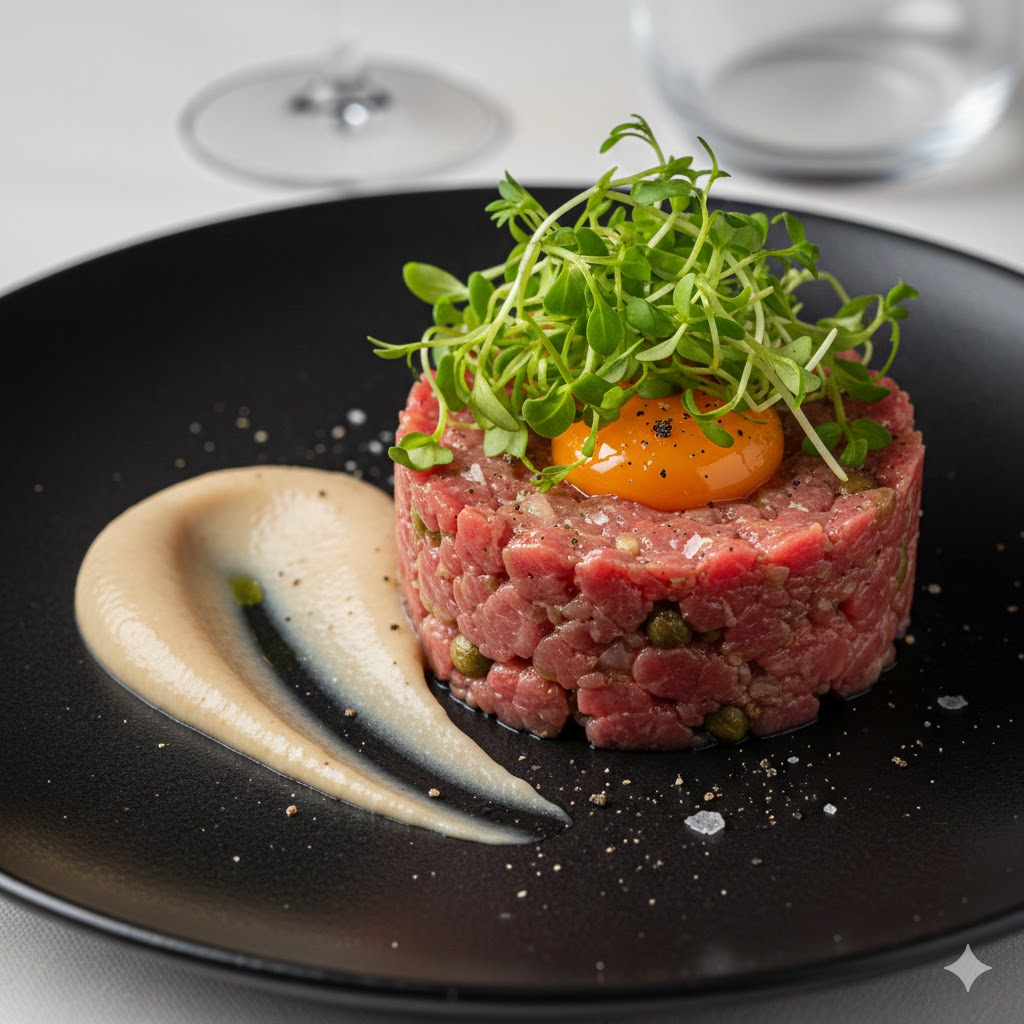
Hand-cut veal tartare with capers and shallot, served with silky roasted pear cream and a generous crown of peppery mustard microgreens. A modern chef-level dish for the confident home cook.
INGREDIENTS
- 120 g — veal (tenderloin or top round, well-chilled)
- 1/2 — pear (for the cream)
- 1 tbsp — capers
- 1 — egg yolk
- 10 g — shallot
- 10-15 g — mustard microgreens
- 1 tsp — extra virgin olive oil
- to taste — sea salt and black pepper
- 1-2 — toasted bread slices for serving
STEPS
- Roast the pear: halve it, place cut-side down on a lightly oiled baking tray. Roast at 180C for 15-20 minutes until soft and lightly golden. Cool, peel. Blend the flesh with a pinch of sea salt and a drop of olive oil until completely smooth. Set aside.
- Prepare the meat. Place the veal in the freezer for 20-30 minutes — slightly firm meat is far easier to dice cleanly. Slice into 3-4 mm sheets, then into strips, then into 3-4 mm cubes. No chopping, no grinding — knife only, clean cuts.
- Mince the shallot as finely as possible — almost to a paste. Roughly chop the capers. If they are large, halve them.
- In a bowl, combine the diced veal, shallot, capers, and egg yolk. Add olive oil, salt, and pepper. Fold gently with a fork — no pressing, the goal is to bind without crushing the cubes into mince. Add half the mustard microgreens and fold once more briefly.
- To plate: use a chef's ring or a spoon to mound the tartare on a well-chilled plate. Place a small spoonful of pear cream beside it — not under, alongside — so the guest controls how much they take with each bite.
- Top generously with the remaining fresh mustard microgreens. A few whole capers as garnish if you like. Serve immediately with toasted bread. Tartare does not wait.
Why Mustard Microgreens Replace Traditional Mustard
In a classic tartare, mustard acts as a flavor amplifier and an emulsifier for the sauce. Mustard microgreens do the same, but in a different form: instead of a paste, you get fresh, crunchy greens with natural essential oils that deliver the same characteristic heat. They don’t overwhelm the meat — they underscore it. Another advantage: mustard microgreens contain glucosinolates, the same compounds found in mustard seeds, but in their fresh, unprocessed form with higher bioavailability.
The key is to add the microgreens in two stages: half into the tartare just before serving (they absorb the meat juices and yolk, soften slightly, and become part of the flavor matrix), and the rest on top, fresh (delivering crunch and bright heat in every spoonful).
Roasted Pear Cream: Why Pear and Why Roasted
Raw pear is sweet and watery. Roasted pear is a different ingredient: the sugars caramelize, the texture becomes silky, and the flavor picks up a faint smoky-caramel note. That note is the key to the pairing with veal — sweetness and gentle smoke balance the meat’s richness and the mustard’s heat.
Use a ripe but firm pear — it needs to hold its shape during roasting. Conference or Williams are ideal. Avoid very sweet varieties like Red Bartlett — the cream will be cloying.
The cream keeps refrigerated for up to 2 days — make it ahead.
Cutting Technique: Knife Only, Cube Only
Tartare quality is 80% technique. A meat grinder or blender destroys texture — you get mince, not tartare. The rules:
- Meat must be cold — 20-30 minutes in the freezer before cutting
- Sharp knife, cold cutting board
- Slice into 3-4 mm sheets, then strips, then 3-4 mm cubes
- No chopping — only straight, deliberate cuts
- Fold with a fork, never press — to preserve the cube structure
Raw Meat Safety
Tartare is a raw meat dish. A few practices make it genuinely safe:
- Buy from a trusted supplier with quality certification — ideally a butcher who knows the provenance
- Use tenderloin or clean trim — no sinew, membrane, or fat
- Prepare and serve immediately — tartare does not hold
- A chilled plate extends the window and preserves the meat texture
- Use eggs from a trusted source or pasteurized yolks
Variations
- With tuna — replace the veal with sashimi-grade tuna. The pear cream and mustard microgreens work just as well with fish. Add a few drops of sesame oil to the dressing.
- Classic version — skip the pear cream, add Dijon mustard, Worcestershire sauce, and Tabasco. Mustard microgreens on top replace the standard garnish.
- With avocado — replace pear cream with lime-seasoned avocado puree. Creaminess plus mustard heat is a strong pairing.
- With truffle oil — a drop in the dressing instead of olive oil. Truffle and veal is a classic combination that the pear cream only amplifies.
Capers and Shallot: Small Details, Large Impact
Capers are a fermented product that delivers salt and acidity to the tartare. Even one tablespoon completely shifts the flavor profile. Rinse them before chopping — excess brine will unbalance the seasoning.
Shallot is milder and sweeter than regular onion, with no bitterness and no interference with the meat. Mince it as finely as possible — nearly to a paste. If shallots are unavailable, use the white part of a spring onion.
CHEF'S TIPS
Add mustard microgreens in two stages: half folded into the tartare before serving, the rest fresh on top. Tartare does not hold — plate and serve immediately. The pear cream can be made up to 2 days ahead. Sashimi-grade tuna works equally well as a substitute for veal.