
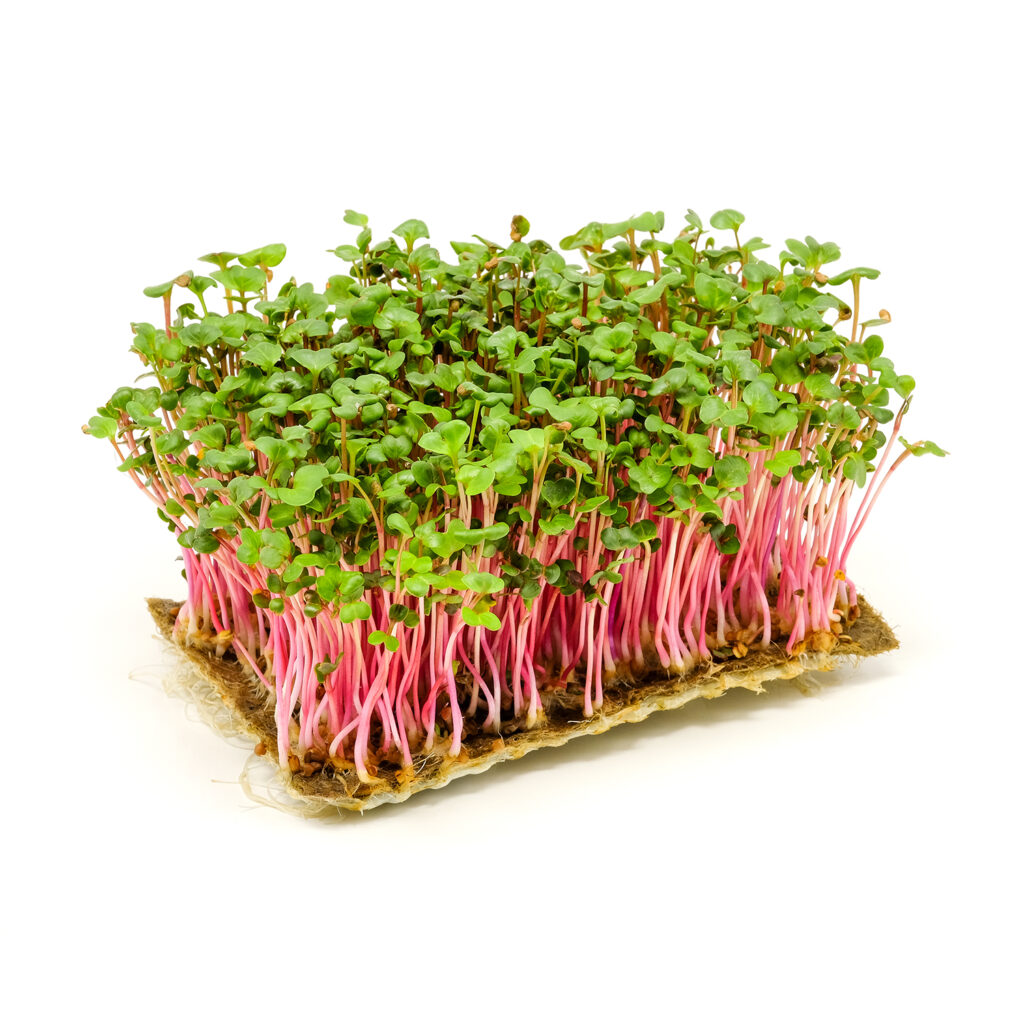
Flavor profile
Taste & aroma
Fresh, sharp, spicy - more "red" and decisive, but without burning. Clean, vegetable aroma.
more "red" and decisive, but without burning. After the first bite, a clean feeling of freshness remains
Clean, vegetable, without earthy notes - radish aroma in a concentrated form.
Dense, Elastic, Crisp - the main decorative effect for which Red Koral is grown
Ripening and optimal harvest time
Cotyledons are open, rich coral-red color, balanced sharpness - the optimal moment.
The first real leaf, the sharpness intensifies, the stem lengthens.
Outgrows: the leaf becomes rough, the taste becomes burning-bitter, the marketability declines.
Why flavor may vary batch to batch
The intensity of the peppery taste of radish depends on the temperature and lighting. At cool cultivation (+14...+18°C) glucosinolates are concentrated higher — the taste is sharper and more pronounced. At warm (+22°C and above) - more tender and less spicy. The stage of the cut is also important: an early cut (5–6 days) is more tender, a late one (8–9 days) is sharper.
Culinary use
How to use
Radish Red Koral is a great culinary accent. Add fresh at the end of cooking or directly on the plate.
Poke Bowl or Buddha Bowl
Red Koral as one of the color components is red next to avocado, rice and salmon
Scrambled eggs or omelette
a few stalks on top - and a normal breakfast looks like a restaurant serving
Gazpacho or cold tomato soup
Red Koral in the middle on a bright red background — the colors reinforce each other
Beef burger
a layer of Red Koral between the meat and the bun — sharpness, crunch, red color in the cut
Beef tartare
Red Koral is more beautiful on top - the spiciness emphasizes the raw meat taste
Meat cuts (charcuterie)
bunches of Red Koral between prosciutto, bresaola or smoked meat
Perfect pairings
Toast, soup, bowl — the best combinations
Against a background of green arugula or spinach, a coral-red stem is an instant color accent
Shades the fattiness of meat, cheese or avocado - spiciness without "aggressiveness"
- Do not add to hot dishes - the red color darkens and becomes dirty brown from the heat
- Do not top-water with acidic dressings in advance - the acid can change the shade of anthocyanins in the stem
- Do not wait for the first real leaf - Red Koral must be cut before it appears
Home storage
How to store
Radish Red Koral keeps longer than most microgreens. Follow simple rules to keep it fresh for up to 12–14 days.
Keep at +2...+5°C in the refrigerator. The term is up to 12–14 days. The dense structure of the stem keeps turgor and color very well.
Dry sealed container at +2...+5°C. The term is up to 12–14 days. **Do not wash before storage** - moisture accelerates the darkening of the stem. Wash only immediately before serving. ---
Don't wash until ready to eat. Wet greens spoil much faster. Rinse just before serving.
Pro tip: **Handy grower tip:** Red Koral is one of the lightest radishes. Up to 14 days in a dry refrigerator without loss of color and crunch. This allows you to ship once a week and not worry about quality.
Nutrients & health
Benefits & composition
Radish Red Koral is valued for its rich vitamin-mineral composition and bioactive compounds typical of microgreens.
Like most microgreens, radish red koral contains a concentrated amount of nutrients relative to its weight — many times more than the mature plant.
| Protein | 2.5 g — building material for cells |
|---|---|
| Calories | ~30 kcal |
| Vitamins | C, E, K |
| Minerals | Iron, Potassium, Magnesium |
- People with gastritis or peptic ulcer disease should use it sparingly - isothiocyanates can irritate the inflamed mucous membrane.
- Small children may find the taste too hot.
This information is general in nature and is not medical advice. Composition data: USDA FoodData Central.
Worth knowing
Red Koral combines
Red Koral combines anthocyanins (for color) and isothiocyanates (for pungency) — just like other colored radishes and red mizuna. Vitamin E is traditionally included in the diet for skin health. Sulfur supports keratin synthesis.
Antioxidants and biologically active substances
Microgreens are a concentrated source of antioxidants — compounds that are being studied in the context of protecting cells from oxidative stress. Regular consumption of a variety of microgreens is part of a balanced plant-based diet.
Antioxidants and biologically active substances
Microgreens are a concentrated source of antioxidants — compounds that are being studied in the context of protecting cells from oxidative stress. Regular consumption of a variety of microgreens is part of a balanced plant-based diet.
Antioxidants and biologically active substances
Microgreens are a concentrated source of antioxidants — compounds that are being studied in the context of protecting cells from oxidative stress. Regular consumption of a variety of microgreens is part of a balanced plant-based diet.
Similar crops
Similar by taste microgreens
If you are looking to complement or replace Radish Red Koral:
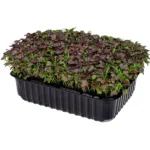
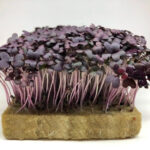
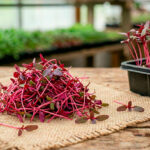
Radish Red Koral: how to grow — step-by-step guide
Growing parameters, agronomy, common mistakesGrowing parameters
Large, round, cabbage-like
Step-by-step guide
Seed preparation
Red Koral is not soaked - a standard rule for all radishes. Large seeds germinate well when the substrate is properly moistened without pretreatment.
Sowing
- Moisten the substrate evenly.
- Spread the seeds evenly. The norm of 7 g is a fairly dense uniform layer without overlaps. Large seeds are easy to control "by eye".
- Spray the surface with water from a spray bottle.
Red Koral, China Rose and Sango are three radishes with the same agricultural technology and almost the same cycle. Sow them simultaneously in three separate boxes and get a ready-made "radish mix of three colors" on one date. Minimum effort — maximum effect when selling.
Clamp - 0.5 kg (light)
Mandatory for equal friendly stairs. Without pressing, part of the seed remains on the surface and gives "curly" uneven sprouts. 0.5 kg is enough - heavier pressure can damage the seeds during active growth.
Darkness (Blackout) — 3–4 days
Conditions:
- Complete darkness
- Temperature: +18...+22°C. At a higher temperature (+26°C and above), the color may fade and become dirty green instead of coral
- Watering is moderate, lower
Root hairs: as with all radishes, thick white fluff appears on the 2nd day. Not mold - root hairs. Check: sprinkle with water - they will disappear.
A sign of readiness: the sprouts have raised the clamp, the height is 3–4 cm.
Vegetation in the light — 5–7 days
The main task of this stage is to form a rich coral-red color of the stem.
Lighting and color: Red Koral anthocyanins are formed under the influence of bright light. In the dark, the stem is pale or almost green. The more intense the lighting, the more saturated and uniform the red color will be. 16 hours a day, as close as possible to the lamp.
Temperature and color: this is the fundamental difference between Red Koral and China Rose and green radish. At temperatures above +26°C, the color becomes dull and "dirty" — anthocyanins are unstable in heat. Maintain +20...+22°C for a stable coral shade.
Ventilation: dense sowing of 7 g creates a dense carpet that is poorly aerated near the roots. Stagnation of moist air = mold. Provide air circulation every day.
Watering: moderate, lower. Avoid getting water on the leaves during the growing season - this can wash away the waxy coating and leave stains that spoil the marketability of the red stem.
Watering
- Water it 1-2 times a day
- Lower watering is better — preserves the rich red color of the stems
- The parameters are similar to other varieties of radish
- A sign of lack: rich red color fades, leaves curl → water
Storage
| Uncut in tray | Fridge +4...+6°C | up to 3 weeks |
|---|---|---|
| Cut in container | Refrigerator | up to 7 days |
| Room temperature | 1–2 days |
Harvest
- Full pigmentation of cotyledons — bright red or coral color throughout the box
- Height 6–9 cm
- Before the appearance of the first real leaf
Use a sharp knife as close to the substrate as possible to preserve the maximum length of the beautiful red leg. The length of the stem is the decorative value.
Rinse in cold water just before serving. Do not wash before storing - moisture accelerates the darkening of the stem.
Seasonal adjustments
- Soaking: reduce by 2–3 hours from the standard - the seeds are active in the heat
- Ventilation: open more often in the blackout phase to avoid excess moisture
- Watering: increase the frequency - the substrate dries faster at a higher temperature
- Expect: shortening of the cycle by 2–3 days, a more tender stem
- Soaking: increase by 2-3 hours from the standard - cold water is absorbed more slowly
- Placement: keep the trays in a warmer place (next to the battery, but not close to it)
- Watering: use water at room temperature—cold slows growth
- Expect: lengthening the cycle by 2-4 days, denser and more fragrant result
Water pH and EC
The optimal range for Radish Red Koral: 5.8–7.0. Similar to other varieties of radish. Anthocyanins (red color) are more stable at lower pH (5.5–6.5).
Optimal range: 1.0–2.0 mS/cm. The parameters are identical to other varieties of radish. The rich color of Red Koral is a genetic feature of the variety.
Experienced grower tips
Temperature is a major factor in color
In China Rose or Sango, the color depends primarily on the intensity of the light. In Red Koral, the temperature is no less important: even with good lighting, but at +27°C you will get a dull product. Control both parameters.
Cut as long a stem as possible
The knife is as close to the substrate as possible - every centimeter of the red leg is valuable. When cutting 1-2 cm above the base, you lose the most saturated part of the stem.
Do not wash before storage is a strict rule
Moisture on cut Red Koral accelerates darkening and bacterial decomposition many times over. Always store dry, wash only before serving.
Three colors for the price of one effort
Red Koral, China Rose and Sango have the same agricultural technology. If you already grow one of them, growing all three together is almost no more difficult. The result is a complete "radish mix" for the restaurant segment.
"Restaurant Red" is your marketing pitch
Red Koral is the only microgreen in the catalog where the stem retains a rich coral-red color even after serving. Emphasize this when selling to restaurant customers: the color "lives" on the plate, does not fade and does not change its shade at room temperature.
Agronomy notes and common mistakes
- Sowing: No soaking. High density.
- Clamp: Light or no pressure.
- Temperature: +18...+24°C.
- Watering: 1-2 times a day.
- Ventilation: It is important. Prevention of "black leg".
- Weak lighting → Pale stem, the name Red Koral "disappears" → Increase the intensity, bring it closer to the lamp, 16 h/day
- High temperature (above +26°C) → Color fades, becomes dirty green → Maintain +20...+22°C — critical for color
- Poor ventilation → Mold in the base of the thick carpet → Air circulation every day; fan with a dense rack
- Top watering on vegetation → Spots on the stem, loss of marketable appearance → Only bottom watering through a pallet
- Overstay (more than 11 days) → The leaf becomes rough, the taste is burning-bitter → Cut when the cotyledons are fully pigmented to the first true leaf
- Panic due to "white fluff" → Throwing out a healthy tray → Spray with water - the root hairs will disappear
Variety selection
Radish Red Koral
Raphanus sativus Red Coral
A profile variety with a bright red stem. Saturated color and pronounced burning sensation.
Radish alternative red varieties
Hong Vit, Chinese Red
Similar decorative characteristics. The taste and color are compared to Red Koral.
Що далі?
More crops in the catalog
Explore similar and contrasting flavors — from basil to amaranth