
Flavor profile
Taste & aroma
Peppermint, refreshing, menthol - Intense, cooling, with a slight sweetness in the background. A strong, menthol aroma.
Intense, cooling, with a slight sweetness in the background. Menthol "chill" appears immediately and remains on the palate for several minutes after eating
Powerful, menthol, awakening - opens immediately upon touch, felt for a meter when opening the package.
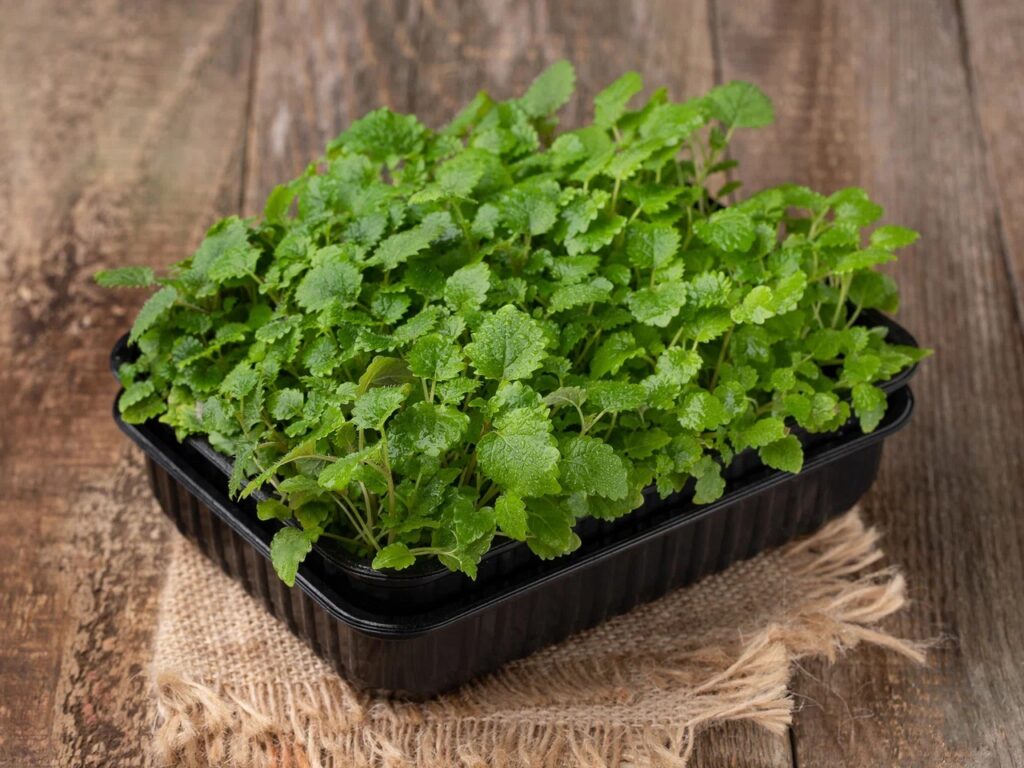
Gentle, Velvety, Soft — Soft velvety leaves with light pubescence, characteristic of the Labiataceae family. Much softer and more delicate than adult mint
Why flavor may vary batch to batch
The content of menthol and menthone in mint depends primarily on lighting. At bright light (+20...+23°C) more essential oils - the aroma is rich and cooling. At weak light or heat above +26°C the aromatic sprouts are weaker. Mint is a slow crop (14-18 days) and the patience of the grower is critical to the outcome.
Culinary use
How to use
Mint is a great culinary accent. Add fresh at the end of cooking or directly on the plate.
Mojito and lemonade
micromint instead of sprigs: it is smaller, does not "climb" out of the glass and looks restaurant-like. The aroma is the same
Fruit salad
throw leaves at the last moment before serving. There is no heat treatment, the aroma is completely preserved
Ice cream or panna cotta
two or three leaves on top: this is the fastest way to turn an ordinary dessert into a restaurant serving
Water with lime
a handful of micromint in a jug with water and lime stands in the refrigerator for hours, gradually flavoring the drink
Vietnamese rice rolls
inside next to rice noodles, cucumber and crab sticks: mint here is natural and traditional
Mutton or lamb
served side by side, not baked. Micromint leaves instead of mint sauce - a lighter, fresher serving
Perfect pairings
Mint and citrus fruits are a classic union, but it is most pronounced with strawberries and watermelon: the sweetness of the fruit emphasizes the cooling effect of menthol
This is probably the main area of use of micromint: a few leaves in a glass - and ordinary water becomes a drink with taste
Mint in a non-sweet context is unexpected, but organic
- Do not add to hot dishes: menthol instantly evaporates from the heat, the aroma disappears, the leaf darkens and becomes unattractive. Mint is exclusively raw and in the finale.
- Do not combine with very spicy flavors: coriander, garlic, hot chili "overlap" menthol. Mint needs a neutral or sweet background.
- Do not cut - tear or put whole: when cutting, the knife "squeezes out" essential oils and the leaf darkens around the edges in a few minutes. A whole sheet keeps the look much longer.
- Do not prepare in advance: mint in a seasoned dish or drink quickly withers and darkens. Add only immediately before serving.
Home storage
How to store
Mint keeps longer than most microgreens. Follow simple rules to keep it fresh for up to 3 weeks.
Don't cut more than you plan to eat right away. Store in refrigerator at +4...+6°C. No watering needed — natural moisture is enough.
Place in an open container or plate, cover with a damp paper towel. Don't seal — without air, greens yellow faster.
Don't wash until ready to eat. Wet greens spoil much faster. Rinse just before serving.
Nutrients & health
Benefits & composition
Mint is valued for its rich vitamin-mineral composition and bioactive compounds typical of microgreens.
Like most microgreens, mint contains a concentrated amount of nutrients relative to its weight — many times more than the mature plant.
| Protein | 3.3 g — building material for cells |
|---|---|
| Calories | ~70 kcal |
| Vitamins | A |
| Minerals | Calcium |
- To people from increased acidity of the stomach or a tendency to heartburn be careful: menthol relaxes the lower esophageal sphincter and can increase acid reflux. Use sparingly or avoid.
- To people who accept blood thinners, it is worth maintaining a uniform intake of vitamin K without sudden changes in the diet.
- In small culinary quantities (several leaves in a dish), both restrictions are usually not relevant.
This information is general in nature and is not medical advice. Composition data: USDA FoodData Central.
Worth knowing
vitamin K
Mint is one of the richest plant sources of vitamin K — it is involved in blood clotting and bone health. It contains **calcium and magnesium** in a concentration noticeable for green.
menthol
Essential oils of mint, primarily menthol, are traditionally associated with a calming effect on the digestive system and a feeling of freshness of breath. That is why mint is used as a spice and as a tea after meals in many culinary traditions.
flavonoids
The mint leaf is a source of flavonoids — antioxidants of plant origin, which are actively studied in the context of protecting cells from oxidative stress.
Antioxidants and biologically active substances
Microgreens are a concentrated source of antioxidants — compounds that are being studied in the context of protecting cells from oxidative stress. Regular consumption of a variety of microgreens is part of a balanced plant-based diet.
Similar crops
Similar by taste microgreens
If you are looking to complement or replace Mint:
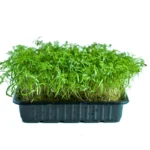
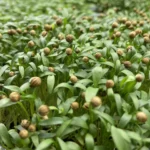
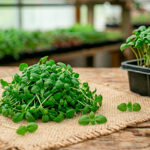
Mint: how to grow — step-by-step guide
Growing parameters, agronomy, common mistakesGrowing parameters
Dust-like, photosensitive (requires light for germination)
Watering
- Water it 1-2 times a day (in the morning - mandatory)
- Bottom or shallow top watering - avoid excess
- Mint is prone to mold with excess moisture and without ventilation
- A sign of lack: tender leaves curl slightly, mint aroma weakens → water
Storage
| Uncut in tray | Fridge +4...+6°C | up to 3 weeks |
|---|---|---|
| Cut in container | Refrigerator | up to 7 days |
| Room temperature | 1–2 days |
Harvest
2–3 pairs of real leaves are formed, the leaves are velvety with a characteristic mint look, height 5–8 cm. The landmark is not the appearance, but the smell: rub the leaf and you will feel the distinct menthol. If there is no smell, it is too early.
Manicure scissors - the plants are very delicate. Cut with individual stems or small bunches above the base. Do not pull - the thin stem breaks and crushes the leaf.
Carefully submerge in cold water for a second, shake slightly. Dry naturally on a towel without friction. Pack immediately - mint darkens faster than any other crop.
Seasonal adjustments
- Soaking: reduce by 2–3 hours from the standard - the seeds are active in the heat
- Ventilation: open more often in the blackout phase to avoid excess moisture
- Watering: increase the frequency - the substrate dries faster at a higher temperature
- Expect: shortening of the cycle by 2–3 days, a more tender stem
- Soaking: increase by 2-3 hours from the standard - cold water is absorbed more slowly
- Placement: keep the trays in a warmer place (next to the battery, but not close to it)
- Watering: use water at room temperature—cold slows growth
- Expect: lengthening the cycle by 2-4 days, denser and more fragrant result
Water pH and EC
Optimal range for Mint: 6.0–7.0. Mint grows optimally in a neutral environment. Regular tap water is perfect.
Optimal range: 1.0–2.0 mS/cm. A moderate consumer of minerals. High EC (>2.5) can inhibit the development of tiny mint sprouts.
Experienced grower tips
Mint — only to order
Cycle 25-35 days, low yield, poor storage after cutting. It makes no sense to grow "for storage". Received an order from the restaurant - sowed. No order - do not sow.
A live tray is the only correct sales format
Do not attempt to pack cut mint. Sell the tray as a whole: the chef cuts it himself before serving, the quality is maximum, there are no complaints.
A fog generator is mandatory equipment
Without it, the first half of the mint cycle cannot be watered. This is not a wish, it is a condition. An ultrasonic humidifier or garden fogger will do.
Gradual hardening - do not skip
Three days difference between "slow film" and "sharp film" is the difference between a live ladder and a dead one. Spend these three days.
Position as a premium product
The long cycle, small yield and exclusivity justify the price, which is 3-5 times higher than cabbage crops. Restaurants where decor and aroma are important — your audience. Mass market - no.
Agronomy notes and common mistakes
- Sowing: No soaking. Very high density - tiny seeds in a thin, even layer.
- Clamp: Without clamping.
- Temperature: +18...+24°C. Moderate to warm temperatures are ideal.
- Watering: 1-2 times a day. Mint does not like excess moisture.
- Ventilation: Mandatory and active. Mint with poor ventilation — the risk of mold on the surface of the substrate.
- Sprinkle seeds with substrate → Zero or minimal germination → Sow only superficially - seeds need light
- Watering with a sprayer at the beginning → Seeds and sprouts are washed into piles or buried → Only fog generator up to a height of 2–3 cm
- Sharp removal of the film after germination → Sprouts dry in a few hours → Gradual hardening 3–4 days
- Lack of nutrition → Plants stopped growing, turned yellow → Nutritional profile from the 14th day after sowing
- Expecting a quick result → Disappointment and early cut → Mint is almost invisible for the first 10-12 days — this is the norm
- Selling cut → Black before delivery, complaints → Sell only live tray
Variety selection
Peppermint
M. piperita, Chocolate, Black
The most common choice. Intense menthol aroma, characteristic darker shade of leaves.
Garden mint (green)
M. spicata, Spearmint
Softer and sweeter aroma without harsh menthol. Suitable for dishes where a delicate mint note is required.
Що далі?
More crops in the catalog
Explore similar and contrasting flavors — from basil to amaranth