Flavor profile
Taste & aroma
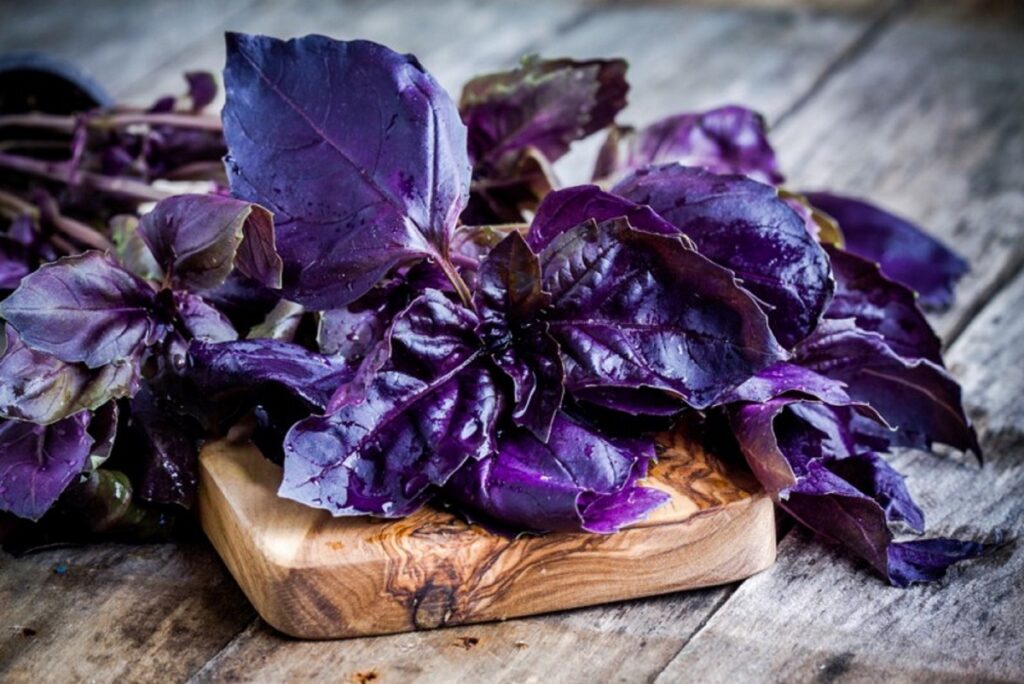
Spicy, sweet, clove - without a sharp herbal "hit", but with depth. A classic Mediterranean fragrance.
without a sharp grassy "kick", but with depth. The taste lingers on the palate longer than most microgreens
Classic Mediterranean - warm, spicy, with a note of cloves and light sweetness. Opens already when touching the leaves. Unlike Thai basil, there is no anise component here - the aroma is recognizable and familiar to most.
The leaves are soft, without hardness. The stem is thin, edible in its entirety
Ripening and optimal harvest time
Cotyledons, the color is still uneven, the taste is clean, but not saturated.
The first pair of real leaves, full pigmentation, aroma and taste at its peak.
The taste becomes sharper, grassy bitterness appears, the color may fade.
Why flavor may vary batch to batch
The purple color of purple basil is not a constant, but the result of growing conditions. Anthocyanins, which give a dark color, are synthesized only with sufficient light intensity and a temperature above +20°C. A batch grown in low light or cool conditions will be green or mottled - this is considered a failure. That is why the quality of the product depends on the technology, and not on the seed variety.
Culinary use
How to use
Purple Basil is a great culinary accent. Add fresh at the end of cooking or directly on the plate.
Caprese
instead of large leaves - a handful of microgreens between layers of mozzarella and tomato. It looks neater, it is more convenient to eat
Pasta with tomato sauce
sprinkle on top before serving - the basil will preserve the aroma and add a color contrast
Margherita pizza
only after the oven, not together with the cheese. The leaves will remain fresh and will not dry out
Strawberry-basil salad
strawberries, ricotta, honey and a handful of purple basil - a simple dish with a restaurant feel
Purple pesto
grind microgreens with olive oil, pine nuts and parmesan. The color of the pesto will be unusual - dark green with a purple tint
Beef or salmon tartare
a few stalks on top instead of a mix of greens — purple basil is more appropriate and expressive here
Perfect pairings
The combination of flavors here is classic, proven
Especially expressive in combination with balsamic cream or good olive oil
It is added after serving, not during cooking — the leaves retain their shape and aroma
- Do not add to hot dishes during cooking - essential oils evaporate, the leaves darken and become unattractive
- Do not water from above after serving - drops of water leave spots on dark leaves, especially visible in photos
- Do not store cut in an open container at +4°C - darkens and wilts much faster than most microgreens
Home storage
How to store
Purple Basil keeps longer than most microgreens. Follow simple rules to keep it fresh for 5–7 days.
Do not put in a regular refrigerator - at +4°C the leaves darken and black spots appear. Store at room temperature or at +10...+12°C. The term is 5–7 days. Cut just before serving.
An airtight container with a sheet of paper towel inside will absorb the condensation. Store at +10...+12°C (upper shelf of the refrigerator, away from the freezer). The term is 3-4 days. At +4°C - no more than a day, the risk of blackening increases. Do not wash before use - moisture accelerates the darkening of the leaves. ---
Don't wash until ready to eat. Wet greens spoil much faster. Rinse just before serving.
Pro tip: **A practical tip for the grower:** It is more profitable to sell purple basil alive in a tray - the customer cuts it as needed, the sales period is longer. Cut greens are critical to storage conditions and quickly lose their marketability. If you sell it cut, be sure to instruct the client: not in a regular refrigerator.
Nutrients & health
Benefits & composition
Purple Basil is valued for its rich vitamin-mineral composition and bioactive compounds typical of microgreens.
Like most microgreens, purple basil contains a concentrated amount of nutrients relative to its weight — many times more than the mature plant.
| Protein | 3.0 g — building material for cells |
|---|---|
| Calories | ~22 kcal |
| Minerals | Calcium, Potassium, Magnesium, Iron |
- People taking blood thinners should consider their total intake of vitamin K-rich greens and discuss this with their doctor.
- Essential oils in concentrated form are not recommended for pregnant women in large quantities. In normal cooking portions, this is not a problem.
- People with sensitive stomachs usually tolerate purple basil well — it's milder than sharp greens and doesn't contain mustard oils.
This information is general in nature and is not medical advice. Composition data: USDA FoodData Central.
Worth knowing
There is purple basil
Purple basil is one of the few types of microgreens with a very high content of vitamin K - up to 300 μg per 100 g. This vitamin is involved in maintaining the normal state of bone tissue and blood clotting processes.
Anthocyanins that give
Anthocyanins, which give the dark color, are polyphenols, plant compounds that are traditionally included in a variety of diets as part of antioxidant nutrition. They are more stable in an acidic environment, so basil in combination with tomatoes or balsamic vinegar preserves pigments better.
Basil essential oils
Basil's essential oils—eugenol and linalool—are traditionally used in Mediterranean cooking and are part of a well-studied dietary practice.
Antioxidants and biologically active substances
Microgreens are a concentrated source of antioxidants — compounds that are being studied in the context of protecting cells from oxidative stress. Regular consumption of a variety of microgreens is part of a balanced plant-based diet.
Similar crops
Similar by taste microgreens
If you are looking to complement or replace Purple Basil:
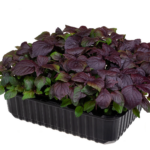
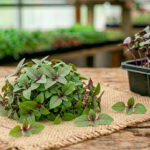
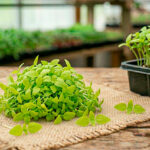
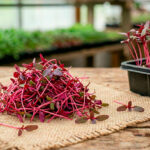
Purple Basil: how to grow — step-by-step guide
Growing parameters, agronomy, common mistakesGrowing parameters
Small, mucilaginous
Step-by-step guide
Seed preparation
Purple basil do not soak. When the seed comes into contact with water, it secretes mucilage, a mucous membrane that turns the seed into a gel-like mass. It is impossible to sow such seeds evenly: they clump together and germinate unevenly.
The seed must be dry at the time of sowing.
Sowing
- Moisten the substrate evenly - it should be moist, but without standing water below. Excess water is in the tray, not in the substrate.
- Spread the seeds evenly over the surface. The guideline for density is that the seeds should not lie in two layers.
- After sowing spray the surface liberally with water from the atomizer. The seeds will secrete a white slime and be fixed on the substrate - this is normal and necessary. It is not necessary to wash off the mucus.
White slime around the seeds after spraying is not a sign of spoilage. It is a natural mucilage covering that holds the seed in place and maintains moisture around the sprout during the germination stage.
Start (without clamping)
Physical clamp for purple basil forbidden — small seeds sink into the substrate and rot instead of sprouting upwards.
Cover the box with transparent film or a dome - to keep 100% humidity around the seeds. Ventilate once a day for 1 minute: carefully remove the film, let the air change, cover again.
Starting temperature: +23...+26°C. Below +20°C, growth slows down, the color becomes dull. Drafts at this stage are a stress for sprouts.
Darkness (Blackout) — 4–5 days
In the dark, the sprout stretches up, forming a long internode. Conditions:
- The temperature is +23...+26°C
- Complete darkness: cover with a second box or move to a dark place
- Airing once a day for 1 minute
- Bottom humidification: add water to the tray as needed
A sign of readiness: sprouts actively stretch upwards, height 3–4 cm, yellow-cream color is the norm, in the light it will turn green and take on a purple hue.
Vegetation in the light — 8–12 days
This is the most important and most responsible stage for purple basil. Here the main question is solved: whether the product will be a dark purple or green defect.
Lighting is a key factor: anthocyanins are synthesized only with sufficient light intensity. Pigmentation begins to appear on the 3rd-4th day of vegetation. If the plant remains green after 5 days in the light, the intensity is not enough. LED phytolamps with an emphasis on the blue spectrum give better results. Lighting duration: 16 hours per day.
Watering: only the lower one - through the pallet. Water leaves salt stains on the leaves, which look like dirt on a dark background and spoil the product appearance.
Temperature: store at +23...+26°C. Falling below +18°C at night slows down development and inhibits pigment synthesis.
For the first 2-3 days in the light, keep the boxes as close as possible to the lamp (10-15 cm for LED). A shock dose of light at the start accelerates the synthesis of anthocyanins. After the appearance of a stable purple color, you can move to a standard distance.
Watering
- Water it 1-2 times a day ONLY bottom watering
- Purple basil is the most capricious of all basils
- Strictly lower watering: water on the leaves will destroy the decorative color in a day
- A sign of lack: purple color fades, leaves curl → pour through pan
Storage
| Uncut in tray | Fridge +4...+6°C | up to 3 weeks |
|---|---|---|
| Cut in container | Refrigerator | up to 7 days |
| Room temperature | 1–2 days |
Harvest
- Full pigmentation of cotyledons and the first pair of true leaves
- The color is uniform, without green spots - a sign of sufficient lighting
- The aroma of classic basil is palpable to the touch
With a sharp knife or scissors above the level of the substrate. A dull tool cuts the stem - a spot darkens on the cut, which accelerates wilting.
Rinse in water at room temperature (+18...+20°C) immediately before serving. Cold water (+8–10°C) gives a temperature shock — the leaves darken in minutes. Gently dry with a paper towel without pressing.
Seasonal adjustments
- Ventilation: twice a day during a blackout — heat and humidity under shelter increase the risk of mold
- Watering: increase the frequency - the substrate dries faster at a higher temperature
- Vegetation: watch more carefully, the cycle may be shortened by 2-3 days
- Placement: away from direct sunlight — overheating blocks the synthesis of anthocyanins
- Expect: a more delicate stem, a less saturated color at a temperature above +28°C
- Temperature: critically important — below +18°C the synthesis of anthocyanins stops, the leaves turn green. Thermal mats under the boxes give a stable result
- Placement: rack away from windows and exterior walls — cold surfaces cool the substrate
- Expect: prolongation of the cycle by 3–5 days, the risk of color fading during nighttime temperature changes
Water pH and EC
The optimal range for purple basil: 6.5–7.0. Sensitive to an acidic environment - at a pH below 6.0, the aroma weakens and the synthesis of anthocyanins slows down. Regular tap water is fine.
Optimal range: 1.5–2.0 mS/cm. Purple basil does not require intensive nutrition. An excess of nitrogen gives juicy, but less fragrant sprouts with a weaker color - essential oils and anthocyanins are better concentrated with moderate nutrition.
Experienced grower tips
Color is real-time quality control
The uniform dark purple color of the leaves on the 4-5th day of vegetation is a signal that the temperature and lighting are normal. Uneven or green color is a reason to review the conditions now, without waiting for collection.
Spraying after sowing is accurate and plentiful
Insufficient spraying leaves part of the seed unfixed: it migrates during ventilation and forms uneven clumps. Abundant spraying from the edges to the edges of the box - and the mucilage will evenly hold the entire crop.
Lower watering with cold water is a hidden problem
Even if the air in the room is +24°C, the tap water can be +10°C. For purple basil, this is temperature stress. Allow the water to settle or warm to room temperature before watering.
A basil mix is an easy way to increase your average check
Violet looks good in combination with lemon or Thai basil: different color, different aroma, but the same growing conditions and harvest times. Such mixes are willingly bought by chefs and home gourmets.
Do not rush to cut if the color is uneven
If some of the plants are still green, give them another 1-2 days in the light. Violet basil selects pigment gradually. A prematurely cut batch will look like a product with broken technology.
Agronomy notes and common mistakes
- Sowing: No soaking. Very high density.
- Clamp: Without clamping.
- Temperature: +24...+28°C. Purple basil is the most thermophilic of all basils.
- Watering: ONLY the lower one.
- Ventilation: Mandatory and active — even more important than for green.
- Soaking seeds → Seeds stick together in a gel, uneven sowing, sparse and uneven seedlings → Sow only dry. Start the batch again - fixing after soaking is impossible
- Press with a load → Seeds sink into the substrate, mass death of sprouts → Remove the load, replace it with film for shelter
- Weak lighting → The plant is green or mottled instead of dark purple → Increase the intensity or duration of lighting; move the boxes closer to the lamp
- Top watering → Salt spots on dark leaves; mold in the substrate at the base → Switch exclusively to bottom watering through a tray
- The temperature is below +20°C → Slow growth, dull color, weak aroma → Eliminate drafts, move to a warmer place
- Storage at +4°C → Black spots on the leaves after 2–6 hours → Store at +10...+12°C or at room temperature
- Excess moisture in the substrate → Mold at the base of the stem, rotten smell → Reduce the amount of water in the tray, improve ventilation
Variety selection
Basil of this variety
profile grade
A standard choice for microgreens. Even germination, pronounced aroma, stable germination.
Alternative varieties
organic seeds
Suitable for organic production. Without treatment with fungicides - seeds without color coating.
Що далі?
More crops in the catalog
Explore similar and contrasting flavors — from basil to amaranth