

Researchers at the University of Bayreuth in Germany tested fertilizer from 14 composting and biogas plants and found plastic in every sample made from biowaste. The cleanest was quality-labeled compost, with 20-24 particles per kilogram of dry matter. Digestate from retail food waste held 895, about 45 times more. At farm biogas plants running on manure and silage, eight of ten samples contained no particles at all (Weithmann et al., 2018). Microplastics in vegetables start with what went into the compost, which film stayed on the bed and what water the plants got.
Plastic from cutting boards and bottled water already has its own articles: wood vs plastic cutting boards and bottled vs tap water. This one is about the garden bed: how plastic gets into soil, whether plants can take it up, and what to do about it on your own plot.
Compost: how much plastic at the plant and in the bag
The Bayreuth team counted only particles between 1 and 5 mm, and most were 2-5 mm. They saw smaller ones but did not count them, so these numbers are a lower bound. Most particles were fragments of bags and packaging, mostly polystyrene and polyethylene.
| Fertilizer source | Particles >1 mm per kg dry matter |
|---|---|
| Quality-labeled biowaste compost | 20-24 |
| Compost and digestate from household biowaste | 14-146 |
| Digestate from commercial food waste | 895 |
| Farm digesters (manure, silage, energy crops) | 0-11 |
Here is what that means per bag. The authors assume a kilogram of compost is about half dry matter. A 10 kg bag then holds 5 kg of dry matter, which works out to 100 particles in good compost and 4,475 in the worst sample. Compost from household waste comes to about 610.
The EU limit counts mass, not pieces. Regulation 2019/1009 allows CE-marked compost up to 3 g/kg of dry matter of glass, metal or plastic larger than 2 mm, and from 16 July 2026 no more than 2.5 g/kg of plastic (EU Regulation 2019/1009, Annex II, CMC 3). For our bag that is up to 12.5 g of film and fragments while still within the limit. Particles smaller than 2 mm are not counted at all.
Sieving the compost will not help either. Plants already screen it through 8 and 15 mm meshes, and microplastics are by definition smaller than 5 mm, so they pass straight through.
Which compost to buy and what to keep out of your own
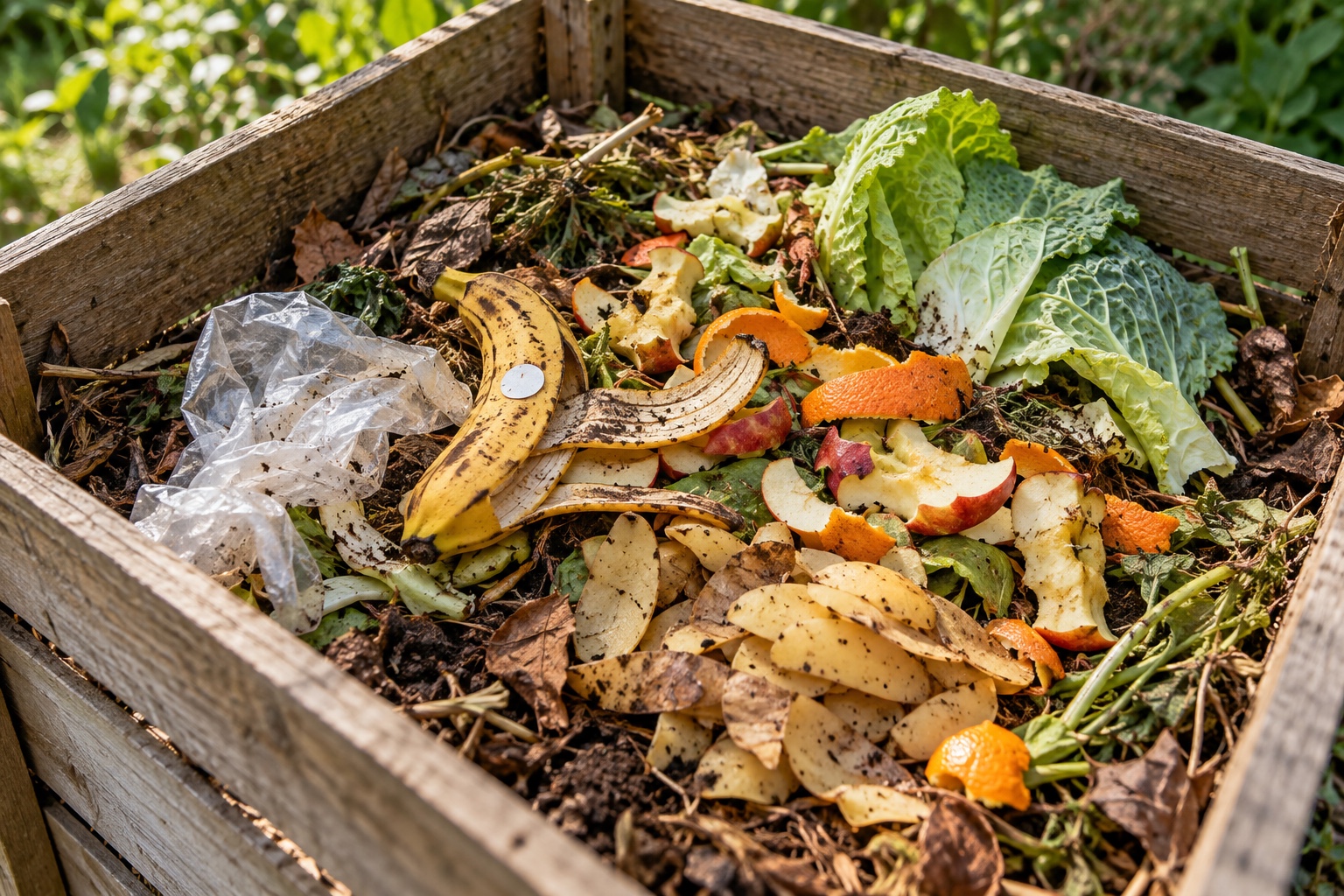
The main lesson from the Bayreuth study is that the plastic coming out equals the plastic going in. For a vegetable garden, asking what the compost is made from matters more than how it looks. By the logic of this study, worm castings and compost from manure and plant residues are closer to the farm digesters in the table, which had almost no particles. Compost from municipal biowaste or retail food waste carries more plastic, because packaging ends up in the feedstock.
Your own compost is the easiest to control. General guidance is in the wiki on organic waste and composting. For plastic, the rules are:
- Peel the stickers off bananas, apples and citrus before the peel goes on the heap.
- Do not put kitchen scraps on the heap in a bag, even a “biodegradable” one.
- Keep bags labeled “compostable” off a home heap too. In a University of Plymouth study, such a bag buried in soil was still there after 27 months, although it tore under load (Napper and Thompson, 2019). Industrial composting runs hot; a garden heap is cooler.
- Pick through the heap before spreading it: rubber bands, polypropylene twine, bits of film and seedling trays.
Film and mulch: plastic that stays in the soil
The second source in the garden lies on top. In China, researchers checked fields mulched with plastic film for decades. The longer the film was used, the more microplastic the soil held: 80.3 particles per kg after 5 years, 308 after 15 and 1,075.6 after 24, about 13 times more. Infrared analysis matched the polymer to the film (Huang et al., 2020).
For comparison, a field in southeastern Germany that never received sewage sludge, biowaste compost or plastic film had 0.34 particles per kg of dry soil and 206 pieces of macroplastic per hectare (Piehl et al., 2018). The methods differ, so the numbers cannot be compared directly, but the scale of the gap is clear.
Film breaks down faster in sunlight than in soil. In the same Plymouth study, every bag, from conventional to “oxo-degradable”, fell apart into fragments within 9 months in the open air. The practical rule: take film and row cover off after the season while they are still whole, before they start to crumble, and never till torn pieces into the bed.
Do roots take up plastic from irrigation water?
The most cited study comes from Chinese and Dutch researchers (Li et al., 2020). They grew wheat and lettuce in nutrient solution, sand and sandy soil with plastic beads and treated wastewater. Particles of 0.2 µm entered the roots, moved up the stem and reached the leaves. Beads of 2.0 µm got in only through cracks where a lateral root breaks out of the main root. The signal from 5 µm beads was weak, and 7 and 10 µm beads were almost never found in roots.
The main caveat is in the paper itself. The authors used 50 mg/L for 10 days to reveal the mechanism and write that they cannot claim this matches real conditions, since particles this small cannot yet be measured accurately in the environment. The study shows the pathway exists. It does not show how much plastic is in garden lettuce.
The authors see the highest risk on fields irrigated with treated wastewater or fertilized with sewage sludge, and in root vegetables such as carrots, radishes and turnips. Home gardens rarely use wastewater. Tap and well water raise their own questions, covered in the article on bottled vs tap water. For hydroponics, the authors specifically mention greenhouse lettuce, where particles can arrive with the water and the fertilizer solution.
How much plastic is found in store-bought vegetables
The loudest number came from a group in Catania, Italy (Oliveri Conti et al., 2020). In produce from markets and supermarkets they counted a median of 223,000 particles per gram in fruit and 97,800 in vegetables. Apples and carrots had the most and lettuce the fewest, 52,050. The particles were tiny, from 1.51 µm in carrots to 2.52 µm in lettuce.
Treat that number with caution. The particles were counted with an electron microscope and elemental analysis, and a 2024 review points out that this method does not identify the polymer (Lazăr et al., 2024). In plain terms, the count does not prove each particle is plastic. We found no independent measurements on market vegetables that identified the polymer.
Whether this plastic harms people is still unknown. What mouse studies and human blood vessel samples show is covered in the articles on cutting boards and water. A similar path from soil into leaves, for a metal, is covered in the article on cadmium in leafy greens.
Does washing remove microplastics from vegetables?
The data here are discouraging. In a 2023 study, lettuce was sprayed with 100 and 500 nm particles to mimic airborne dust. A plain rinse removed almost nothing. Ultrasound removed 4 times more and washing with detergent 6.9 times more. The 100 nm particles were harder to wash off than the 500 nm ones (He et al., 2023).
Detergent is no option for vegetables anyway: the FDA says plainly that soap and produce washes are not needed (FDA). Wash under running water to remove soil, and peel root vegetables, since the skin holds soil and whatever is in it. Peeling does nothing for particles already inside the root, which is why it pays to cut plastic at the source: in compost, mulch and irrigation water.
Microplastics in vegetables: the short version
- Compost carries as much plastic as went into it. Quality-labeled compost had 20-24 particles per kg of dry matter, commercial food waste digestate 895, farm manure digesters 0-11.
- From July 2026 the EU limit allows 2.5 g of plastic larger than 2 mm per kg of dry matter and ignores anything smaller.
- Keep fruit stickers and “compostable” bags off a home heap. Such a bag stayed whole in soil for 27 months.
- Remove film whole after the season. Fields mulched for 24 years held 13 times more microplastic than those mulched for 5 years.
- In the lab, 0.2 µm particles moved from roots to leaves, but at 50 mg/L. How much of this is in garden vegetables has not been measured.
- Rinsing barely removes fine particles. Wash and peel root vegetables, but the main thing is to keep plastic out of the soil.


