On October 1, 2026, three wartime Ukrainian government resolutions expire. They have allowed food labels to diverge from what is actually in the package since March 2022. Resolution No. 980 of July 29, 2026 repeals all three, and anyone packing food for the Ukrainian market has ten days left to bring a label into line.
The document
The repealing act is Cabinet of Ministers Resolution No. 980, signed by Prime Minister S. Koretskyi and published in Uriadovyi Kurier on July 31, 2026. Its annex lists three acts: Resolution No. 186 of March 3, 2022 on food labeling under martial law, Resolution No. 234 of March 9, 2022 on uninterrupted supply of imported food and feed, and Resolution No. 922 of August 19, 2022, which amended No. 234.
Clause 3 sets the date: the repeal takes effect October 1, 2026. Counting from March 3, 2022, the waivers will have run 1,672 days.
What the domestic waiver covered
Resolution No. 186 is two sentences long. It suspended the accuracy requirement for mandatory label information under Article 6 of Ukraine’s Law No. 2639-VIII on consumer food information, with three carve-outs: items 1, 5 and 6 of part one, meaning product name, net quantity and the minimum durability date. Those three lines always had to be true.
Everything else in the thirteen-item list was allowed to differ from the product’s actual parametric values: the ingredient list, the quantity of individual ingredients, special storage conditions, and the nutrition declaration. A separate paragraph permitted the stated composition under item 3 to diverge from the real one, on condition that the consumer be informed of allergens “by any means possible.” The stated reason was forced recipe changes caused by missing raw material.
Most of the import waiver expired on its own
Resolution No. 234 is the one foreign suppliers watch, and reading it closely changes the picture. Its first operative paragraph, as amended by No. 922, covers food “imported into the territory of Ukraine from March 9 through December 1, 2022” whose information is in a language other than the state language. That window closed almost four years ago, and goods that entered through it could stay on the market only until their durability date. Very little of that stock can still be in date.
Three paragraphs of the same resolution are still doing real work, and those are what actually end on October 1:
- feed business operators unable to meet the labeling requirement of Article 23 of the feed safety law because of hostilities may sell imported feed labeled in a foreign language, provided each consignment carries Ukrainian-language feed information supplied on request;
- food and feed brought in as humanitarian aid may be labeled in a foreign language;
- an operator whose facility shut down because of hostilities may use leftover packaging at a different facility producing similar food or feed.
The third one is the clause with teeth for a working producer. After October 1, a stack of pouches printed for a plant that no longer exists cannot legally be filled somewhere else.
Transition terms favor long shelf life
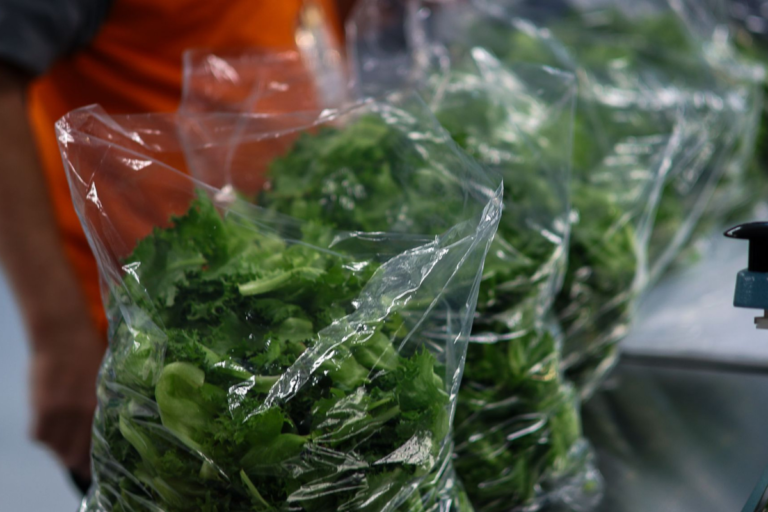
Clause 2 of Resolution No. 980 lets product already labeled under the waivers stay on the market until its minimum durability date or use-by date, and feed until the end of its minimum storage period. The value of that clause scales with shelf life. Canned goods get years. Packed fresh greens with a five to seven day shelf life get a week, which in practice means no transition at all.
Penalties
Fines sit in Article 65 of Law No. 2042-VIII on state control. Item 22 covers selling product whose labeling does not comply where no threat to life or health arises: five minimum monthly wages for a legal entity, three for a registered sole proprietor. Item 5 covers the same violation where a threat does arise: thirty and twenty minimum wages.
The minimum wage has been 8,647 hryvnia since January 1, 2026. At the National Bank rate of 44.6743 hryvnia to the dollar on September 21, 2026, a sole proprietor faces 25,941 hryvnia, about 581 dollars, for a non-hazardous labeling mismatch, and 172,940 hryvnia, about 3,871 dollars, if an inspector finds a hazard. The same 8,647 figure sets the social contribution base, where one late quarter now ends a subsidy worth 1,712 hryvnia a month per insured person.
What to check before October 1
Ingredient statement matching the actual contents. A lot code on every package rather than on the invoice alone. Storage conditions that match how the product really travels. A documented basis for omitting the nutrition declaration, if one is claimed: Annex 4 to Law No. 2639-VIII exempts unprocessed single-ingredient products, packages whose largest surface is under 25 square centimeters, and small volumes supplied directly to the end consumer or to local retailers. And no leftover pre-October label stock, on anyone’s product.
For growers reading this from the other side of the shelf, the full thirteen-item list and the two traps inside it are worked through in our piece on selling microgreens to grocery. Before any of that, the growing site itself has to be registered as a food facility, and who needs it and how to file is set out in the wiki on food production registration in Ukraine.