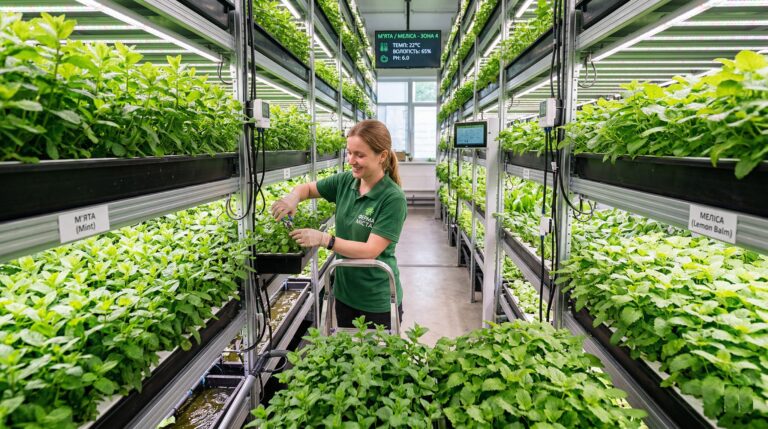
A grow light puts 200 µmol/m²/s on the leaves and runs 16 hours a day. That comes to 11.5 moles of light per square meter per day. For lettuce, it falls short: Cornell University grew its lettuce at 17 mol/m²/day. Eric Stallknecht of Virginia Tech works through this same example, 200 for 16 hours, in his DLI guide and puts lettuce at 12-17.
Below is a DLI and PPFD calculator with three modes. “Grow light” works out how much light your fixture delivers per day and compares it with the crop’s range. “Target” shows the PPFD or the hours you need to hit that range. “Greenhouse” takes your outdoor DLI, subtracts what the glazing blocks, and tells you how many hours of supplemental light to run. After the calculator, we cover the formula, where the crop numbers come from, and why a lux meter won’t do the job.
DLI and PPFD calculator: grow light, target, greenhouse
- Use PPFD measured at leaf level, not the number on the box. Manufacturers state it at a set hanging height and often at the center of the footprint, and the tray edges get less.
- The crop ranges come from the Virginia Tech guide (lettuce, basil, tomato) and from a Purdue University trial with brassica microgreens. For your own cultivar or another crop, pick “Custom range.”
- In “Greenhouse” mode, enter the average outdoor DLI for your location and month and your own light loss. Virginia Tech puts typical greenhouse losses at 30-50%.
DLI vs PPFD: the formula and the difference
PPFD is how many photons of photosynthetically active light (400-700 nm) land on a square meter each second, in µmol/m²/s. It is an instant reading, like a speedometer. DLI, the daily light integral, is how much light piles up over the day, in mol/m²/day. That is the odometer.
The formula: DLI = PPFD × hours × 3,600 / 1,000,000. The 3,600 turns hours into seconds, and the million turns micromoles into moles. In short, PPFD × hours × 0.0036.
| PPFD, µmol/m²/s | 12 h | 16 h | 18 h | 24 h |
|---|---|---|---|---|
| 100 | 4.3 | 5.8 | 6.5 | 8.6 |
| 150 | 6.5 | 8.6 | 9.7 | 13.0 |
| 200 | 8.6 | 11.5 | 13.0 | 17.3 |
| 250 | 10.8 | 14.4 | 16.2 | 21.6 |
| 300 | 13.0 | 17.3 | 19.4 | 25.9 |
| 400 | 17.3 | 23.0 | 25.9 | 34.6 |
DLI in the table is in mol/m²/day. Why fixture wattage tells you nothing about these numbers, and how to check coverage across a bench, is in the wiki on lighting: PPFD, DLI, and watts.
DLI for crops: how much light each one needs
| Crop | DLI, mol/m²/day | Source |
|---|---|---|
| Brassica microgreens | 6-18 (trial range) | Purdue, 2016 |
| Lettuce | 12-17 | Virginia Tech; Cornell: 17 with airflow, 12 without |
| Lettuce seedlings | about 22 | Cornell |
| Basil | 15-25 | Virginia Tech |
| Tomato | 20-30 | Virginia Tech |
Lettuce. Melissa Brechner and A.J. Both of Cornell write that 17 mol/m²/day worked best for the Boston bibb cultivar they grew, Ostinata, which is no longer sold. The same handbook adds a condition: 17 only works with a fan blowing down on the plants. Without that airflow, they could not go above 12 before tipburn showed up. Moving air speeds up transpiration, which carries more calcium to the young leaves. At 17 mol, they got 150 g heads 24 days after transplant. Seedlings there run at 250 µmol/m²/s around the clock, about 22 mol. Solution targets and the full lettuce cycle are in the wiki on growing lettuce and leafy greens.
Microgreens. Joshua Gerovac, Roberto Lopez, and colleagues grew kohlrabi, mizuna, and mustard under LEDs at 105, 210, and 315 µmol/m²/s for 16 hours, which works out to 6, 12, and 18 mol/m²/day. Harvest came at 10-15 days. More light gave shorter hypocotyls and a higher share of dry matter. Mineral concentrations ran higher under the weakest light. The authors give no single target: the right light depends on what the buyer wants the microgreens to look like. Why microgreens stretch when light runs short is covered in the wiki on leggy microgreens, and how blue light affects yield is in blue light and microgreen yield.
Basil and tomato want more light than lettuce: 15-25 and 20-30 mol/m²/day in the Virginia Tech guide. A windowsill in winter won’t get anywhere close. Strawberries need at least 10 to 12 mol, and we worked out what that means for a windowsill plant separately. Herb specifics are in the wiki on basil and culinary herbs, and greenhouse tomatoes in the wiki on greenhouse tomatoes and cucumbers.
DLI and photoperiod: hours or intensity
You can reach the same DLI with strong light over a short day or weaker light over a long one. Cornell says as much for lettuce seedlings: a shorter photoperiod is fine if you raise the intensity to deliver the same 22 mol or so. The “Target” mode shows both routes: the PPFD you need at your hours, and the hours you need at your PPFD.
Hours can’t stretch forever. In some crops a long day triggers flowering or bolting, and others develop chlorosis and scorched leaf edges under 24-hour light. The schedules for microgreens, lettuce, basil, and tomato are laid out in the wiki on photoperiod and plant circadian rhythm. Pick the hours from the crop’s photoperiod first, then close the DLI gap with intensity.
DLI in a winter greenhouse: how long to run supplemental light
The Virginia Tech guide cites the DLI maps by Faust and Logan (2018): outdoors in Virginia, DLI runs 40-45 mol/m²/day in July and 15-20 in December. Inside a greenhouse you get less, since glazing, framing, and dirt on the panes take their share. Stallknecht puts the loss at 30-50%.
Take a December day in Virginia at 15 mol outdoors. With a 40% loss, about 9 reaches the crop. To bring lettuce to 12-17, the lights have to add 3-8 mol. At 200 µmol/m²/s at leaf level, that is 4.2-11.1 hours a day. For comparison, Kyiv, Ukraine, averages 4.1 mol outdoors in December, so the same greenhouse there gets about 2.5, and lettuce needs 13-20 hours of supplemental light.
To get monthly figures for your own site, NASA POWER publishes average total PAR at any location, averaged over 2001-2020, in MJ/m²/day. Multiply by 4.57, the micromoles of photons per joule of sunlight from the Thimijan and Heins table (1983), and you have outdoor DLI.
Summer flips the problem. At 40-45 outdoors, a greenhouse still gets well over what lettuce needs. Ways to cut the midday peak are in the wiki on shading and reflective surfaces, and running a greenhouse through short, cold days with power outages is covered in the wiki on winter growing in Ukraine.
Monthly figures are averages. A cloudy week in November delivers less, a clear one more. A sensor inside the greenhouse does better: it tracks accumulated DLI through the day and turns the lights on when the total is running short.
PPFD: how to measure it at canopy level
PPFD is measured with a quantum sensor. The Virginia Tech guide lists prices from under $100 to over $1,000. It also mentions phone apps that read light through the phone’s built-in photodiode. They are fine for a rough check, but for sizing supplemental light, use a sensor.
A lux meter measures light the way the human eye sees it, not the way a plant uses it. The conversion factor depends on the light source. In the Thimijan and Heins table, 1 µmol/m²/s equals 54 lux for sunlight, 82 for high-pressure sodium, 71 for metal halide, and 74 for cool-white fluorescent. LEDs have no single factor: for white LEDs it depends on the spectrum, and a lux meter badly underreads red and blue grow lights, since the eye barely sees those wavelengths. That is why this calculator skips lux.
Once you know the PPFD, the next question is how much light the fixture delivers per watt. That is covered in the wiki on PPE and grow light efficiency. Our other hydroponics calculators are collected on the calculators page.
DLI calculator: key points
- DLI = PPFD × hours × 0.0036. 200 µmol/m²/s for 16 hours gives 11.5 mol/m²/day.
- Lettuce needs 12-17. Cornell reached 17 only with a fan blowing down on the crop. Without it, the limit was 12.
- Set the hours from the crop’s photoperiod first, then raise intensity to hit the DLI.
- Greenhouses lose 30-50% of outdoor light. Subtract that before you size supplemental lighting.
- Measure PPFD with a quantum sensor at leaf level. There is no reliable way to convert lux for LEDs.