People grow sea fennel (Crithmum maritimum) indoors for its leaves: fleshy, slightly salty, with notes of celery, fennel and green citrus peel. Restaurants pickle it like capers and serve it with fish. You rarely see it fresh in shops, so growing your own is the easier route. Below is what open research says about how it germinates, what it grows in, whether it needs salt and what to do with it after harvest. Studies are few, so where there is no data, the article says so.
What the plant is
It shares only a family with garden fennel, the carrot family Apiaceae. Crithmum maritimum is the only species in its genus. It is a perennial with a woody base, 20 to 60 cm tall, with thick leaves split into narrow segments. It grows on rocks and shingle by the sea, from the Mediterranean and Black Sea coasts to the Atlantic coast of Portugal, southern England and Ireland. Common fennel microgreens, sweet and anise flavored, are covered in the fennel card, and they are a different plant.
Foraging it is a bad idea. In England and in Italy’s Monte Conero park, picking wild sea fennel is banned because overharvesting wiped it out in parts of its range. So you start from seed.
What is in the leaves. According to the Renna (2018) review, 100 g of fresh leaves hold 1.57 g of protein, 3.74 g of fiber and only 0.65 g of sugars, plus 76.6 mg of vitamin C. The wild versus cultivated comparison is more interesting: wild plants had 291 mg of sodium per 100 g and cultivated ones 168 mg, while potassium went the other way, 335 and 588 mg. Cultivated sea fennel is less salty than plants from the shore.
How to germinate the seed
The main rule: germinate in fresh water. The plant lives by the sea, yet salt slows its seed. In a population from Brittany, germination stopped almost completely at 50 mM NaCl (about 2.9 g of salt per liter), and Tunisian studies agree that seed barely germinates at 200 mM. Seed from the southern Spanish coast tolerated more: almost all of it germinated in distilled water, 22% less at 150 mM and 95% less at 300 mM. Most seed that failed in salt water germinated once moved to plain water, so the salt put it to sleep rather than killing it.
Two more conditions from the research. For a Sardinian population the optimum was 20 °C in darkness. At the University of Salento botanical garden, seed collected in October and November was sown in mid December in a 1:1 mix of peat and river sand and kept in an unheated tunnel. Germination was 70 to 75% with no promoters, seedlings appeared a month later and came up slowly, and the root system filled the cell only after 5 months.
A plan for an apartment:
- Sow into a cell tray filled with peat and sand or peat and perlite 1:1, covering the seed lightly.
- Water with plain water, no salt and no fertilizer, until true leaves appear.
- Keep the tray around 20 °C. Expect seedlings in weeks, not days: in Salento it took a month.
- Transplant once roots fill the cell. Budget several months for the seedling stage.
Cuttings do not work. In the same garden, stems and young shoots failed to root, and the same Apulian review adds that a mother plant yields too few cuttings anyway.
Pot or hydroponics
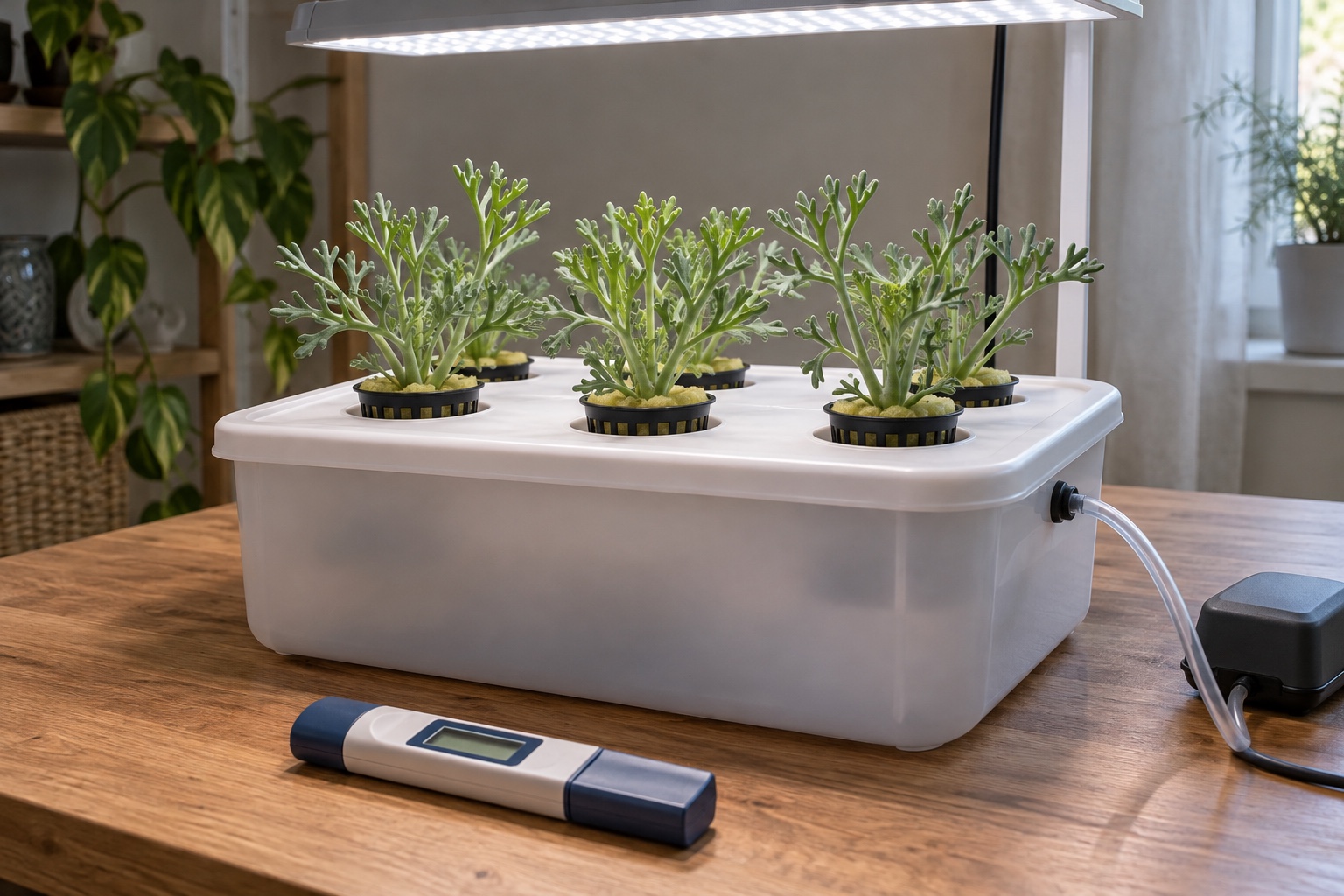
Both have been tested. The difference is how often you want to harvest.
| Pots (Thessaly, Greece) | DWC hydroponics (Hannover, Germany) | |
|---|---|---|
| Start | seedlings sown in September, potted into 6 L pots in January | seedlings set in 35 mm holes in the lid |
| Medium | peat and perlite 1:1 | Hoagland solution, 13 L per container, 8 plants |
| Conditions | winter in an unheated glasshouse, then outdoors | greenhouse at 14 to 35 °C, 14 h supplemental light |
| Harvest | once a year, 3 years running | after 11 weeks |
| Yield | 34 to 113 g of leaves per pot per harvest | 1440 g fresh weight for the no salt treatment |
In Thessaly the plants lived three years and gave a harvest each year. After each season they were left to set seed and then cut back to 5 cm above the medium. In year one the strongest solution gave the most, 59 g of leaves per pot against 42 g with no fertilizer. By year three a middle dose did best (107 g) and the highest doses fell behind. Young plants need more feeding than established ones.
In Hannover, sea fennel grew in aerated containers of Hoagland solution topped up with tap water. The no salt treatment produced 1440 g of fresh biomass in total. Each treatment had three containers of 8 plants, so if 1440 g covers all 24 plants, that is roughly 60 g per plant in 11 weeks. Of the three halophytes in the trial, sea fennel produced the least biomass and took the longest: the other two were cut after 5 weeks. How to build such a system at home is covered in the NFT, DWC and Kratky comparison, and the NPK calculator helps mix the solution.
In pots, mind the depth. On Mediterranean green roofs, sea fennel grew better in 15 cm of substrate than in 7.5 cm. A shallow tray is the wrong home for it.
Does it need salt
Here the studies disagree, which is worth knowing before you add salt to the tank.
- Hannover, DWC: the most biomass came from the solution with no salt. At 342 mM NaCl (20 g per liter) the yield fell to 126 g from 1440 g, and at higher salinity the plants did not survive.
- Bari and Cartagena, floating rafts: at 150 mM (about 8.8 g per liter) the fresh weight of shoots rose while root mass fell. Leaves held less nitrate and more sodium and chloride. Tasters easily picked up the salty flavor.
- Ben Hamed and colleagues (as cited by Renna): plants grew better at 50 mM than at 300 mM, with no toxicity symptoms in either. A Spanish group led by Martins-Noguerol put the greenhouse optimum at about 50 mM, roughly 5 dS/m.
My reading of the three: salt is optional, and the plant grows well on a normal solution. Moderate salt (up to 50 mM, about 2.9 g of table salt per liter) does no harm and may bring back the familiar sea taste. If you want to try 150 mM as in the Italian trial, do it in one container and weigh the harvest, because the Hannover result shows yield can drop. And salt water is for established plants only, never for seed.
Light and temperature
Sea fennel loves light. The Apulian review calls it a strict heliophile and recommends spacing that lets every leaf see the sun. A winter windowsill will not deliver that.
I could not find a published DLI requirement for this species. The trial conditions give a reference: in Hannover the greenhouse ran sodium lamps 14 hours a day, and light ranged from 65 to 850 µmol/m²·s depending on season and weather, with temperatures from 14 °C at night to 35 °C by day. The Spanish group germinated seed at 28/22 °C with 16 hours of light. For an apartment that means a lamp over the plant and a 14 to 16 hour day. Check what your lamp delivers with the DLI calculator.
Harvest, kitchen and storage
In Apulia people pick the tender stem tips in late spring, peel and blanch them, and preserve them in oil or vinegar with garlic and mint. Fresh leaves are cut into strips for salads with oil and lemon. Dried sea fennel works as a spice and a colorant: in the trial by Renna and colleagues, freeze drying and microwave drying kept color and flavor better than the other methods, though every drying method cut the essential oil content.
Fresh cut leaves keep well. In the Bari and Cartagena trial they were stored 12 days at 5 °C, weight loss and color change were not significant, and microbial counts were the same in both treatments by day 12. Leaves from the control solution were firmer and grew firmer still during storage, which the authors link to lignification.
Key points
- Sea fennel is a perennial: in 6 L pots it gave a harvest every year for three years.
- Germinate in fresh water at about 20 °C. Seedlings take weeks to appear and months to grow. Cuttings do not root.
- In DWC on Hoagland solution it was ready in 11 weeks, and the no salt solution gave the most biomass.
- Salt up to 50 mM did no harm in trials, and 150 mM adds a salty taste, but results on yield conflict.
- The plant needs strong light: indoors in winter, run a lamp for 14 to 16 hours.
- Cut leaves last 12 days at 5 °C.