

Microgreen pesto is made the same way as classic Genovese pesto: greens, nuts, hard cheese, olive oil and a little garlic. The crop decides the flavor, color and body of the sauce. The site already has two recipes, pea and basil. They get a short note here, and three more crops are written out in full: sunflower, hot radish and dill. At the end: how long pesto keeps in the fridge.
The base formula
All five variations use one ratio for about 150 ml (2/3 cup) of sauce, enough for 3 to 4 servings of pasta:
- 50 g microgreens;
- 30 g (1/4 cup) nuts or seeds, toasted in a dry skillet for 2 to 3 minutes;
- 30 g aged hard cheese or 40 g salty soft cheese;
- 80 to 100 ml (1/3 to a scant 1/2 cup) olive oil;
- half a garlic clove, salt, 1 to 2 tsp lemon juice if needed.
The technique is shared too. Chop the stems with a knife before blending so the sauce has no long strands. Blend in short pulses, because heat from the blades darkens the greens. Toss pesto with hot pasta off the heat and loosen it with a spoonful of pasta water.
1. Pea: mild and slightly sweet
The easiest option for anyone who finds basil too strong. Pea microgreens taste of fresh sweet peas and keep a bright color. The full recipe with pine nuts and jalapeño is pea microgreen pesto. Pea is also a good mild base for hot crops, as in variation 4.
2. Basil: classic flavor, softer texture
Micro basil smells like mature basil but has almost no fiber, so the sauce comes out silky. Use green basil: purple turns the sauce grayish. The recipe with roasted cherry tomatoes is here: basil microgreen pesto pasta.
3. Sunflower with sunflower seeds and lemon
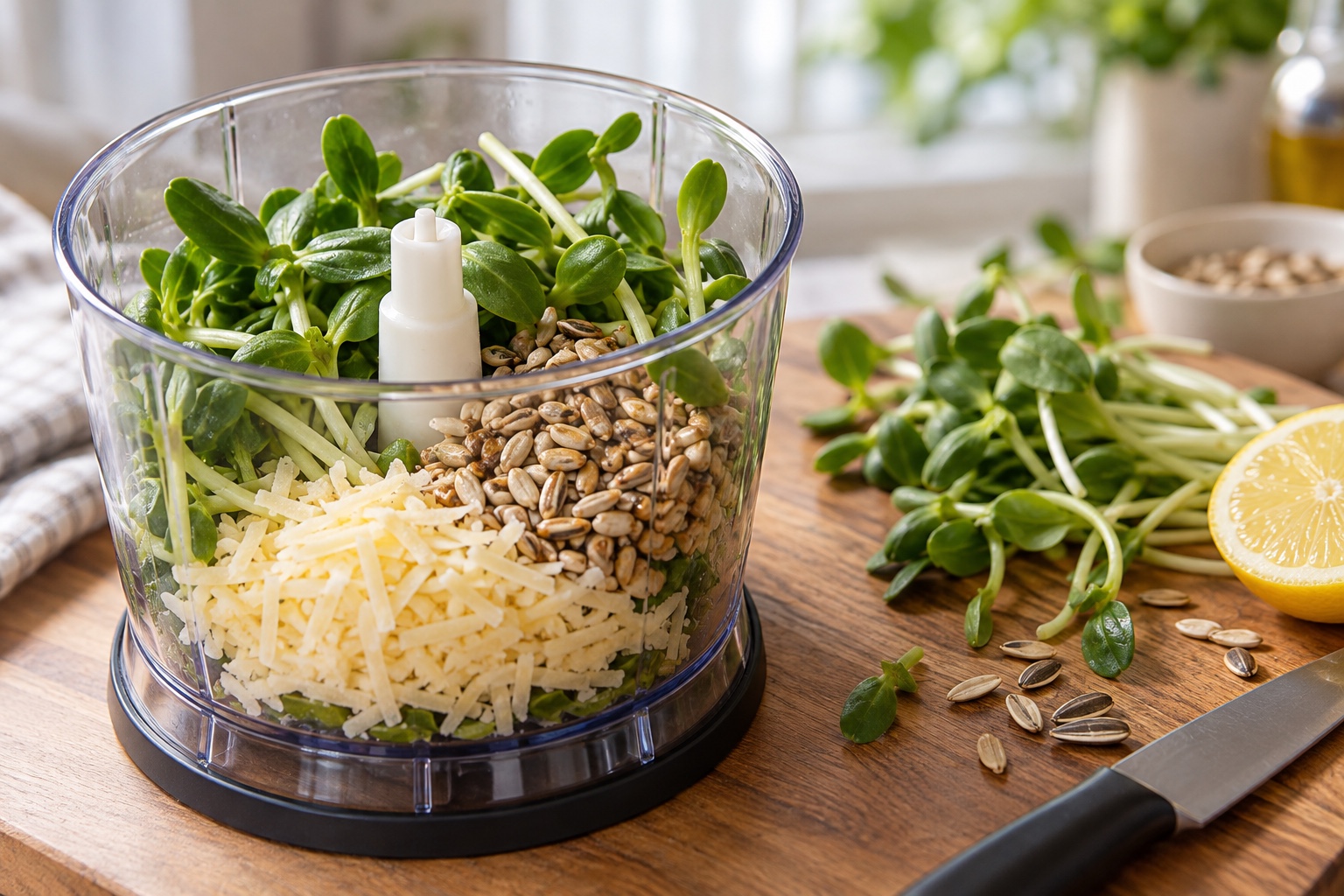
Sunflower microgreens are nutty, oily, free of bitterness and the densest of all microgreens. The pesto comes out thick, almost a spread, and tastes of the seed it grew from.
- 50 g sunflower microgreens;
- 30 g (1/4 cup) hulled sunflower seeds, toasted;
- 30 g Parmesan or another hard cheese;
- 100 ml (a scant 1/2 cup) oil, part of it can be unrefined sunflower oil;
- half a garlic clove, 2 tsp lemon juice, salt.
Look the greens over before blending: seed hulls often stay stuck to the cotyledons, and they crunch in the sauce. Shake them off or pick them out. Buy sunflower cut before the first true leaf shows between the cotyledons; after that it turns bitter. Because it is so dense, this pesto needs a bit more oil than the others, plus a spoonful of pasta water.
Serve with: baked potatoes, toast with eggs, grain bowls with roasted vegetables.
4. Radish: hot, cut with a mild base
Straight radish pesto is too fiery. On the taste panel scale, China Rose radish scored 67 out of 100 for heat, close to mustard. So radish goes in as one third, and the rest is a mild base, pea or sunflower.
- 15 g China Rose or Sango radish microgreens;
- 35 g pea or sunflower microgreens;
- 30 g (1/4 cup) walnuts;
- 30 g Parmesan;
- 80 ml (1/3 cup) oil; garlic is optional, the radish brings the heat.
Radish heat fades when warmed, so add this pesto at the end and do not cook it. Sango gives purple flecks and a slightly darker color, China Rose pink ones. The ratio is easy to shift: taste and add another handful of radish if you want more heat.
Serve with: boiled new potatoes, eggs, salmon, or mixed into cream cheese as a spread.
5. Dill with walnuts and feta
Micro dill has the same aroma as mature dill without the bitterness of an overgrown plant. Salty feta or brynza replaces Parmesan here, and there is almost no lemon: acid mutes the delicate dill aroma.
- 50 g dill microgreens;
- 30 g (1/4 cup) walnuts;
- 40 g feta or brynza;
- 80 ml (1/3 cup) oil;
- half a garlic clove, a pinch of salt, lemon juice only on the tip of a knife.
Micro dill is very delicate: do not spin it after washing, pat it dry on a towel. Blend in 2 or 3 pulses. Dill does not like heat, so combine the pesto with hot food on the plate. Leave basil and cilantro out of this sauce; they drown the dill.
Serve with: new potatoes, baked or smoked fish, eggs, cold soups.
What to save for garnish
Not every microgreen works as a sauce base. Mustard and cress are too sharp for pesto: on the same scale, Dijon mustard scored 86 for heat, and peppercress had the highest bitterness, sourness and astringency of the six crops. In a sauce that sharpness concentrates, since there are several handfuls of greens in it. Use these crops a few stems at a time on top of the finished dish.
Red crops such as amaranth and Bull’s Blood beet taste mild, but red stems blended with green leaves give a muddy brown sauce. The same goes for purple basil. Keep them for garnish too: a handful of red microgreens looks better on top of green pesto than inside it.
Five variations side by side
| Variation | Nuts | Cheese | Acid | Flavor |
|---|---|---|---|---|
| Pea | pine nuts | Parmesan | a little vinegar or lemon | mild, slightly sweet |
| Basil | pine nuts or sunflower seeds | Parmesan | none | classic, herbal |
| Sunflower | sunflower seeds | Parmesan | 2 tsp lemon | nutty, thick |
| Radish and pea | walnuts | Parmesan | none | hot |
| Dill | walnuts | feta or brynza | minimal | dill, salty |
How long it keeps
Pesto with garlic and oil does not belong at room temperature: greens and garlic under oil create an oxygen-free environment where botulism bacteria can grow. Oregon State University Extension advises keeping homemade oil mixtures, pesto included, in the refrigerator for up to 4 days or freezing them. Label the jar with the date it was made and the date by which it must be eaten or moved to the freezer. Why such mixtures are not canned is explained in the article on botulism in home canning.
To freeze, portion pesto into ice cube trays or small jars with tight lids so the smell does not spread through the freezer. You can stir in the cheese after thawing. Chopped greens left out in the warmth also change chemically, as covered in the article on nitrates in vegetables, and what must stay cold is in the never-refrigerate list.
Key points
- One ratio for every variation: 50 g microgreens, 30 g nuts, 30 g cheese, 80 to 100 ml oil.
- Pea and sunflower make a mild base, basil gives the classic flavor, dill suits potatoes and fish.
- Radish goes in as one third of a mild base and is never heated.
- Clear sunflower greens of seed hulls before blending.
- Pesto with garlic and oil keeps up to 4 days in the fridge, or freeze it.


