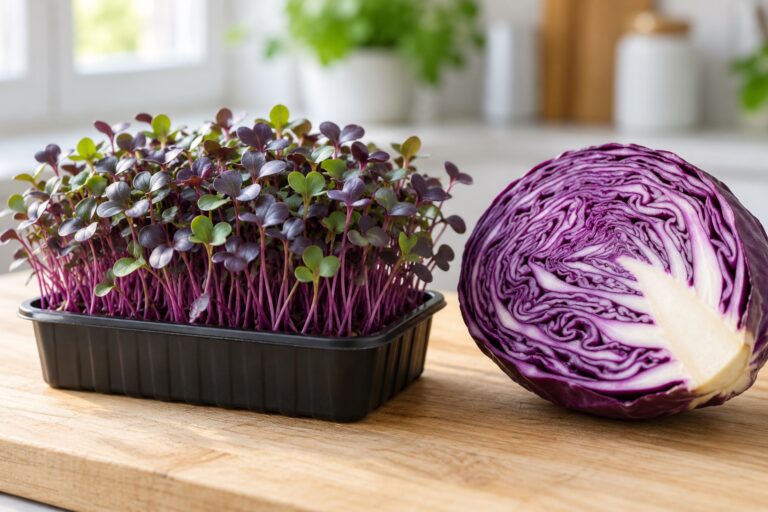

A crop card usually describes flavor in words: peppery, mild, a little spicy. That works for a shopper, but for a menu or a mix you want a number. I found one open intensity scale with numbers. It comes from an 80-person taste panel in Zhenlei Xiao’s dissertation (University of Maryland and the USDA labs in Beltsville, 2013), later published in Postharvest Biology and Technology. Below are its numbers and a way to repeat the test yourself.
How flavor was measured
The authors state that no sensory lexicon for microgreens existed at the time, so they built their own ballot. Eight experienced tasters worked through 25 commercial varieties over five sessions and agreed on 12 attributes. Eight describe intensity: aroma, texture, astringency, bitterness, grassiness, heat, sourness and sweetness. Four describe liking: appearance, texture, flavor and overall eating quality.
Three terms got exact definitions because they are the easiest to read differently. Astringency means a drying, rough, puckering mouthfeel. Grassy means an earthy or herbal flavor. Heat means a peppery, spicy or pungent note.
The same tasters sorted the 25 varieties into five flavor groups:
- mustard: arugula, Dijon mustard, mizuna, red mustard, wasabi;
- herbal: cilantro, Italian basil, opal basil, red sorrel, sorrel;
- veggie: Brussels sprouts, Bull’s Blood beet, celery, Merlin beet, red cabbage;
- mild: magenta orach, pak choi, popcorn shoots, red amaranth, Tuscan kale;
- peppery/radish: China Rose radish, daikon, peppercress, purple kohlrabi, ruby radish.
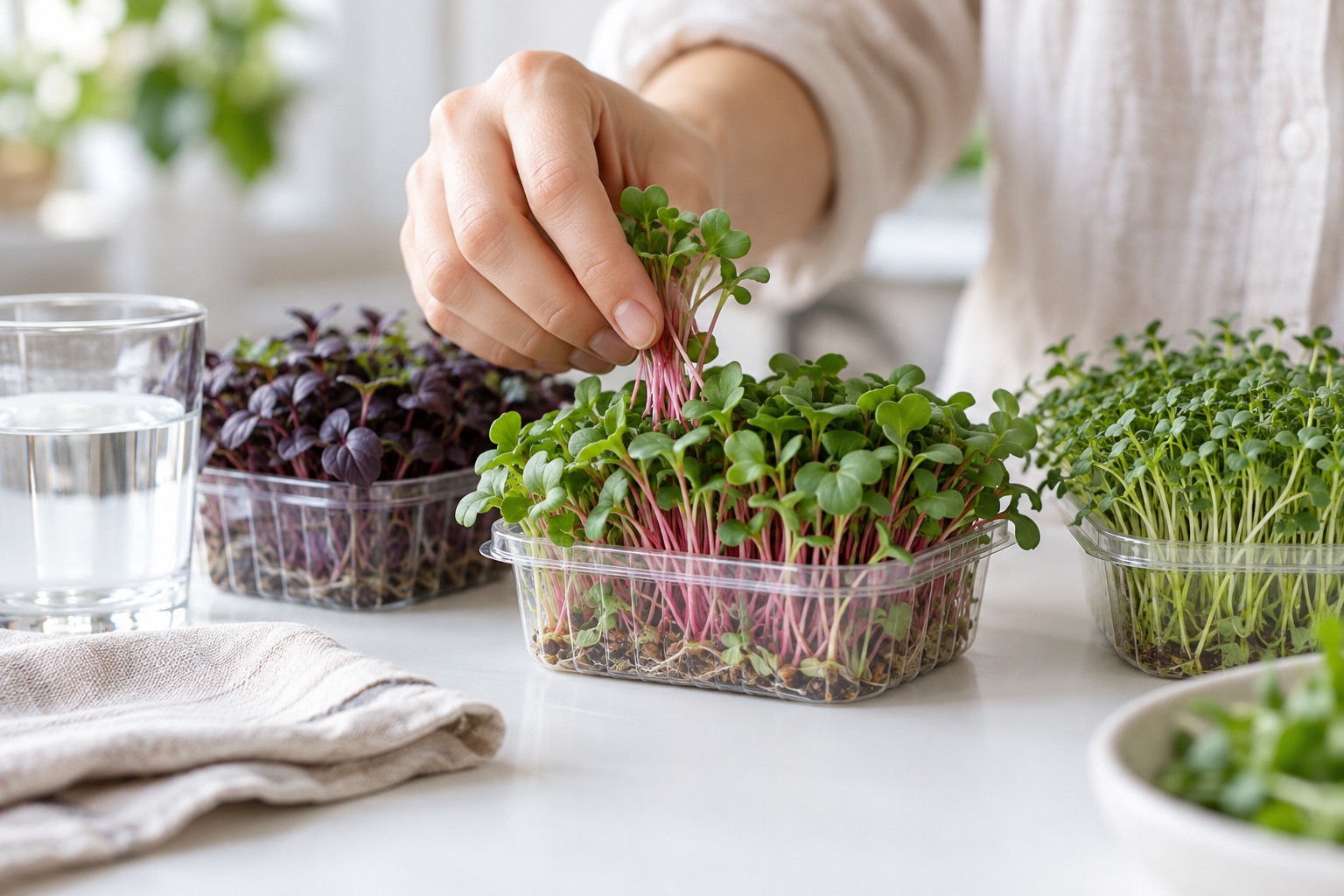
From each group they took the best-liked variety, plus peppercress, which had the strongest and most complex flavor in the preliminary test. In February 2013, 80 people rated these six crops: research center staff and students who like vegetables and did not know the purpose of the study. The greens were washed in tap water and spun dry. Each taster got 5 g in a container with a random three-digit code, in random order. Each attribute was marked on a line from 0 (none) to 100 (very strong), and liking was scored the same way.
The scale: six crops in numbers
Crops are sorted by heat, from mildest to hottest. The last column is different: overall eating quality, which measures liking.
| Crop | Heat | Bitterness | Sourness | Astringency | Grassy | Aroma | Overall quality |
|---|---|---|---|---|---|---|---|
| Red amaranth | 10.8 | 24.1 | 17.2 | 23.1 | 69.5 | 29.2 | 63.1 |
| Bull’s Blood beet | 12.7 | 31.0 | 13.3 | 19.3 | 61.0 | 20.0 | 76.5 |
| Opal basil | 30.9 | 51.3 | 24.0 | 36.6 | 69.5 | 49.5 | 49.0 |
| Peppercress | 66.0 | 51.9 | 29.5 | 41.9 | 61.7 | 35.1 | 39.7 |
| China Rose radish | 67.2 | 40.3 | 24.2 | 40.7 | 58.2 | 21.6 | 53.7 |
| Dijon mustard | 86.2 | 40.8 | 24.0 | 35.5 | 50.2 | 24.3 | 61.0 |
Heat spreads the crops apart the most, from 11 to 86 points. For convenience I split it into four tiers; the split is mine, not the study’s. Under 20, there is almost no heat: amaranth and beet. From 20 to 40 it is noticeable but not leading, as in opal basil. From 40 to 70 it is distinct: China Rose radish and peppercress. Above 70 it drives the flavor, and only Dijon mustard is there.
Two attributes barely separate the crops. Sweetness sat at 9 to 15 points for all six, with no statistical difference. These greens hold about 1 g of sugar per 100 g or less, and sugar content did not track perceived sweetness. Grassiness was high across the board, 50 to 70 points. It is the shared background of all microgreens.
Our crop cards carry a single overall intensity score: 8 out of 10 for purple basil and 5 out of 10 for China Rose radish. The panel shows why one number falls short. The basil is the strongest in aroma and bitterness, but it has half the heat of the radish. Choose basil as a hot crop and you get aroma, not heat.
Bitterness, sourness and astringency travel together
In this panel, sourness was closely tied to astringency (correlation coefficient 0.81), bitterness (0.80) and heat (0.72). Astringency followed bitterness (0.77) and heat (0.70) as well. Bitterness ran against sweetness (-0.67): the more bitter a green, the less sweet it seemed. The author calls flavor a gestalt: people perceive it as a whole.
So you can rarely tune one attribute alone. Peppercress scored the highest bitterness, sourness and astringency, and its heat was nearly equal to the radish. A variety that brings strong heat usually brings the other sharp notes along.
Why bitterness and heat come from different chemistry, and how harvest age and growing stress change them, is covered in the article on bitter microgreens. The panel answers a different question: how those notes come across to someone simply eating the greens.
What people liked
Bull’s Blood beet earned the highest overall score, 76.5, and peppercress the lowest, 39.7. The other four did not differ statistically. Overall quality almost exactly mirrored flavor liking (correlation 0.98). Sourness pulled it down the most (-0.87), then bitterness (-0.71) and astringency (-0.66), while sweetness lifted it (0.61).
Heat is missing from that list. Dijon mustard, the hottest crop, came third because it had less bitterness, sourness and astringency than peppercress. Women, though, rated the mustard’s flavor much lower than men did (P = 0.001). For every other attribute of the six crops, the panel found no difference between women and men.
An Italian panel on 12 microgreen species in 2020 reached the same conclusion: the lower the astringency, sourness and bitterness, the higher the acceptance. Mibuna and cress were liked least, Swiss chard and coriander most. In a 99-person panel in Colorado, all six crops, including arugula, beet, amaranth and pea, averaged acceptable or better. Lower scores came from people who are wary of unfamiliar food in general.
How to run this test yourself
For a farm or a kitchen, the Maryland numbers are a reference point, but your radish from your rack may taste different: variety, harvest age and temperature all shift the profile. You can check with the same method, simplified.
- Use the same eight attributes and the same definitions of astringency, grassy and heat. Without definitions, one person calls bitter what another calls hot.
- Draw a 10 cm line for each attribute, labeled none at the start and very strong at the end. The distance to the mark in millimeters gives a score from 0 to 100.
- Wash the greens, spin them dry and give everyone the same portion. The study used 5 g.
- Label containers with random three-digit numbers and change the serving order for different people. The first crop in a row always seems brighter.
- Ask separately how much they like the flavor and the overall eating quality. Intensity and enjoyment differ: strong heat did not keep the mustard from scoring well.
- Average each crop and compare batches. If a new batch scores 15 to 20 points higher on bitterness, look for the cause in how it was grown.
The scale works for mixes too: the loudest component for heat or bitterness sets the flavor of the whole pack. For ideas on handling sharp crops in the kitchen, see 10 chef techniques.
Where the scale has limits
Six crops, one delivery from one grower, one panel in the US. The tasters liked vegetables; people who avoid them would likely judge the sharp crops more harshly. The preliminary data on 25 varieties were not published, so for the other 19 crops we only know which group they were placed in. I did not find another open intensity scale for microgreens built on the same attributes. Read the table as a comparison of these six crops with each other, not as a universal standard.
Key points
- The one open, numeric flavor scale for microgreens comes from an 80-person US panel in 2013: eight intensity attributes scored 0 to 100.
- Heat separates crops the most: from 11 points for amaranth to 86 for Dijon mustard.
- Sweetness and grassiness are nearly the same across all six crops.
- Sourness, bitterness and astringency rise together, and they lower liking the most. Heat on its own did not lower the score.
- Bull’s Blood beet was liked most, peppercress least.
- Your own panel with the same definitions and a 0 to 100 line shows whether a batch has changed.