
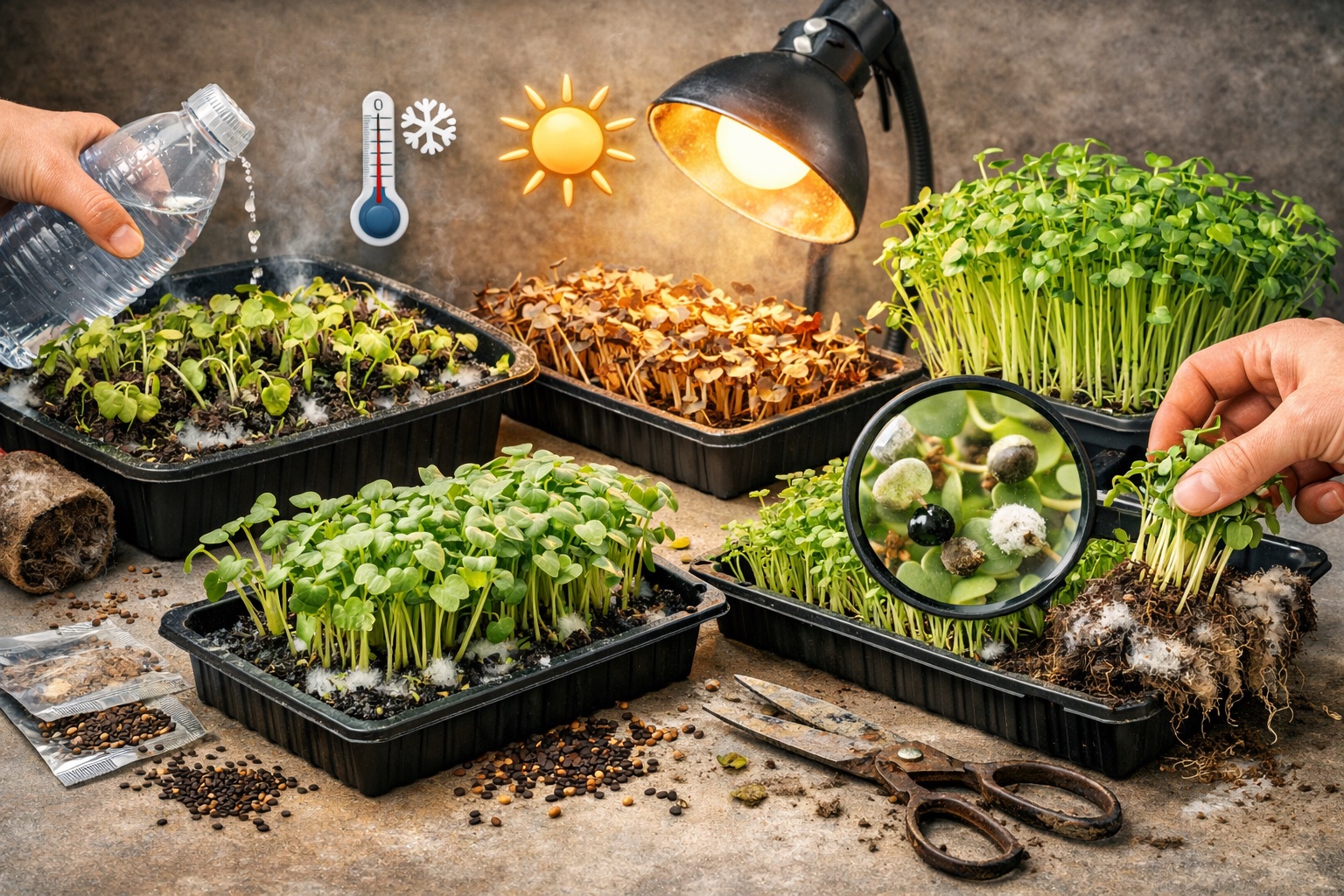
Most of these mistakes happen once — and never again. Microgreens are genuinely easy to grow, but only once you understand a few basics about moisture, airflow, and timing.
Mistake 1 — Too Much Water at the Start
The most common one. The logic seems right: seeds need water, so water them well. But microgreens at the germination stage need moisture — not a puddle.
If the substrate is soaking wet, seeds begin to rot before any roots appear. This happens fastest with flax and basil — they produce mucilage when wet, and excess water turns the tray into a swamp.
The rule is simple: the substrate should feel like a well-wrung sponge — damp but not wet. After the first watering, press it with your hand. If water seeps out, wring it out or wait for the excess to drain.
Mistake 2 — Wrong Seed
Not all seed is suitable for microgreens. Treated seed — the kind sold for garden sowing, coated with fungicides — is toxic. Eating sprouts grown from it is not safe.
Look for seed labelled “for microgreens” or “for sprouting.” There is a price difference, but it is small. The safety difference, however, is fundamental.
One more point: some nightshade crops — tomato, pepper, aubergine — produce toxic sprouts even from untreated seed. They are simply not eaten at the microgreen stage at all.
Mistake 3 — Leaving the Tray Uncovered in the First Days
For the first 3–4 days after sowing, microgreens need to grow in darkness under a lid or black bag. This is not a quirk — darkness and pressure push seeds to germinate more actively, driving roots downward rather than sprawling sideways.
Many growers skip this step: they put the tray on a windowsill and wait. The result — uneven, weak sprouts with thin stems that flop over within days.
Cover the tray and place something heavy on top — an empty second tray, a book. This also helps distribute pressure evenly and produces straight stems.
Mistake 4 — Poor Substrate or No Substrate at All
Some growers try microgreens on a damp paper towel or gauze. For radish or mustard this can work after a fashion, but for most crops it does not. Roots have nothing to grip, the plant sways and falls, and the harvest comes out uneven.
Coconut coir, a jute mat, or a linen mat — that is the minimum required. A separate article on choosing the right substrate for microgreens covers what works for which crop in detail.
Garden or flower-bed soil is also a bad idea. It can contain pathogens, pests, and weed seeds.
Mistake 5 — Sowing Too Densely
The instinct is to get more yield, so seed goes down in a layer two or three times the recommended rate. The logic is understandable; the result is the opposite.
At excessive density, plants start competing for air and moisture. The centre of the tray becomes stuffy, mould appears, and stems are thin and yellow. It looks impressive from outside — lush and green — but only at the edges where there is airflow.
Seeding rates for all crops are in the seeding norms table on the site. Follow them — it is not over-caution, it is proven practice.
Mistake 6 — Confusing Root Hairs with Mould
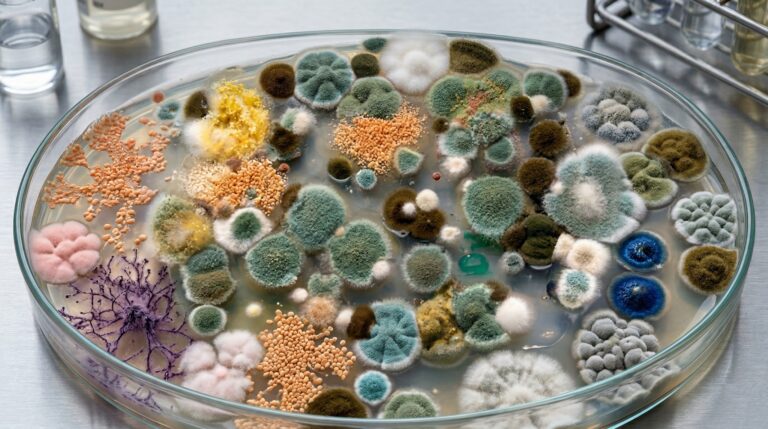
You see white fuzz on the seeds and immediately throw the tray out. In reality, in the first 2–3 days what looks like mould is almost always root hairs. These are fine white threads that emerge from the seeds and look fluffy — particularly on flax, basil, and rocket.
Root hairs are a good sign. They mean the seeds are actively germinating.
Real mould looks different: it is grey or green, appears on stems or substrate rather than on the seeds, and has a distinctive smell. The article on mould in microgreens covers how to tell the difference and what to do if mould does appear.
Mistake 7 — Harvesting Too Late or Too Early
The harvest moment is critical. Cut a day or two too early and the flavour is weak, the texture limp to the point of formlessness. Wait a week too long and stems toughen, leaf quality drops, and bitterness sets in.
Most crops are cut 7–12 days after sprouts emerge, when the cotyledon leaves have opened and the first true leaves are just beginning to appear. For pea and sunflower the signal is 8–12 cm height and firm, crunchy stems.
The simplest way not to miss the moment: pinch off a leaf and taste it. If the flavour is distinct and pleasant — time to cut. If it still tastes grassy and bland — give it one more day.
What Next
Most of these mistakes happen once and are never repeated. Microgreens are genuinely simple to grow — but only once you understand the basics around moisture, airflow, and timing.
If you have not yet decided where to start, browse the microgreens catalogue. For a first attempt, the easiest crops are sunflower, pea, and radish. They are fast, undemanding, and forgive almost every mistake on the list above.