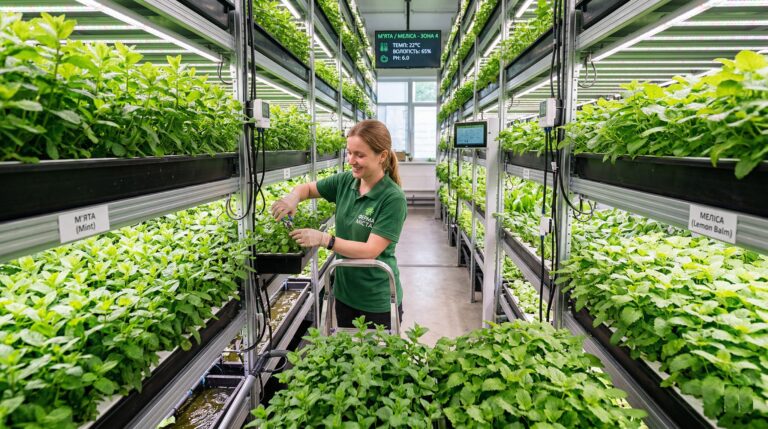
Manual vs automated pH dosing: for an 11-gallon (40 L) reservoir of lettuce, adjusting once a day is enough. In a study by Lithuanian researchers (Kudirka and co-authors, Horticulturae, 2023), lettuce grew in DWC tanks holding 40 L each, with 12 plants per tank. pH was corrected with acid or base once a day. Every day it drifted toward alkaline, but it never went past the top of a 0.5-unit window, right up to day 35 after germination, when the plants were harvested for analysis.
A ready-made automatic pH doser from Bluelab lists at $629, and a pH and EC system at $1,499. Below: when manual correction works, where it stops working, what a buffer in the solution does, and where to start if you do need automation.
Manual pH dosing: when once a day is enough
pH in hydroponics rises on its own: plants take up ions unevenly, and the solution gradually turns alkaline. Where that drift comes from, and why pH “bounces back” after acid, is explained in the wiki entry water alkalinity. The real question is speed. If pH can’t leave your target window within a day, automation adds nothing over a morning check and a measuring spoon of acid.
In the Kudirka study, each 40 L tank held 12 lettuce plants, so more than 3 L (about 0.8 gal) of solution per plant, and EC was kept at 1.3-1.6 mS/cm. Under those conditions, daily correction was enough. If your system has a similar volume per plant, manual dosing is a perfectly workable option.
Test it on your own reservoir for a week. Set pH in the morning, then log the reading in the evening and again the next morning before you correct it. If pH stays inside your window (say, 5.8-6.3) for 24 hours, you don’t need an automatic doser yet. How much acid a tank needs is what the hydroponic acid dosing calculator is for. It works out the dose from your water’s alkalinity, not from pH.
Manual dosing: where it stops working
Manual dosing runs out of room in four situations:
- Your week-long log shows pH leaving the window in less than a day. That happens when there are many plants and little solution, or when plants are in a fast-growth phase.
- You run several tanks. Each one means its own reading, its own dose, and its own log entry every day.
- There are days when nobody can get to the system: weekends, travel, illness.
- You need to hold EC as well: topping up with water and concentrate is a daily job too.
People tend to underestimate that last one. Plants drink water faster than they take up nutrients, so topping up with plain water “to the line” gradually shifts EC. How to top off by EC reading instead of by level is covered in the wiki entry top-off and flushing. Automatic top-off by EC takes that job off your hands; a pH-only doser doesn’t.
MES buffer: pH without daily correction
There’s a third option between manual correction and automation. In a second experiment by the same group, pH wasn’t corrected daily. Instead it was held back by MES buffer added to the solution at the start at 0, 1, 3, and 5 mM. The target window was 6.0-6.5.
- Without buffer, pH drifted out of the 6.0-6.5 range.
- 1 mM MES wasn’t enough to hold the window.
- 3 and 5 mM kept pH in the window. At 3 mM, leaf dry weight was 17% higher than without buffer.
There are limits. MES works best near its dissociation constant, 6.15 at 68°F (20°C), so it suits a 6.0-6.5 window and does less for lower targets. The authors note that buffering the nutrient solution is still rarely used in practice. This is one study on one lettuce cultivar (‘Hugin’), so test it on one tank next to a control before relying on it.
Automated dosing: what $629 buys you
Prices and features of Bluelab’s ready-made systems from the manufacturer’s website as of September 2026 (sale price at the time of checking in parentheses):
| System | What it doses | Price, $ |
|---|---|---|
| Bluelab pH Controller Wi-Fi | pH up or down, built-in peristaltic pump | 629 (566.10) |
| Bluelab Pro Controller Wi-Fi | pH and up to 12 nutrients through separate PeriPod pumps | 1,499 (1,349.10) |
| Bluelab IntelliDose Controller Kit | pH, separate day and night EC, lowers EC by adding water, up to 4 irrigation outputs | 1,499 |
Mostly, that money buys safeguards. According to the manufacturer, the pH controller holds pH within 0.1, has lockouts against overdosing, out-of-range alarms, and pauses for mixing between doses, and it resumes dosing on its own after a power outage. In a DIY controller, you’d have to write and test all of that yourself.
A homemade controller on an ESP32 or Arduino costs a fraction of that: in the SMART GROW project, all the hardware came to about $72. But it has its own traps, and the nastiest is that an EC sensor in the same tank interferes with the pH sensor. That, and choosing modules, is covered in Arduino pH and EC controller for hydroponics.
Automated dosing doesn’t replace checks
An automatic doser doses based on what its sensor reads. If the electrode is fouled and reads 7.5 when the real pH is 5.8, the pump will keep adding acid until a limit kicks in. So with automation you need to calibrate the pH electrode at least as often as with manual control, and keep buffer solution on hand. The procedure is in the wiki entry pH meter calibration. The limits and shutdown scenarios every doser needs are covered in the wiki entry pH and EC automation.
A manual reading every few days still has a place with automation: it checks the doser itself. If acid use suddenly goes up while the plants and recipe stay the same, look for the cause in the sensor, the water’s alkalinity, or a leak.
Manual vs automated dosing: how to decide
- One tank, pH stays in the window for a day, and you’re there every day: correct by hand once a day. In the lettuce study with 40 L tanks, that was enough through day 35.
- You hold pH at 6.0-6.5 and want fewer corrections: try 3 mM MES buffer on one tank.
- pH leaves the window in less than a day, or you’re away for days at a time: get an automatic pH doser.
- Several tanks, and EC has to be held too: a pH and EC system with top-off by EC. Ready-made ones start at $1,499; a DIY build is cheaper, but you write the safeguards yourself.