
Flavor profile
Taste & aroma
Spicy, sweet-bitter, bready - the same as caraway seeds, which are sprinkled on rye. Powerful, recognizable aroma.
the same as caraway seeds, which are sprinkled on rye. Deep, earthy, with warm notes
Powerful, recognizable - a mixture of anise, dill and something warm and "pharmacy". The main value of cumin is its aroma. It is formed only with the appearance of the first true leaf. At the cotyledon stage, microgreens smell just like grass — this is normal and does not mean a quality problem.
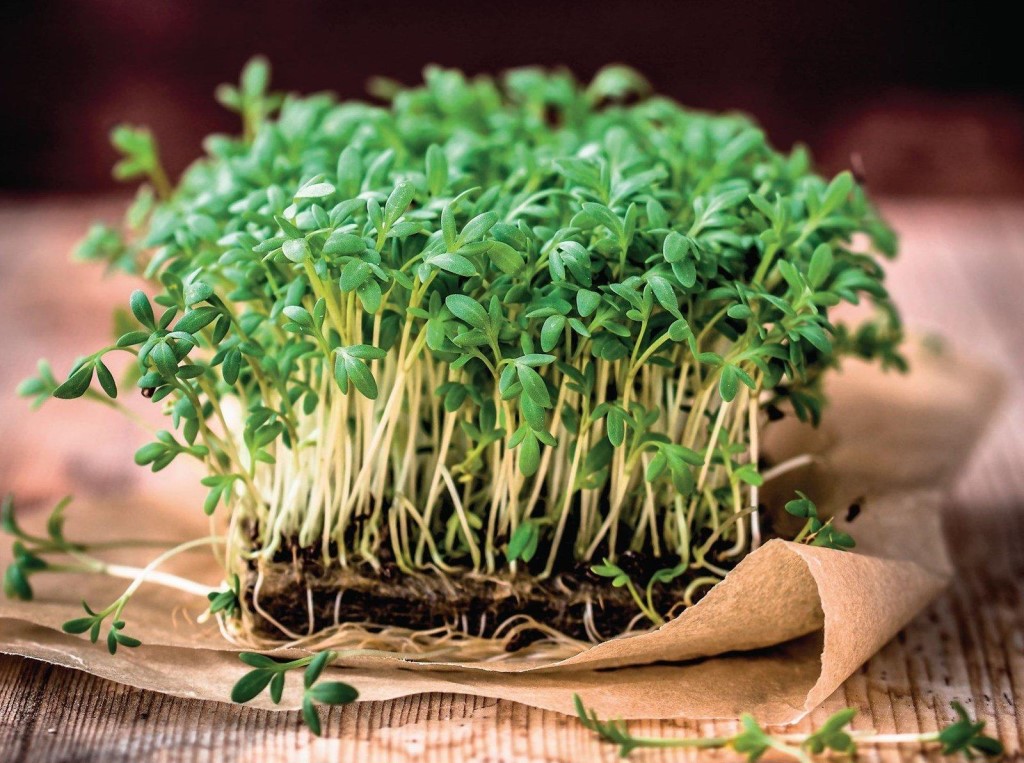
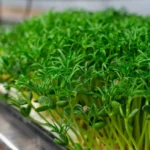
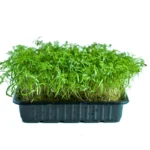
Gentle, thin elastic stems. The leaves are small, carved, similar to young dill or carrots at an early stage
Ripening and optimal harvest time
The cotyledons are narrow and long, the taste is neutral-herbaceous, the aroma of cumin is not yet present.
The first carved leaf appears, the characteristic spicy aroma is revealed - this is the moment of collection.
The aroma can become excessively sharp and "pharmacy".
Why flavor may vary batch to batch
The intensity of the characteristic cumin aroma (carvone and limonene) depends on lighting and temperature. At bright light and moderate temperature (+18...+22°C) more essential oils - the aroma is pronounced and rich. At low light or heat sprouts are drawn out and smell weaker. Cumin is a slow culture, quality is more important than speed.
Culinary use
How to use
Caraway is a great culinary accent. Add fresh at the end of cooking or directly on the plate.
Goulash or pork stew
a few stalks on top when serving — the aroma opens from the heat of the dish and replaces dry cumin
Baked camembert
cumin microgreens + honey + nuts nearby — a classic reinterpreted
Pumpkin cream soup
a drop of cream + cumin stalks — a deep spicy accent on a creamy background
Rye toast
butter + a few stalks of cumin — the taste of "Borodinsky" in a fresh version
Meat cuts or charcuterie
cumin as a live green garnish instead of dry spices
Cheese or feta
a piece of cheese + olive oil + cumin stalks — a simple and effective snack
Perfect pairings
A few stalks add an aromatic accent when served and emphasize the taste of the dish
Microgreens give a fresh take on this classic flavor
The aroma is fresher and more subtle than that of ground seeds
- Do not add in large quantities - cumin dominates and easily overpowers other flavors; it's a spice, not a salad green
- Do not use in sweet dishes, desserts or fruit smoothies - the combination is unpleasant
- Do not cut at the cotyledon stage - there is no aroma yet, the greens will be simply uninteresting
Home storage
How to store
Caraway keeps longer than most microgreens. Follow simple rules to keep it fresh for up to 9 days.
Refrigerator +4...+6°C. The term in the tray is 7–9 days. Cumin keeps its shape and aroma well even after cutting.
Open container or plate, refrigerator +4...+6°C. The term is 7–9 days. The aroma is preserved well.
Don't wash until ready to eat. Wet greens spoil much faster. Rinse just before serving.
Nutrients & health
Benefits & composition
Caraway is valued for its rich vitamin-mineral composition and bioactive compounds typical of microgreens.
Like most microgreens, caraway contains a concentrated amount of nutrients relative to its weight — many times more than the mature plant.
| Protein | 2.5 g — building material for cells |
|---|---|
| Calories | ~35 kcal |
| Vitamins | A, C |
| Minerals | Iron, Calcium, Potassium |
- Younger children usually do not like the specific spicy taste - it is better to start with more neutral cultures
- For people with individual sensitivity to umbelliferae (carrot, dill, parsley, coriander) - cumin belongs to the same family; it is worth starting with small amounts
This information is general in nature and is not medical advice. Composition data: USDA FoodData Central.
Worth knowing
Carvone and limonene essential oils
they give cumin its characteristic spicy aroma and are traditionally associated with digestion support - that is why cumin is traditionally served with fatty dishes in Central European cuisine.
iron
is contained in cumin in a quantity noticeable for a plant product. Vegetable iron is better absorbed in combination with vitamin C.
Vitamin C
present in fresh green cumin.
Antioxidants and biologically active substances
Microgreens are a concentrated source of antioxidants — compounds that are being studied in the context of protecting cells from oxidative stress. Regular consumption of a variety of microgreens is part of a balanced plant-based diet.
Caraway: how to grow — step-by-step guide
Growing parameters, agronomy, common mistakesGrowing parameters
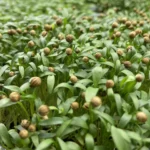
Ribbed, curved, brown - contains essential oils
Step-by-step guide
Seed preparation
Cumin seeds are hard, ribbed, curved - similar to a small sickle. Contains essential oils, which are both cultural value and natural inhibitors of germination. That is why cumin is the slowest and heaviest among the umbrella seeds.
Soaking is optional, not mandatory:
- No soaking: the steps are uneven, but there is no risk
- With soaking (4-6 hours in cold water): germination is accelerated, but there is a risk of souring if the time is exceeded or the water is warm. If soaking - only cold water, strictly no more than 6 hours, immediately sow after washing
If you decide to soak, add a pinch of citric acid to the water. Weak acidification inhibits pathogens and reduces the risk of acidification during soaking. After soaking, be sure to rinse and sow immediately.
Sowing
- Evenly moisten the substrate - it should be well saturated with moisture, but without puddles
- Spread the seeds evenly - 3-4 g per tray
- Lightly press the palm of your hand to contact the seed with the substrate
Due to the ribbed shape, the seeds may lie unevenly and stick together - it's not scary, but try to distribute them as evenly as possible.
Clamp — 1–2 kg
Clamping is critically important. The hard shell of cumin softens only with constant close contact with a moist substrate. Without clamping or with a weak clamping - stairs in "helmets" (the remains of the shell are not removed, because there is no corresponding pressure).
- Empty tray on top + 1–2 kg evenly
- Keep all 5-7 days of darkness without removal
Darkness (Blackout) — 5–7 days
The most important and longest stage for cumin.
The problem of "helmets": if the substrate dries out during darkness, the seed coat dries out and "cements" around the sprout. It is impossible to remove it by hand - the cotyledon comes off. Prevention: constant high humidity of the substrate throughout the darkness.
What is normal:
- Very slow growth - the first sprouts only on 3-4 days, this is the norm
- Uneven seedlings — germination is 70–80%, not all grains will germinate at the same time
What is NOT normal:
- Helmets on the sprouts → the substrate is dry. Moisturize abundantly and return under pressure for another day
- The smell of sourness → overhumidification or poor ventilation. Ventilate
Watering in the dark: mandatory when drying out — the lower one through the pallet. The substrate should always be moist, not dry.
Vegetation in the light — 10–14 days
Lighting:
- LED phytolamps: 16–18 hours a day
- Natural light: acceptable for cumin - the culture does not require intensity
- When there is a lack of light, the stems are elongated, but the aroma is formed from the content of essential oils, and not from lighting
Temperature: +18...+20°C is optimal. Cumin does not like heat. At +24°C and above, growth accelerates, but the aroma may become less balanced.
Watering: 1 time a day, lower through the pallet. Cumin is an umbrella crop with weak roots, does not tolerate "swamp".
Key point: the aroma and characteristic taste of cumin appear only with the first real carved leaf. Before that - neutral grass greens. Do not cut early, even if the greens look ready for height.
Watering
- Water it 1 time a day light watering (in the morning)
- Bottom or top watering is equally acceptable - moisten carefully
- Cumin is a slow grower, the substrate should dry out slightly between waterings
- A sign of lack: filiform sprouts begin to lie down → moisten gently
Storage
| Uncut in tray | Fridge +4...+6°C | up to 3 weeks |
|---|---|---|
| Cut in container | Refrigerator | up to 7 days |
| Room temperature | 1–2 days |
Harvest
- The first real carved leaf appeared - it looks like a young dill or carrot leaf
- When you touch a leaf, you can feel the characteristic spicy aroma of cumin
- Cotyledons are long, narrow - do not confuse them with a real leaf; cut after it appears
With scissors or a sharp knife, 1–1.5 cm above the level of the substrate. Cumin is delicate - it is cut easily, without effort. Do not crumple the stems: places damaged when cut turn sour faster and shorten the shelf life.
Rinse in cold water immediately before use or shipment. Dry on a towel or in a salad bowl. Pack only completely dry greens - moisture accelerates wilting and loss of aroma.
Seasonal adjustments
- Aroma: in the heat, essential oils are synthesized more intensively, but less balanced - sharper, without subtle notes
- Soaking: the risk of souring increases — it is better to sow dry or reduce soaking to 4–6 hours
- Placement: keep the tray in the coolest part of the room, away from direct sunlight
- Ventilation: when it is warm, it is more important - when cumin is thickened, it is prone to mold from below
- Cycle: can be shortened by 1-2 days - check readiness more often
- Aroma: best season — coolness gives the most balanced and pleasant cumin profile
- Cycle: can be extended for 2–3 days at +16°C — do not rush to cut
- Heating: if the temperature is below +16°C, heating the substrate with a thermostat significantly accelerates germination
Water pH and EC
The optimal range for cumin: 6.0–7.0. Cumin is relatively undemanding to pH. Normal tap water is fine. Germination slows down at pH below 5.5.
Optimal range: 1.0–1.5 mS/cm. Cumin is undemanding to nutrition. The main quality factor is lighting, not the mineral composition of the water.
Experienced grower tips
Moisture is the main parameter for cumin
Not lighting, not temperature, but constant humidity of the substrate in the dark. Drying even for a few hours gives helmets from which there is no escape. Check the tray daily.
Niche product — niche price
The long cycle (18–22 days) and low yield (~15–25 g) make cumin expensive to produce. Position as a premium spice for restaurants and gourmets - not for mass sale.
Restaurant format
Chefs who cook Central European or Scandinavian cuisine will appreciate the fresh microgreens of cumin. This is a product for targeted HoReCa sales, not for retail.
Combine the cotyledons and true leaf
If part of the tray is still at the cotyledon stage, and part already has the first leaf, cut the entire tray. The difference in aroma between early and late sprouts in the mix becomes an advantage.
Agronomy notes and common mistakes
- Sowing: No soaking. Medium density. Small seeds are evenly spread over the surface.
- Clamp: No clamping or very light.
- Temperature: +16...+20°C. Cumin is a cold-resistant crop that does not need heat.
- Watering: 1 time a day, carefully. Cumin does not like excess moisture.
- Ventilation: moderate Tender cumin sprouts need protection from strong drafts.
- Drying of the substrate in the dark → Caps on the sprouts, cotyledons do not open → Maintain constant humidity of the substrate throughout the darkness
- Weak grip → Helmets, uneven stairs → 1–2 kg, the entire period of darkness
- Early sunrise → Sprouts in helmets, growth stop → Wait full 5–7 days in the dark
- Section at the cotyledon stage → No cumin aroma, neutral grass → Wait for the first real leaf
- Expecting a quick result → Frustration, premature ejection of the tray → 18-22 days is a normal cycle for cumin
- Soaking for more than 6 hours → Souring, death of seeds → Strictly up to 6 hours, only cold water
Variety selection
Seed cumin
Arrow, Eagle, Sand
A standard choice for microgreens. Anise-cumin aroma, uniform germination.
Cultural varieties
Humenskyi, Shabskyi
A slightly higher yield of green mass. The taste is identical, but the seedlings are more even if the seeds are stored correctly.
Що далі?
More crops in the catalog
Explore similar and contrasting flavors — from basil to amaranth