
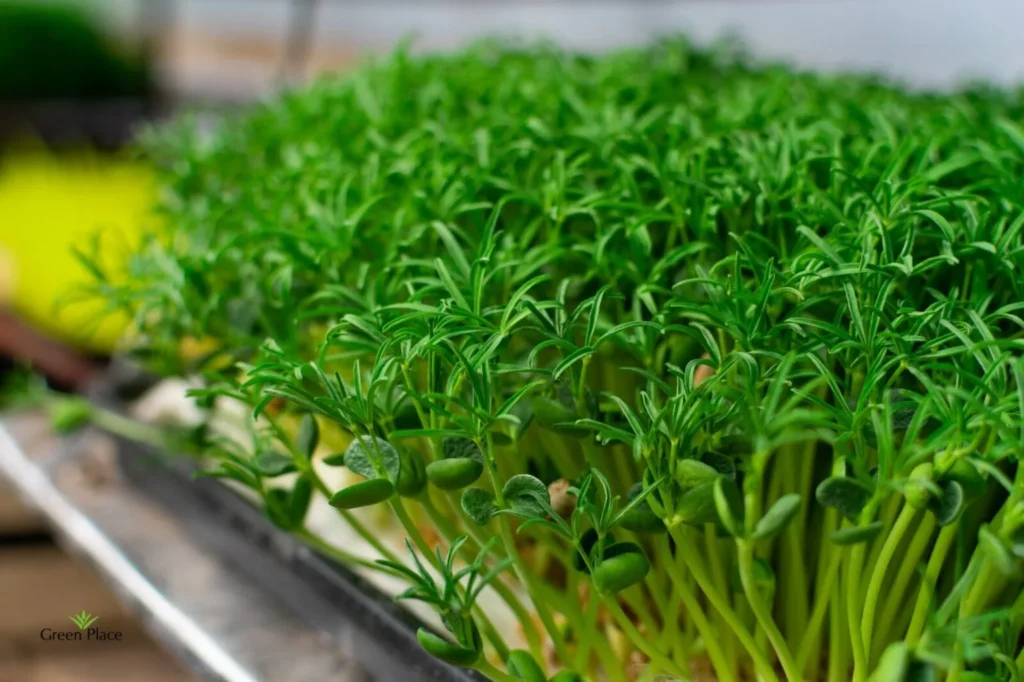
Flavor profile
Taste & aroma
Nutty, leguminous, sweet - somewhat reminiscent of almonds or young peas, but denser and deeper. Fresh, herbal and bean aroma.
somewhat reminiscent of almonds or young peas, but denser and deeper. Without bitterness (if the variety is chosen correctly - only sweet lupine)
Fresh, grassy and leguminous, unobtrusive. It is easily felt when slicing, but does not dominate the plate.
The main difference from all other microgreens. Very dense, crispy, juicy - needs real chewing
Ripening and optimal harvest time
The cotyledons open, the taste is delicate, the nutty note just appears.
Optimum: large open cotyledons, maximum juiciness and crunch, full bean flavor.
The stem begins to become woody, the texture becomes hard, the taste acquires a grassy bitterness.
Why flavor may vary batch to batch
The bitterness of lupine depends on the content of alkaloids (lupanine, etc.) in the seeds. At soaking seeds for 12–24 hours part of the alkaloids is released into the water - the bitterness decreases. At cool cultivation (+16...+18°C) sprouts are denser and less prone to wilting. The growing temperature has little effect on the alkaloid content — it is contained in the seeds.
Culinary use
How to use
Lupin is a great culinary accent. Add fresh at the end of cooking or directly on the plate.
Brutal salad
lupine + steak slice + cherry tomatoes + parmesan + balsamic dressing — a complete meal, where microgreens play the role of not a side dish, but the basis
Olivier of a new generation
lupine instead of peas. The same bean character, but more interesting
Burger
a lupine between a cutlet and a bun instead of an iceberg — crunch and protein in one
Edamame is an alternative
lupine + salt + lemon + olive oil. A simple and hearty snack
Bowl
lupine as a base + avocado + poached eggs + seeds — a complete protein lunch
Warm salad
some fried mushrooms + lupine + goat cheese — the texture of the lupine does not soften immediately from the heat, it keeps its shape
Perfect pairings
Steak, burger, bowl — the best combinations
Lupine is a rare microgreen that does not get lost next to heavy meat and bacon as an equal component
Lupine gives a similar texture, but a brighter nutty flavor
- Don't expect tenderness or a "melting" texture — lupins need to be chewed, that's their nature
- Do not use in dishes where you need light airy greens - here lupine will be too heavy
- Do not buy seeds without marking "sweet" or "food" - bitter varieties make the product inedible
Home storage
How to store
Lupin keeps longer than most microgreens. Follow simple rules to keep it fresh for up to 12 days.
Refrigerator +4...+6°C with ventilation. The term in the tray is up to 12 days. Thanks to the thick stem, lupine does not wither for a long time.
Semi-open container (needs ventilation), refrigerator +4...+6°C. The term is 10–12 days. Due to the large mass of the cut product, avoid hermetically closing - moisture accumulates and accelerates spoilage.
Don't wash until ready to eat. Wet greens spoil much faster. Rinse just before serving.
Nutrients & health
Benefits & composition
Lupin is valued for its rich vitamin-mineral composition and bioactive compounds typical of microgreens.
Like most microgreens, lupin contains a concentrated amount of nutrients relative to its weight — many times more than the mature plant.
| Protein | до 7 г g — building material for cells |
|---|---|
| Vitamins | A, C |
| Minerals | Вітамін PP (нікотинова кислота), Potassium, Calcium, Magnesium |
| Fiber | high concentration |
- People with allergies to legumes (peanuts, soybeans, peas) - lupine belongs to the same family; there are documented cases of cross-allergy. Start with a small amount the first time you use it
- Lupine is one of the 14 main allergens according to the EU classification - if you are cooking for others, you should be warned
This information is general in nature and is not medical advice. Composition data: USDA FoodData Central.
Worth knowing
Record content of vegetable protein
Among all legumes, lupins have the highest ratio of protein to carbohydrates. Up to 7 g of protein per 100 g of fresh greens is exceptionally high for microgreens. A complete addition to the diet for those looking for vegetable sources of protein.
Low glycemic index
Lupine is low in carbohydrates and high in fiber, a combination traditionally associated with slow digestion and long-lasting satiety.
Fiber
in lupine is higher than in most microcultures — it is traditionally associated with the support of digestion and intestinal work.
Antioxidants and biologically active substances
Microgreens are a concentrated source of antioxidants — compounds that are being studied in the context of protecting cells from oxidative stress. Regular consumption of a variety of microgreens is part of a balanced plant-based diet.

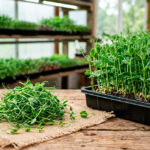

Lupin: how to grow — step-by-step guide
Growing parameters, agronomy, common mistakesGrowing parameters
Very large, bean-like, hard
Step-by-step guide
Seed preparation
Lupine seeds are large and hard - one of the largest among microcultures. Without soaking - sow dry on abundantly moistened substrate.
Why not soak: the hard shell of lupine softens directly on a wet substrate under pressure. Soaking before sowing does not give advantages and makes it difficult to evenly distribute large seeds.
After spreading the seeds and before setting the clamp, generously spray the seeds with water from a spray bottle. The initial moistening accelerates the softening of the hard shell and the start of germination.
Sowing
- Moisten the substrate evenly - it should be well saturated
- Spread the seeds evenly in one layer — 30 g it's quite dense, but lupine needs seed contact for stability
- Sprinkle the seeds on top
- Install the clamp immediately - large seeds will roll around the box without fixation
Substrate: coconut or peat - you need a layer at least 2-3 cm deep for powerful taproots. Lupine will be unstable on a thin linen mat.
Clamp — 2 kg
The maximum weight among all microcultures — and this is not reinsurance. The tap root of the lupine literally lifts the substrate from below during germination. Without heavy pressing:
- the seeds roll on the tray
- the substrate is broken and deformed
- the stairs are uneven, the plants fall
- Empty tray on top + 2 kg evenly
- Keep all 4-5 days of darkness
Darkness (Blackout) — 4–5 days
What is normal:
- Slow start - large seeds germinate in 2-3 days, this is the norm
- Even strong sprouts supporting the clamp from below are a sign of strong growth
What is NOT normal:
- Mold on seeds or stalks → main risk due to dense sowing and large mass. The reason is excess moisture or poor air exchange. Ventilate, reduce humidity
- Unmoistened seeds do not germinate on the 4th day → insufficient moisture at the start. Bottom watering through a pallet
Watering: 1 time in the dark when drying - only the lower one through the pallet.
Vegetation in the light — 6–8 days
Ventilation is the most important parameter:
Due to the large mass of greenery and dense planting, air does not circulate well inside the "forest". These are ideal conditions for mold on stems. Constant blowing with a fan or daily intensive ventilation are mandatory conditions.
Lighting:
- LED phytolamps: 16–18 hours a day
- Natural light: acceptable — lupine is undemanding to intensity
Temperature: +18...+22°C. Lupine grows in a wide range.
Watering: only the bottom through the pallet. Water on the stems and in the axils of the leaves is a risk of rotting. Moderate - excess moisture with dense planting of lupine is especially dangerous.
Watering
- Water it 1-2 times a day (in the morning - necessarily, in the evening - if necessary)
- Lower watering (through a pallet) is better, more uniform
- Lupine is an active consumer of moisture, similar to peas and fava beans
- A sign of lack: large leaves hang down, stems become soft → water urgently
Storage
| Uncut in tray | Fridge +4...+6°C | up to 3 weeks |
|---|---|---|
| Cut in container | Refrigerator | up to 7 days |
| Room temperature | 1–2 days |
Harvest
- Large cotyledons have completely opened
- The stem is juicy, not yet woody
- Do not wait for a real leaf - the stem is already becoming hard
Sharp knife under the root. The stem is thick and crunchy - it takes effort to cut compared to most microcultures.
In a semi-open container, due to the large mass of the product, ventilation is required, otherwise condensation will spoil the bottom layer.
Seasonal adjustments
- Mold: the risk increases due to heat and dense planting — ventilation becomes critical
- Collection: shorten the cycle by 1-2 days - cut earlier, while the stem is still juicy
- Watering: reduce the frequency - moisture + heat = perfect environment for fungus
- Placement: move the trays to the coolest part of the room
- Blackouts: do not delay more than 4 days - in the heat, the seeds overheat in the dark
- Mold: the coolness naturally reduces the risk—one of the few cases where winter is better than summer
- Cycle: may be extended by 1-2 days due to slower growth - take your time to cut
- Heating: if the temperature is below +14°C, heating the substrate accelerates soaking and germination
Water pH and EC
The optimal range for lupine: 6.0–7.5. Lupine is relatively undemanding to pH - in nature it grows even on poor acidic soils. Regular tap water is fine.
Optimal range: 1.0–1.5 mS/cm. Lupine, as a legume, fixes nitrogen and is undemanding to mineral nutrition. In substrate cultivation, EC is not critical.
Experienced grower tips
Yield of 200+ g is the main commercial argument
Lupine gives 5-10 times more product per tray than small-seeded crops. With proper pricing, this is one of the most profitable crops in terms of the cost of 1 kg of the finished product.
Seeds are half the battle
Do not skimp on seed quality. Check the supplier, ask for confirmation of the variety. One tray of bitter lupine is not just a loss of product, it is a reputational risk when selling.
A fan is a must-have tool
When growing lupine, regular airing is not an option, but a necessity. Even a USB desk fan several times a day significantly reduces the risk of mold.
Half-open packaging at the time of sale
The mass of the product in a closed package causes condensation and spoils the bottom layer. Perforated or semi-open containers are the only correct format for cut lupine.
Agronomy notes and common mistakes
- Sowing: Soaked (8–12 h) lupine - in one dense layer. Large seeds - take the volume into account when calculating the quantity.
- Clamp: 2–3 kg evenly, 2–3 days. Large seeds need a firm grip to sink the root into the substrate.
- Temperature: +18...+24°C. Lupine tolerates moderate temperatures well; above +26°C it is possible to pull out the stems.
- Watering: 1-2 times a day, the lower one is a priority. Lupine drinks a lot - do not let the substrate dry out.
- Ventilation: moderate Large lupine leaves need air movement to prevent mold under the canopy.
- A bitter variety of seeds → The product is inedible due to strong bitterness → Only sweet / edible lupine from a verified supplier
- Weak grip → Seeds roll out, substrate breaks, plants fall → 2 kg — no compromises
- Insufficient hydration at the start → The hard shell does not soften, the seeds do not germinate → Abundant spraying after sowing + bottom watering
- Poor ventilation → Mildew on stems and leaves → Constant blowing, daily ventilation
- Top watering → Rotting of the stem and axils of the leaves → Only lower watering through a tray
- Late collection → Hard woody stem → Cut when the cotyledons are open, do not wait for a real leaf
Variety selection
Lupine is white
Belosnizhny, Start, Milena
The best choice. Large yield of mass, pronounced nutty taste, even germination.
Narrow-leaved lupine (blue)
Meteor, Crystal, Snigur
Smaller seeds, but straighter seedlings. The taste is identical - nutty and bean profile.
Що далі?
More crops in the catalog
Explore similar and contrasting flavors — from basil to amaranth