
Flavor profile
Taste & aroma
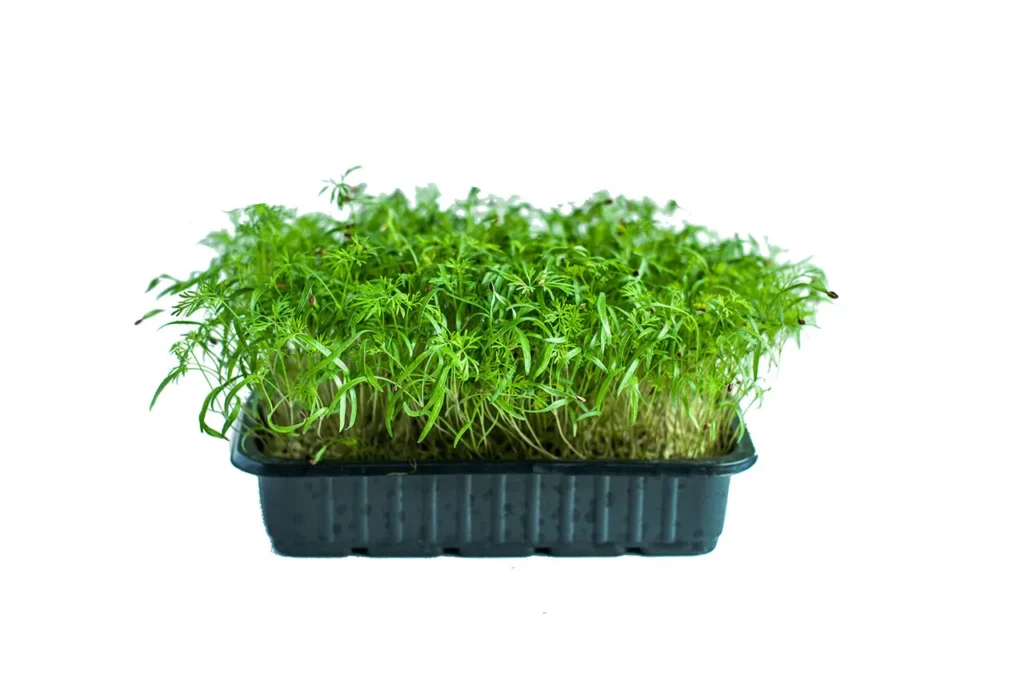
Spicy, fresh, aniseed — Clean, sweet-spicy, without the bitterness of an adult plant. Intense, spicy aroma.
Clean, sweet-spicy, without the bitterness of an adult plant. The essential oils in micro dill are more concentrated, but without the harsh "soapy" finish that overgrown dill sometimes gives
Intense, spicy, dill - it opens immediately when cut, even a small handful noticeably aromatizes the dish.
Gentle, Thin, Soft - they are put whole. The stem is thin and juicy, completely edible
Why flavor may vary batch to batch
The intensity of the dill aroma (carvone and phellandrene) depends significantly on the conditions. At bright light and a temperature of +18...+22°C the aroma is rich and characteristic. At low light or heat above +24°C sprouts are pulled out and smell more neutral. Dill is a slow crop (10-14 days) and quality is highly dependent on the patience of the grower: premature cutting produces pale greens with no flavor.
Culinary use
How to use
Dill is a great culinary accent. Add fresh at the end of cooking or directly on the plate.
New potatoes with butter
a handful of micro dill instead of ordinary dill: the aroma is the same, but the texture is more delicate and the greens do not stick together
Toast with salmon and cream cheese
micro dill on top instead of lemon juice: spicy accent without acid, looks restaurant-like
Okroshka and cold soups
throw in a plate before serving. In a cold environment, the aroma of dill becomes fresher and more distinct
Tzatziki or cucumber sauce
mix micro dill into yogurt with cucumber and garlic. More delicate texture than chopped dill, uniform aroma
Eggs in any way
scrambled eggs, scrambled, poached, boiled. Dill and eggs are a win-win combination for breakfast
Fish soup or soup
add to the plate after pouring, do not boil. The preserved aroma of essential oils is strikingly different from boiled dill
Perfect pairings
Dill and cucumber are a classic pairing that needs no explanation
Жирна риба і кріп — один із найстійкіших гастрономічних союзів у слов'янській і скандинавській кухнях
Кріп у молочних соусах розкривається краще, ніж у будь-якому іншому контексті — Дзадзикі, соус тартар, кропова сметана
- Do not boil or stew: essential oils of dill evaporate instantly when heated, leaving only herbaceous bitterness without aroma.
- Do not mix with very acidic dressings: vinegar and lemon juice "extinguish" the delicate aroma of micro dill. If acid is needed, add minimally and at the last moment.
- Do not combine with sweet fruits: dill in fruit salads or desserts gives a strange conflict of flavors, unlike mint or basil.
- Do not interrupt with coriander or basil: if dill is in the dish, other intensely spicy greens will destroy its subtle flavor.
Home storage
How to store
Dill keeps longer than most microgreens. Follow simple rules to keep it fresh for up to 3 weeks.
Don't cut more than you plan to eat right away. Store in refrigerator at +4...+6°C. No watering needed — natural moisture is enough.
Place in an open container or plate, cover with a damp paper towel. Don't seal — without air, greens yellow faster.
Don't wash until ready to eat. Wet greens spoil much faster. Rinse just before serving.
Nutrients & health
Benefits & composition
Dill is valued for its rich vitamin-mineral composition and bioactive compounds typical of microgreens.
Like most microgreens, dill contains a concentrated amount of nutrients relative to its weight — many times more than the mature plant.
| Protein | 2.5 g — building material for cells |
|---|---|
| Calories | ~34 kcal |
| Vitamins | C |
| Minerals | Potassium |
- There are few specific restrictions for dill as a microgreen — the culture is safe for most people
- People with individual sensitivity to umbelliferous essential oils (Apiaceae: dill, parsley, cumin, fennel, coriander) should start with small amounts
- Dill is traditionally considered to be moderately stimulating for digestion - in culinary portions, this is the norm
This information is general in nature and is not medical advice. Composition data: USDA FoodData Central.
Worth knowing
vitamin A
Dill is a source of vitamin A in significant concentration - more than most leaf crops. It is traditionally included in the diet as part of a variety of green food.
caravan
Dill essential oils, in particular carvone, are traditionally associated with stimulating digestion and reducing the feeling of heaviness after eating. That is why dill as a spice and as an herb accompanies fatty dishes in many culinary traditions - from Scandinavian to Ukrainian-Polish.
calcium and magnesium
It is a source of calcium and magnesium — minerals that are involved in the work of muscles and the nervous system. Suitable as part of a diverse plant diet.
Antioxidants and biologically active substances
Microgreens are a concentrated source of antioxidants — compounds that are being studied in the context of protecting cells from oxidative stress. Regular consumption of a variety of microgreens is part of a balanced plant-based diet.
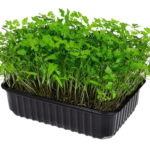
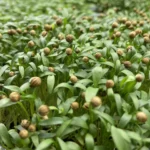
Dill: how to grow — step-by-step guide
Growing parameters, agronomy, common mistakesGrowing parameters
Medium, ribbed, saturated with essential oils
Watering
- Water it 1 time a day (in the morning) with light watering
- Bottom or shallow top watering is equally acceptable
- Dill is slow, but unpretentious: do not overmoisturize
- A sign of lack: threadlike leaves dry at the tips → water and check moisture
Storage
| Uncut in tray | Fridge +4...+6°C | up to 3 weeks |
|---|---|---|
| Cut in container | Refrigerator | up to 7 days |
| Room temperature | 1–2 days |
Harvest
Two options — depending on the purpose:
- Cotyledon stage (10–12 days): long juicy filamentous cotyledons, delicate taste, maximum delicate texture - for restaurant serving
- The first leaf (14–16 days): the first lacy leaf appeared, the appearance of "real dill", the maximum aroma - for retail sale
With scissors, very carefully - dill stalks are the thinnest among all crops, they tear from sharp movement. Cut in small bunches, do not pull.
Rinse in cold water, shaking slightly - do not rub, the feathers will stick together. Dry naturally on a towel. Do not centrifuge. Pack immediately - dill wilts quickly.
Seasonal adjustments
- Stem: in the heat it becomes even thinner and prone to lying down - reduce the blackout to 4 days
- Collection: cut a little earlier - in the heat, the stem thickens faster
- Ventilation: strengthen it - the thin, dense carpet of dill molds faster in the heat
- Watering: water in the evening - there is less risk of moisture stagnation at night
- Height: germination is accelerated, but quality may be inferior to the cool season
- Similarity: in the cold, the essential oils in the seed coat are less soluble - pre-moistening before sowing is mandatory
- Heating: a thermomat significantly improves germination — without it, the culture is unstable in winter
- Cycle: may be extended by 2-3 days - do not rush to open the tray
Water pH and EC
The optimal range for Dill: 5.5–7.0. Dill is unpretentious to pH. The Umbrella family tolerates a neutral and weakly alkaline environment well.
Optimal range: 1.0–1.8 mS/cm. Moderate mineralization is optimal. A long cycle (10–14 days) is an advantage of clean water.
Experienced grower tips
Moisten the seeds before sowing - always
30 seconds in a bowl with a sprayer radically changes the appearance. Dill essential oils are a natural protective barrier, and it must be "broken" before entering the substrate.
Two "couples" before going out into the world
One hydration on the last day of the blackout is standard. But if you do it twice with an interval of 2-3 hours, the "caps" will be noticeably smaller. The time spent pays off with a good product.
Dill is a culture for assortment, not for volume
Output of 10 g is the norm and the ceiling. Do not try to increase the seeding rate to get more mass: more seeds will give more problems, not more greens. The price of dill should reflect the difficulty of growing it.
Advertise two stages of collection
The cotyledon stage (thin filamentous cotyledons) and the first leaf stage (lace dill) are two different products for different customers. Restaurants often value the early harvest for a sophisticated presentation.
Bright light is not a wish, but a condition
Dill does not stand upright without sufficient lighting. If there are doubts about the brightness of the lamp, check with a dill tray: if it stands straight, there is enough light.
Agronomy notes and common mistakes
- Sowing: No soaking. Medium-high density. Small seeds evenly.
- Clamp: Without clamping.
- Temperature: +18...+22°C. A moderate temperature is ideal.
- Watering: 1 time a day. Dill is not picky about watering.
- Ventilation: moderate
- Dryness of the substrate under pressure → Seeds do not germinate for weeks → Check the humidity on the 3rd day and moisten through the edges without lifting the clamp
- Coming to light with "caps" → The shells have dried on the leaves, it is impossible to remove them → Mandatory "steaming" on the last day of the blackout — moisturizing + a few hours under the lid
- Insufficient lighting → Stems are thin, elongated, "threads", fall → Bright lamp at a distance of 20–25 cm, at least 14–16 h/day
- Cutting at the cotyledon stage for shredding → Greens "do not look like dill", there is no demand → Wait for the first lacy leaf - another 4-5 days
- Too dense seeding (>2 g) → Accumulation, mold in the dark, lying down → 1 g is the norm and maximum for dill
- Delay in packaging after cutting → Greens wither before sale → Pack in an airtight container immediately after cutting and drying
Variety selection
Common dill
Hrybovskyi, Amazon, Zontyk
A classic choice. Pronounced dill aroma, even stairs, stable similarity.
Curly dill
Buyan, Accurate
More decorative leaves, similar taste. Useful for restaurant serving where the appearance of greenery is important.
Що далі?
More crops in the catalog
Explore similar and contrasting flavors — from basil to amaranth