
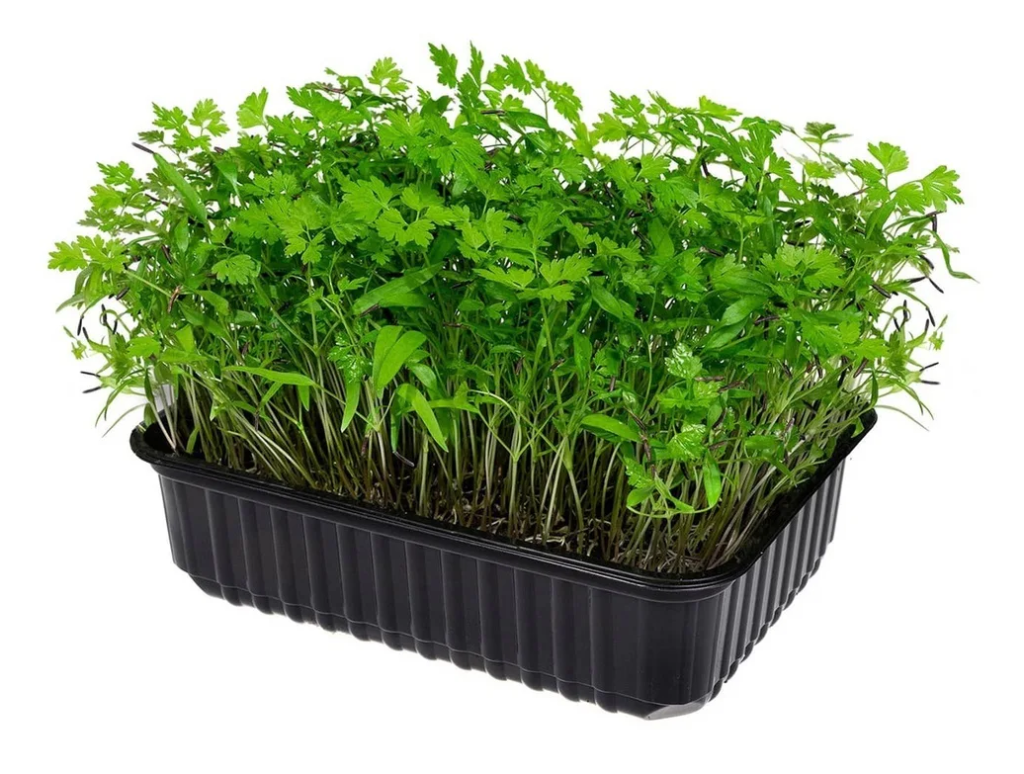
Flavor profile
Taste & aroma
Soft, grassy, sweet - without the bitterness of mature greens. Clean, grassy aroma.
without the bitterness of adult greens. More concentrated and fresher than store-bought parsley
Clean, grassy, recognizable - the classic smell of fresh parsley with a light citrus note, opens when cut and does not spread without mechanical impact.
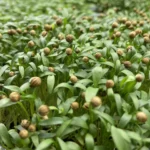
Tender, Soft, Juicy - without hard fibers and petioles. The carved leaf is the main decorative feature
Why flavor may vary batch to batch
Parsley is one of the slowest microgreens (14-18 days). The intensity of the aroma (apiol and myristicin) depends on the lighting and time of cutting. At bright light and a temperature of +18...+22°C the aroma is rich. At weak light sprouts are pulled out and smell neutral. Do not cut before 14 days - younger sprouts do not have a characteristic parsley taste.
Culinary use
How to use
Parsley is a great culinary accent. Add fresh at the end of cooking or directly on the plate.
Chicken broth or borscht
a handful of parsley on a plate when serving — aroma on the first spoonful
Poached eggs on toast
parsley on top + a drop of olive oil — a simple and good breakfast
Steak or fish
a few twigs nearby when serving - instead of dry greens from a bunch
Green oil
butter + parsley microgreens + garlic + lemon zest. Grind, wrap, cool
Parsley pesto
parsley + pine nuts + parmesan + olive oil + lemon - milder than basil
Baked potatoes
parsley + sour cream on top is a classic that cannot be spoiled
Perfect pairings
Add to the plate before serving - the aroma is revealed by the heat of the dish, it does not boil
Omelet, scramble, poached eggs — a classic combination, where the microgreens of parsley look neater and more delicate than chopped adult greens
Parsley pesto (instead of or with basil), green butter, chimichurri, salad dressing - parsley as the base green ingredient
- Do not cut the cotyledons at the stage - they have neither the aroma nor the appearance of parsley
- Do not add to the dish during long cooking - the essential oils evaporate, leaving only the green color
- Do not replace coriander or chervil with parsley - the taste is radically different despite the similar appearance
Home storage
How to store
Parsley keeps longer than most microgreens. Follow simple rules to keep it fresh for up to 14 days.
Refrigerator +2...+6°C. The term is up to 14 days. Cut before serving.
Place in an open container or plate, cover with a damp paper towel. Don't seal — without air, greens yellow faster.
Don't wash until ready to eat. Wet greens spoil much faster. Rinse just before serving.
Pro tip: Parsley is the absolute champion of freshness among microgreens. 14+ days in the refrigerator without noticeable loss of appearance and aroma. That is why a long growing cycle is justified from a commercial point of view - the product is in no hurry to spoil.
Nutrients & health
Benefits & composition
Parsley is valued for its rich vitamin-mineral composition and bioactive compounds typical of microgreens.
Like most microgreens, parsley contains a concentrated amount of nutrients relative to its weight — many times more than the mature plant.
| Protein | 3.7 g — building material for cells |
|---|---|
| Calories | ~36 kcal |
| Vitamins | K, C, A |
| Minerals | Potassium, Iron, Calcium |
- People taking blood thinners — because of the very high vitamin K content, should stick to a moderate amount and consult a doctor
- Pregnant - Parsley in cooking amounts (as a seasoning) is safe for most people. Use in large quantities as a dietary supplement - it is worth discussing with a doctor, since the essential oils of parsley in large doses have a tonic effect
- In kidney diseases - in large quantities, parsley has a mild diuretic effect; for specific purposes, check with your doctor
This information is general in nature and is not medical advice. Composition data: USDA FoodData Central.
Worth knowing
Vitamin C
Parsley contains a significant concentration — higher than in most vegetables. Fresh microgreens of parsley are a good plant source of this vitamin.
Vitamin K
found in parsley in a very noticeable amount - one of the highest concentrations among green microgreens. It is traditionally associated with the support of blood vessels and bone tissue.
Potassium
(~480 mg per 100 g) is a significant plant source of this mineral, which is traditionally associated with the support of the cardiovascular system.
Chlorophyll
parsley has more of it than most microcultures. It is he who gives a bright green color and is traditionally considered a natural freshener.
Parsley: how to grow — step-by-step guide
Growing parameters, agronomy, common mistakesGrowing parameters
Hard shell, ethereal
Step-by-step guide
Soaking — 12–24 hours
Parsley seeds have a hard shell saturated with essential oils — apiol and myristicin. They are natural inhibitors of germination and block the flow of moisture to the embryo.
Soaking technology:
- Pour warm water +40...+50°C over the seeds in a small container
- Leave for 12-24 hours - water washes out some of the essential oils from the shell
- Drain the water, wash the seeds and sow immediately
Change the water 1-2 times during soaking - the first water will turn yellow from the essential oils, this is normal. Fresh water continues the process better. Do not use water from soaking for irrigation - it contains inhibitors.
Sowing
- Moisten the substrate evenly - it should be well saturated
- Spread the seeds evenly after soaking — 1.6–2.0 g
- Press lightly with the palm of your hand
Do not thicken: Parsley with dense sowing and poor ventilation is prone to rotting. The norm of 1.6–2.0 g is optimal.
Clamp - 1.5 kg
The clamp performs a double role: it helps the seed to "bite" into the substrate and helps to shed the hard seed coat ("helmet"). If the helmet remains on the leaf, it is almost impossible to remove it by hand without damaging the sprout.
- Empty tray on top + ~1.5 kg evenly
- Keep all 6-8 days of darkness
Darkness (Blackout) — 6–8 days
The main trap is impatience. Parsley "thinks" for a long time. The first sprouts can appear only on the 5-7th day - even after soaking. Growers who do not know this throw away the tray on the 4th day, considering the crop dead.
What is normal:
- Absence of shoots on the 3rd-4th day is the norm for parsley
- Uneven stairs - parsley sprouts in waves
- Individual "helmets" on the sprouts are some remnants of the shell
What is NOT normal:
- Mold with an unpleasant smell → excess moisture or poor ventilation. Ventilate
- Complete lack of germination on day 9-10 → check seed quality or soaking
Watering: moderate lower watering when dry. Parsley does not drink water as quickly as sunflower or peas - the risk of overflow is higher than drying out.
Vegetation in the light — 12–16 days
Lighting:
- LED phytolamps: 16–18 hours a day
- Natural lighting: acceptable, but the cycle is lengthened
Temperature: +20...+24°C is optimal for start and growth. Parsley is cold-resistant, but it needs warmth for a good growth rate.
Watering: moderate lower through pallet. Parsley does not drink much - check the substrate before watering, and do not water according to the schedule.
Ventilation: required daily. A long cycle and moderate humidity are conditions for mold in stagnant air.
Key point: the aroma and recognizable appearance of parsley appear only with the first carved leaf - just like cumin and mizuna. At the cotyledon stage, they are just green sprouts with no identity. Endure until the end.
If part of the tray lags behind, do not rush to cut it. Parsley is cooked unevenly. Wait until 70-80% of the plants have the first carved leaf and cut the whole tray - the difference in taste between the early and late sprouts in the mix is not noticeable.
Watering
- Water it 1 time a day (in the morning)
- Bottom or careful top watering - the substrate should not dry out
- Parsley is slow-growing: maintain consistent moisture for 10-14 days
- A sign of lack: openwork leaves begin to dry from the tips → water and maintain humidity
Storage
| Uncut in tray | Fridge +4...+6°C | up to 3 weeks |
|---|---|---|
| Cut in container | Refrigerator | up to 7 days |
| Room temperature | 1–2 days |
Harvest
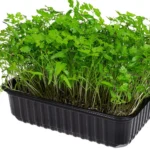
- The first real carved leaf has completely unfolded
- When touched, the characteristic aroma of parsley is felt
- Height 6–8 cm
A dry, clean knife. The stems are thin and easy to cut.
Immediately before use or sale.
Seasonal adjustments
- Cycle: shortened by 2-3 days - in warm weather, parsley grows more evenly, but watch for overripe shoots
- Mold: the risk increases - parsley is slow, and a long blackout phase in warm and humid conditions provokes mold
- Ventilation: open the tray 1-2 times a day for the first 5 days - ventilation is more important than for fast cultures
- Watering: reduce the rate - the substrate dries out noticeably, but overflow in the heat is more dangerous
- Aroma: may become sharper when warm—pick a little earlier for a milder flavor profile
- Cycle: extends to 26-28 days - put in the schedule with a margin, parsley does not tolerate a rush
- Mold: the coolness reduces risk, one of the few advantages of winter for this slow-growing crop
- Aroma: when grown cool, more balanced and less harsh - winter parsley is often better in quality
Water pH and EC
The optimal range for parsley: 6.0–7.0. Parsley is not picky about pH. Normal tap water is fine. At a pH below 5.5, germination slows down.
Optimal range: 1.0–1.5 mS/cm. Parsley is undemanding to nutrition. The main quality factor is lighting and growing time, not the mineral composition of the water.
Experienced grower tips
Lightness is the main commercial argument
14+ days in the refrigerator is a record among microgreens. For customers who buy once a week, parsley is ideal: they will definitely have time to use it. Emphasize this when selling.
Soaking + warm water = competitive advantage
Most home growers do not know about soaking and get uneven growth in a month. The right technology is 18-24 days instead of 30+. The difference is fundamental for business.
Double sowing every 10 days
Due to the long cycle, parsley requires a well-thought-out schedule. Two trays with an interval of 10 days — and you always have a finished product without interruption.
Parsley + chervil in the mix
Both umbelliferous crops with a carved leaf, but different taste. A mix of 70% parsley + 30% chervil is an interesting combination for restaurants that value nuances.
Agronomy notes and common mistakes
- Sowing: Soaked (12 hours) and washed parsley - high density. Uniform sowing.
- Clamp: Without clamping.
- Temperature: +16...+22°C. A moderate temperature is ideal - parsley does not need heat.
- Watering: 1 time a day. A long cycle requires stable moisture control.
- Ventilation: moderate
- No soaking → Uneven steps on the 10-14th day, the cycle is stretched → 12-24 hours of soaking in warm water is mandatory
- Impatience on the 4-5th day → They throw away the tray where the seeds have not yet germinated → The norm is the first sprouts on the 5-7th day after sowing
- An early cut at the cotyledon stage → Uninteresting appearance, no parsley aroma → Wait for the first carved leaf
- Weak or early released clamp → Helmets on sprouts, crooked stems → 1.5 kg throughout the period of darkness
- Overflow → Mildew, rotting → Water as needed, not on a schedule
- Poor ventilation with a long cycle → Mold on the substrate → Daily ventilation is mandatory
Variety selection
Curly parsley
Mooskrause, Bravour, Fry
Decorative curly leaves, classic parsley. Even germination, rich aroma.
Parsley flat (Roman)
Gigante Italiano, Natilia
Even wide leaves, the aroma is even more intense. A popular choice for premium restaurants.
What's next?
More crops in the catalog
Explore similar and contrasting flavors — from basil to amaranth