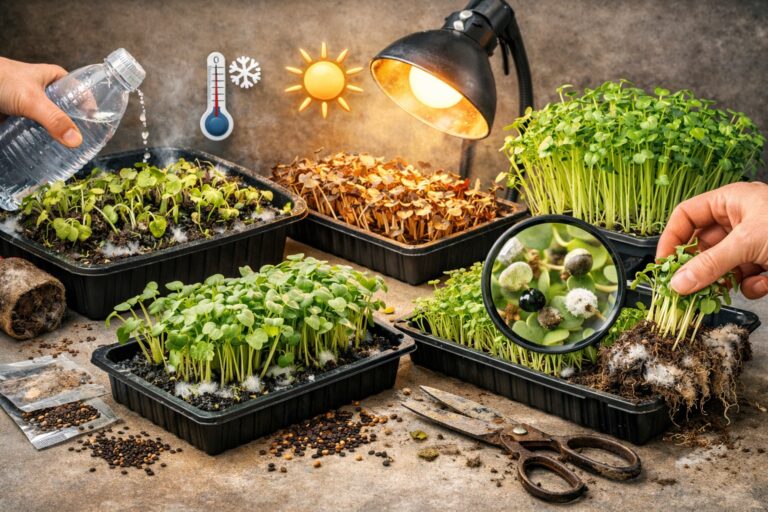
In a spawn catalog, “oyster mushroom” is not one item. It is several different products under one name, and at least two of them will never fruit in your room, even though the mycelium colonizes flawlessly.
Quality has nothing to do with it. Every strain runs its mycelium at the same temperature, and then fruits in ranges that sit up to 49 °F (27 °C) apart. One species. One Latin name. Different mushrooms from the grower’s point of view.
This article is about the oyster mushroom as a species: what it is, what it feeds on, which strains exist, how much it yields and what is actually in it. The growing process itself we cover separately, with links at the end.
What the oyster mushroom is
Pleurotus ostreatus, the pearl or tree oyster. In the wild it lives on hardwood: poplar, willow, beech, maple, usually on standing dead trees and stumps. Fruiting bodies grow in shelving tiers, caps overlapping, the stem offset to one side or barely there at all. The Latin says it plainly: ostreatus means oyster-shaped.
Biologically it is a primary decomposer. An oyster mushroom needs no ready-made humus. It breaks down lignin and cellulose itself, which means it takes on fresh wood and straw directly. That is exactly why it is easy to grow: the substrate needs no months of composting the way button mushrooms do.
Technically it is a white rot fungus. It selectively eats out lignin, the dark binding compound in wood, and leaves the pale cellulose behind. Hence the name: infected wood lightens and turns stringy. The practical consequence is enormous. Button mushrooms need finished compost, which takes weeks in two stages with a heat spike to 158 °F (70 °C) and a smell that carries down the block, and that is precisely where home growers give up on them. An oyster is content with pasteurized straw.
In the woods, oysters fruit late, from September to the first hard frosts, and a mild winter can produce them in December. That is not an accident, and the reason becomes clear below.
Wild oysters are foraged, and among autumn mushrooms they are one of the safer ones to identify. The general rule still holds: a mushroom you are unsure about does not go in the basket, and folk tests for poison do not work in principle. We have a separate piece on that.
One species, several different products
Here is the part worth reading before you buy spawn.
The mycology lab at Ohio State University keeps a list of oyster strains with their working temperatures. Four rows from it are below, and all four are Pleurotus ostreatus, one and the same species.
| Strain | Colonization | Fruiting |
|---|---|---|
| Cold Blue | 70-75 °F (21-24 °C) | 35-50 °F (2-10 °C) |
| Warm Blue | 70-75 °F (21-24 °C) | 60-85 °F (16-29 °C) |
| Pearl (also Tree, Dove) | 70-75 °F (21-24 °C) | 50-80 °F (10-27 °C), tolerates up to 95 °F (35 °C) |
| Sporeless | 70-80 °F (21-27 °C) | 55-75 °F (13-24 °C) |
Look at the second column. It is identical. All four strains run their mycelium in the same narrow window around 70-75 °F, and at that stage you will see no difference whatsoever: the block turns white the same way, smells the same, colonizes in the same time.
Now the third column. Cold Blue fruits at 35-50 °F. Warm Blue fruits at 60-85 °F. Those two ranges do not overlap at all. Between them sits a 10 degree gap where neither one works.
The spread inside this one species is wider than the spread between some entirely different mushrooms.
Cold Blue carries an extra note in its description: a cold shock is required to trigger fruiting. No such requirement is listed for the warm strains. Which explains the autumn oysters in the woods. In the wild the species leans cold, and a drop in temperature is its signal.
What that means when you buy
A typical heated room in winter holds 66-73 °F (19-23 °C); a basement might give you 46-57 °F (8-14 °C). Now read the table again.
- Cold Blue will not fruit in a room at 68 °F. The block colonizes, sits there for weeks, and you go hunting for a mistake in humidity and airflow, when the mistake happened at checkout.
- Warm Blue will not fruit in a basement at 54 °F either, for the same reason running the other way.
- Pearl covers the widest window, 50-80 °F, and tolerates up to 95 °F. It is the most temperature-forgiving option, which is exactly why it dominates the market.
The question to put to a seller is this: what range does this strain fruit in, and does it need a cold shock. If the listing says nothing but “oyster mushroom, high yielding,” you do not know what you are buying.
Note one more row in that table: the sporeless strain. We come back to it later, and the reason is more serious than it sounds.
Matching a strain to a space
Putting the strain table next to real room temperatures gives the following. This part is my arithmetic on overlapping ranges rather than a quote from the source, so check it against your own space with a thermometer.
| Where the block sits | Typical temperature | What fits |
|---|---|---|
| Heated living room | 66-73 °F (19-23 °C) | Pearl, Sporeless, Warm Blue |
| Enclosed porch, spring and fall | 50-64 °F (10-18 °C) | Pearl, Sporeless at the top end |
| Basement | 46-57 °F (8-14 °C) | Pearl at the low end, Cold Blue at 46-50 °F |
| Unheated garage in winter | 32-46 °F (0-8 °C) | Cold Blue only |
| Room in summer, no air conditioning | 79-90 °F (26-32 °C) | Warm Blue to 85 °F, Pearl tolerates to 95 °F |
Two things jump out. First, Pearl covers most household scenarios, and its popularity on the shelf follows directly from that. Second, Cold Blue makes sense in exactly one case: a cold space in winter. In a warm room that strain will sit there white and silent no matter how much you mist it.
What it grows on
The oyster’s reputation as an undemanding mushroom is earned. Cereal straw, hardwood sawdust, legume husks, coffee grounds, cardboard, cotton waste, corn stalks. The list runs long because the fungus breaks down lignocellulose directly.
But “grows on anything” and “grows equally well on anything” are two different claims. An Ethiopian group put seven substrates side by side in 2024, in identical 1 kg bags, and measured the result.
| Substrate | Biological efficiency, % | Yield, g per bag |
|---|---|---|
| Mixture of all six, 1:1 | 238.5 | 2002 |
| Faba bean husk | 231.5 | 1813 |
| Barley straw | 208.6 | |
| Wheat straw | 200.2 | |
| Field pea husk | 195.1 | 1612 |
| Tef straw | 166.7 | 1255 |
| Sawdust alone | 150.2 | 1093 |
The gap between best and worst is nearly twofold: 2002 grams against 1093. Same substrate weight, same bags, same care.
One caveat right away. The trial ran in Ethiopia on local residues, tef straw is not something you will find in North America, and the room conditions were their own. Carrying 238 percent over to your wheat straw as a promise does not work. What does carry over is the ranking of substrates against each other and the size of the gap.
Biological efficiency: why the number exceeds 100
The term shows up in every strain description and is almost never explained. Worth unpacking, because without it the table above reads like magic.
Biological efficiency is the weight of fresh mushrooms harvested, divided by the weight of dry substrate, times one hundred. The word “dry” is the whole trick. Mushrooms are 89 percent water, the substrate is counted without its water, and so a figure above 100 does not mean the fungus created matter out of nothing. Shiitake runs noticeably lower: in a 2024 trial the best mix reached 74%, as covered in growing shiitake.
A BE of 200 percent on one kilogram of dry straw means two kilograms of fresh mushrooms. Those two kilograms hold roughly 220 grams of dry matter. So the fungus converted about 22 percent of the substrate’s dry mass into itself, burned the rest through respiration, and left what remained in the spent block.
What to expect by size. In the trial above, seven substrates spread from 150 to 238 percent, and those are reasonable numbers for oysters on straw under normal conditions. Anything under 100 means something went wrong: substrate, strain, temperature or a competitor in the bag. Anything over 300 in a spawn advertisement deserves a follow-up question about conditions, because BE depends heavily on how many flushes got counted.
Why a grower should care: BE is the only honest way to compare two strains or two substrates. Yield “per block” depends on how much substrate is in the block and how much water is in the substrate. A claim of “two kilos per block” without the block’s weight means nothing at all.
Sawdust alone loses on every count
The most interesting part of that trial is not the yield. Sawdust came out worse on five measures at once, not one.
| Sawdust alone | Mixture | |
|---|---|---|
| Colonization, days | 18.0 | 13.0 |
| Primordia appear, days | 27.0 | 19.7 |
| To first harvest, days | 29.7 | 22.7 |
| Cap diameter, cm | 3.32 | 4.89 |
| Fruiting bodies per bag | 31 | 67 |
Seven extra days to first harvest is seven days of rent, electricity and exposure to green mold. Cap diameter drops from 4.89 to 3.32 cm, which is a sales problem. And there are half as many mushrooms.
The reason is chemistry. Pure sawdust is almost entirely lignin and cellulose with very little nitrogen. Legume husks and cereal bran supply nitrogen, and the fungus moves faster. This is why commercial formulas always supplement sawdust rather than using it straight.
Counting time as well as weight
The same team calculated a separate index combining biological efficiency with the days from spawning to harvest. They called it the production rate, and it reshuffles the ranking noticeably.
| Substrate | BE, % | Adjusted for time |
|---|---|---|
| Faba bean husk | 231.5 | 841 |
| Wheat straw | 200.2 | 834 |
| Barley straw | 208.6 | 813 |
| Mixture of all six | 238.5 | 810 |
| Field pea husk | 195.1 | 791 |
| Tef straw | 166.7 | 715 |
| Sawdust alone | 150.2 | 663 |
The mixture, which won outright on raw biological efficiency, drops to fourth on this measure. The top five rows are not statistically distinguishable from one another, meaning they are effectively level. Plain wheat straw, trailing the mixture by 38 points on BE, catches up once time is counted, simply because it delivers sooner.
For anyone paying monthly rent on a space, this is the right way to look at substrate. A kilogram of mushrooms harvested a week earlier costs less to produce than the same kilogram harvested later.
Three flushes, and why the third halves
Oysters fruit in flushes. Averaged across all substrates in that trial, the numbers fell out like this.
| Flush | Average, all substrates | On sawdust | On the mixture |
|---|---|---|---|
| First | 637 g | 504 g | 800 g |
| Second | 594 g | 435 g | 766 g |
| Third | 280 g | 154 g | 436 g |
The second flush holds nearly level with the first; the third drops by more than half. That is the normal course rather than a sign you broke something. The substrate depletes and the fungus draws less from it.
The practical consequence for anyone counting money: the first two flushes deliver roughly 80 percent of the total. Whether to hold a block for the third comes down to what a shelf slot costs you, not to the mushroom.
The oyster mushroom hunts nematodes
Now for the fact that changes what you think a mushroom is.
The oyster mushroom is a predator. It catches and kills nematodes, microscopic roundworms, to top up its nitrogen when the substrate runs lean. This is a documented property of the genus rather than a curiosity from one experiment.
In 2020 a team from Taiwan published the mechanism in PNAS. Oyster hyphae paralyze a nematode within minutes of contact. The authors took Caenorhabditis elegans, the laboratory roundworm, and screened for mutants resistant to the fungus. Every resistant mutant they found was broken in the same place: in genes required to build the cilia of sensory neurons.
So the fungus strikes at the sense organs rather than the body. Calcium then floods into the nematode, the head and pharyngeal muscles go into hypercontraction, and the cells die. The researchers checked several oyster species against a range of nematodes, and it works across the board.
How widespread this is makes it stranger still. The authors note that predation on nematodes evolved independently in every major fungal lineage, meaning nature invented the trick separately many times over.
What does not follow from any of this. The paper does not say predation adds yield in a bag of straw, and it does not say anything is wrong with the mushroom as food. Nitrogen from nematodes is a supplement under scarcity, not a feeding strategy. But the next time you see “fungi are basically plants,” remember this section.
Spores: four out of four
Oysters release spores heavily. Around a mature block you will see a whitish film on the shelf and the wall, and that is settled spores, billions of them.
Your lungs are not indifferent to this. In 1991 Dutch physicians ran provocation tests on mushroom farm workers: 28 on button mushrooms, four on oysters, six on shiitake. On button mushrooms, 18 of 28 reacted positively. On oysters, all four did.
Four people is a small number, and turning it into “all mushroom growers get sick” would be wrong. But the direction is backed by individual case reports on a related species, the king oyster. In 2002 Japanese doctors described a woman who developed hypersensitivity pneumonitis after two months at an eringi facility. In 2003 a similar case appeared in a man who had worked at one since 1996: in hospital his symptoms cleared up on their own without medication, and returned when he went back to work.
These are full-time factory workers rather than people with one block on the kitchen counter, and the scale of risk differs accordingly. The reasonable takeaway is moderate: keep a fruiting block out of the bedroom, ventilate the space, and wear a respirator if you work around many blocks for long stretches.
And here that first table pays off. A sporeless strain exists and is sold commercially. It fruits at 55-75 °F (13-24 °C), which is room temperature. For anyone putting blocks in living space, that is the simplest answer to the whole question.
What is actually in it
USDA figures per 100 grams of raw oyster mushroom.
| Nutrient | Per 100 g raw |
|---|---|
| Water | 89.2 g |
| Protein | 2.9 g |
| Fat | 0.19 g |
| Carbohydrate | 6.9 g |
| Dietary fiber | 2.85 g |
| Sodium | 1.13 mg |
| Potassium | 282 mg |
| Phosphorus | 86 mg |
| Niacin (B3) | 5.75 mg |
| Riboflavin (B2) | 0.24 mg |
| Vitamin D | 0.04 µg |
Two numbers deserve attention on their own.
Sodium at 1.13 mg. That is effectively zero. Most vegetables run to tens of milligrams. Fresh oyster mushrooms are a salt-free food by definition, and whatever salt ends up in them is the salt you add.
Niacin at 5.75 mg. High for anything in the produce aisle. Together with riboflavin, that makes oysters a respectable source of B vitamins, and it is one of the few nutritional claims here that needs no stretching.
Protein at 2.9 g per 100 grams deserves a sober read. That is less than cooked lentils, and talk of mushrooms replacing meat does not survive contact with that figure. By calories and protein an oyster mushroom is a vegetable, with a good micronutrient profile attached.
Vitamin D: from zero to 58.96
Look at the last row of that table: vitamin D at 0.04 µg, which is to say none. The same is true of any mushroom grown in the dark.
But mushrooms contain ergosterol, and ultraviolet light turns ergosterol into vitamin D2. A Polish group irradiated three cultivated species with UVB in 2017 and measured the result.
| Mushroom | D2 after UVB, µg per gram dry weight |
|---|---|
| Oyster | 58.96 |
| Shiitake | 29.46 |
| Button | 3.55 |
The oyster delivers 16.6 times what the button mushroom does, and twice what shiitake does. At banking vitamin D2 it is the best of the three most widely cultivated mushrooms.
Watch the units, because they are easy to mix up. The USDA table is micrograms per 100 grams of raw mushroom. This table is micrograms per gram of dry weight. The mushroom is 89 percent water, so the two are not directly comparable.
In practice it means something simple: an hour or two in sunlight or under a UV lamp before drying puts a vitamin into the mushrooms that was not there before. The same study also tracked storage, and vitamin D2 in oysters declines gradually over ten days in a refrigerator. A separate paper found dried mushrooms held about two thirds of their original D2 after a year and a half.
What this article leaves out
This piece covers the species, not the process. Everything to do with actually growing them we handle separately, and repeating it here would serve nobody. Three other oyster species sold in kits are compared in pink, yellow, and king oyster mushrooms.
- Where to start, the four numbers that decide a crop, pasteurization, spawn rate, green mold: how to start growing mushrooms at home
- A ready-made block, the first three days, cutting the bag, when to pick, straw from scratch: oyster mushrooms on a windowsill
- The block is sitting there doing nothing: seven reasons a block refuses to fruit
A word on where the numbers come from. Everything here is international: an American strain table, an Ethiopian substrate trial, a Polish vitamin D study, Dutch and Japanese medical data. None of these figures is a regulatory standard anywhere, and none of them was generated on your substrate in your room.
Summary
The oyster mushroom is one species carrying very different strains. Their mycelium colonizes identically, they fruit anywhere from 35 to 85 °F, and a strain mismatched to your room looks exactly like a care mistake. Ask about the fruiting range before you pay.
It grows on almost anything, though not equally well: the gap between the best and worst substrate in a controlled trial ran to nearly twofold. Pure sawdust loses simultaneously on speed, cap size and yield, which is why it always gets supplemented.
The first two flushes deliver roughly four fifths of the total. The third halves, and that is normal.
It also paralyzes nematodes within minutes, sheds spores heavily enough to have earned an occupational diagnosis, and after a couple of hours of ultraviolet becomes the best mushroom source of vitamin D available. For something sold at every market stall, the resume is unexpectedly long.