
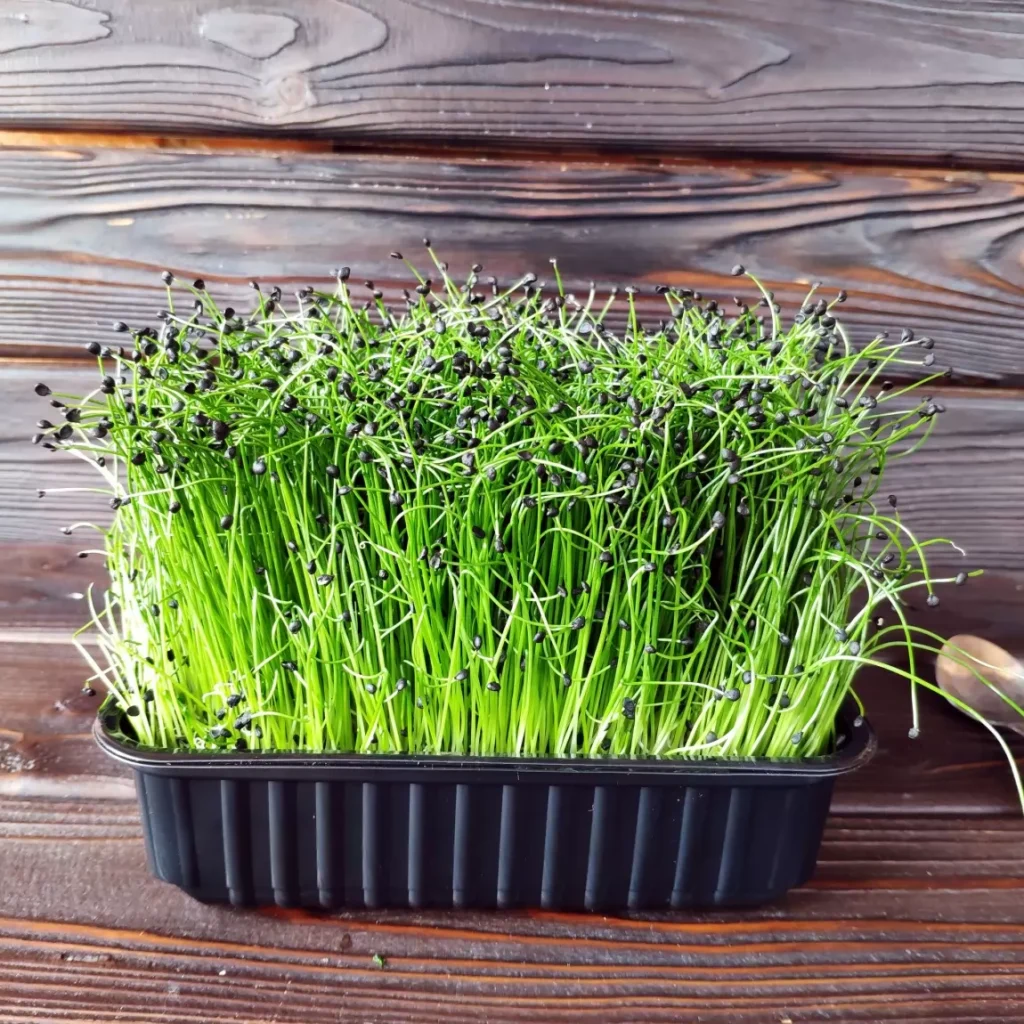
Flavor profile
Taste & aroma
Onion, spicy, sweet - but without bitterness and excessive burning, with a light sweet taste. Appetizing, fresh aroma.
but without bitterness and excessive burning, with a light sweet taste. Softer and more delicate than adult onions and adult chives
Appetizing, fresh, stimulating - that characteristic smell that instantly arouses hunger. When growing indoors, the aroma will be felt quite clearly - take this into account when planning the space for the farm.
Elastic, crispy, very tender - thin tubular feathers. In contrast to adult snit — without stiffness and fibrousness
Ripening and optimal harvest time
The sprouts are 6–8 cm, the taste is the most delicate.
The height is 10–12 cm, the taste is more expressive and balanced - the moment of collection.
The stems become coarser, the taste becomes sharper, the aroma more intense.
Why flavor may vary batch to batch
The sharpness of the cut depends on the content of allicin and propanethiol, which are formed when cells are damaged (chewing, cutting). At bright light and a temperature of +18...+22°C more essential oils - the aroma is rich. At low light the sprouts are pulled out and the taste becomes neutral-onion without characteristic sharpness. Shnit is a slow culture (14–18 days).
Culinary use
How to use
Onion / Chives is a great culinary accent. Add fresh at the end of cooking or directly on the plate.
French onion soup
a few strands of micro-onion on top of the crouton when serving is a modern version of the classic
Poached eggs on toast
schnitt on top + a drop of olive oil — it looks like in a fashionable cafe
Cream cheese or ricotta on bread
micro-onion on top + black seeds — a simple and spectacular snack
Salmon or beef tartare
thin threads in the filling and on top - a delicate onion accent without coarseness
Bowl with rice and chicken fillet
micro-onion as one of the top layers — spiciness without interrupting other flavors
Okroshka or cold soup
instead of mature green onions - more delicate and beautiful
Perfect pairings
Sprinkle on a plate immediately before serving - the aroma is revealed by the heat of the dish
Thin threads with black "drops" - restaurant serving without effort
Toast with cream cheese, bruschetta, fish tartar - thin strings of onions with black seeds serve as both an aromatic and decorative element
- Do not try to wash off the black seeds with water - they hold very firmly and trying to remove them only spoils the greenery
- Do not add to the dish during long cooking - the aroma and texture disappear from the heat
- Do not expect the taste of garlic or leeks - micro-onions are much milder
Home storage
How to store
Onion / Chives keeps longer than most microgreens. Follow simple rules to keep it fresh for up to 16 days.
Refrigerator +4...+6°C. The term is up to 16 days. Cut before serving.
Place in an open container or plate, cover with a damp paper towel. Don't seal — without air, greens yellow faster.
Don't wash until ready to eat. Wet greens spoil much faster. Rinse just before serving.
Nutrients & health
Benefits & composition
Onion / Chives is valued for its rich vitamin-mineral composition and bioactive compounds typical of microgreens.
Like most microgreens, onion / chives contains a concentrated amount of nutrients relative to its weight — many times more than the mature plant.
| Protein | 3.0 g — building material for cells |
|---|---|
| Calories | ~30 kcal |
| Vitamins | C, K, A |
| Minerals | Potassium, Calcium, Zinc |
- For people with high acidity of the stomach or exacerbations - micro-onion is softer than an adult, but it is a representative of onions; moderate use is recommended
- For those who categorically do not perceive the taste and aroma of onions - microgreens are softer, but the taste profile is the same
This information is general in nature and is not medical advice. Composition data: USDA FoodData Central.
Worth knowing
Phytoncides and allicin
Natural antimicrobial compounds characteristic of all cultures of the onion family. Traditionally associated with supporting the immune system. In microgreens, the concentration is lower than in adult onions, but the characteristic taste and smell are completely preserved.
Vitamin C
is contained in fresh microgreen onions in a noticeable amount. Heat-sensitive: stored only in raw form, so it is better to add micro onions after cooking or in raw dishes.
Potassium
(~380 mg per 100 g) is a significant plant source of this mineral. Potassium is traditionally associated with the normal functioning of the cardiovascular system and water-electrolyte balance.
Vitamin K
present in the leafy part of microgreen onions. It plays a role in the processes of blood coagulation and the metabolism of bone tissue.
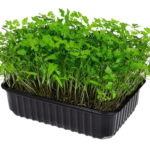
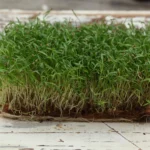
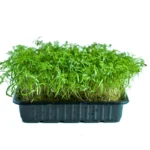
Onion / Chives: how to grow — step-by-step guide
Growing parameters, agronomy, common mistakesGrowing parameters
Black, grainy, hard
Step-by-step guide
Seed preparation
The seeds are black, ridged, hard - clearly visible on any substrate. No soaking. Sow dry.
Sowing
- Evenly moisten the substrate - it should be well saturated, coconut or soil 2-3 cm deep
- Sprinkle evenly 10 g seeds — black seeds are clearly visible, it is easy to control uniformity
- Spray liberally from a spray bottle
- Install the clamp
Clamp — 1 kg
Clamping is necessary - without it, the strong growth energy of the onion raises the "carpet" and the roots do not grow into the substrate. 1 kg is enough: the seeds are smaller than sunflower, the roots are thinner.
Darkness (Blackout) — 5–6 days
The most important nuance of onions is "loop" growth:
The onion emerges from the seed in a bent position — the sprout is folded in half like a pin. Then it gradually straightens. This is not a defect, this is normal onion physiology.
Do not expose to light until the sprout has straightened. If you open before that, the onion will turn green in a bent state and will no longer straighten out completely. The tray will look untidy. Wait for a height of 4-5 cm and straight vertical stems.
What is normal:
- "Hoops" on the 2nd-3rd day are the norm
- Black seeds on the tips of sprouts remain even after the light comes out, this is a feature, not a problem
What is NOT normal:
- Mold with an unpleasant smell → excess moisture. Ventilate, reduce watering
Watering: moderate lower when dry - the coconut or soil should be moist throughout the long cycle.
Vegetation in the light — 10–14 days
Lighting:
- LED phytolamps: 16–18 hours a day
- In case of insufficient lighting, the stalks stretch out and bend — the onion reaches for the light source
- Bright uniform lighting = even vertical "lawn"
Temperature: +18...+22°C. Onions are cold-resistant.
Watering: moderate lower through pallet. Thin stalks of onions dry from the tip when they dry out - monitor the humidity of the substrate. When drying, the tips turn yellow - water them and they will recover.
Ventilation: daily ventilation. When growing in large quantities - constant ventilation of the room, otherwise the smell of onions accumulates.
If the tips of the feathers (where the seeds are) begin to dry and turn yellow, this is a sign of insufficient watering, not a disease. Moisten the substrate and carefully spray the stems from above. Jaundice subsides in 12-24 hours.
Watering
- Water it 1-2 times a day (in the morning - necessarily, in the evening - if necessary)
- Lower watering through a pallet is better; the upper is permissible carefully
- Onion is a moderate water consumer with a slow start
- A sign of lack: thin leaves stop growing and turn slightly yellow → water
Storage
| Uncut in tray | Fridge +4...+6°C | up to 3 weeks |
|---|---|---|
| Cut in container | Refrigerator | up to 7 days |
| Room temperature | 1–2 days |
Harvest
- Height 10–12 cm
- The stems are straight and bright green
- The "loops" have completely straightened
- Black seeds on the tips are normal and beautiful, leave them
Sharp scissors. Onions do not wither immediately after cutting — there is time for careful work.
Immediately before use or sale.
Seasonal adjustments
- The smell intensifies: in the heat, the onion aroma becomes more intense - ventilation of the room is even more important than usual
- The cycle is accelerating for 2-3 days - monitor the height and do not wait for the 18-20th day if the greens are already ready
- Humidity: in the heat, the tips dry out faster - water steadily, do not allow the substrate to dry out
- Ventilation: move the tray to a ventilated place or use a fan - heat + smell without ventilation = discomfort in the room
- Expect: slightly thinner stems and a less even appearance compared to the cool season
- Perfect season for onions: the cycle is extended to 22–24 days, but the stems are straighter and denser
- The smell is milder when cool — less intense and more balanced, a plus for home cultivation
- Expect: lengthening the cycle by 3-5 days and a more pleasant delicate aroma of cut greens
Water pH and EC
The optimal range for the cut: 6.0–7.0. Onions are unpretentious to pH. Normal tap water is fine. Germination slows down at pH below 5.5.
Optimal range: 1.0–1.5 mS/cm. Shnit is unpretentious to power. The main quality factor is lighting and growing time.
Experienced grower tips
Black Seed - Sell as an advantage
"Black drops on green" is a natural decorative effect that cannot be reproduced artificially. Show the photo to the chef and he will understand the value without words.
A shelf life of 14–16 days is a competitive advantage
For customers who pick up orders once a week or less often, micro-onions are ideal. Emphasize the shelf life when selling.
Onion + carrot + parsley is a classic "soup" mix
Three cultures that traditionally go into the broth — in the form of microgreens when served. Restaurants with borscht and homemade soups are the target audience.
Double sowing every 10 days
A 15-21 day cycle is the standard solution for continuous supply. Two trays in rotation cover the weekly needs of regular customers.
Agronomy notes and common mistakes
- Sowing: Soaked (4–6 hours) seeds — in a dense, even layer. Small black onion seeds.
- Clamp: Light pressure (1 kg), 1–2 days.
- Temperature: +18...+24°C. Moderate to warm temperatures are ideal.
- Watering: 1-2 times a day. Onions are not very picky about watering after germination.
- Ventilation: moderate Onion microgreens are not susceptible to mold under normal conditions.
- Early removal of darkness (the sprout is still a "loop") → Greens turn green in a bent state, do not straighten → Keep in the dark until fully straightened, 4–5 cm
- Trying to wash off the black seed → Green damage, seeds are not washed away → Accept as a decorative chip
- Weak watering → Yellowing of the tips, drying of the stems → Stable humidity of the substrate during the entire cycle
- Weak or uneven lighting → Stems lean towards the light source, uneven appearance → Uniform powerful lighting from above
- Ignoring smell when planning → Onion smell throughout the room → Take to a separate ventilated place or plan ventilation
Variety selection
Onions are onion
Exhibition, Stuttgarter, Centurion
A classic choice. Pronounced onion taste, even germination.
Batun onion
Aprilsky, Winter, Nezhynsky
More delicate and less sharp taste. Thinner and smoother stairs are ideal for restaurant serving.
Що далі?
More crops in the catalog
Explore similar and contrasting flavors — from basil to amaranth