When and how available
| the moon | Accessibility |
|---|---|
| January — April | ❌ Not the season |
| May — early June | ✅ The peak is the only flowering window, 2-3 weeks |
| Mid-June — December | ❌ Not the season |
Acacia blooms only 2-3 weeks a year (usually the end of May - the beginning of June). City farms do not grow acacia - only seasonal collection in the open ground. The window is very short: it is necessary to collect before the bunches have darkened and retain their aroma.
| Form | Features of use |
|---|---|
| fresh | The main form is bunches or individual flowers, the term is up to 1 day |
| dry | For teas and aromatic mixtures, the color disappears, the aroma remains |
| Syrup | Sugar syrup infused on flowers — can be stored for months |
| Kandovan | Decor of desserts and cakes, keeps its shape for weeks |
Taste, aroma & texture
Intensely sweet, honeyed, with a pure vanilla note and a light floral shade reminiscent of jasmine. Nectar is concentrated at the base of each small flower - when you chew, you feel a sweet burst. The taste is clean, without bitterness or astringency, which makes acacia one of the most pleasant flowers for direct consumption.
Very strong, far spreading - this is one of the most intense floral aromas among edible plants. Honey-floral, with a vanilla and light jasmine note. During heat treatment (batter), it is partially preserved in the form of a warm sweet aroma. During drying or infusion, the aroma passes into the substrate.
Each flower-cluster consists of small butterfly-shaped flowers. Petals are soft, tender, almost melt in the mouth. The whole cluster is light and airy. The batter is crispy on the outside, soft and fragrant on the inside. When candied, it retains its shape and acquires a light crispness. ---
Safety & edibility
Edible flowers are not the same as florist flowers. Only flowers grown specifically for food use without synthetic pesticides are suitable.
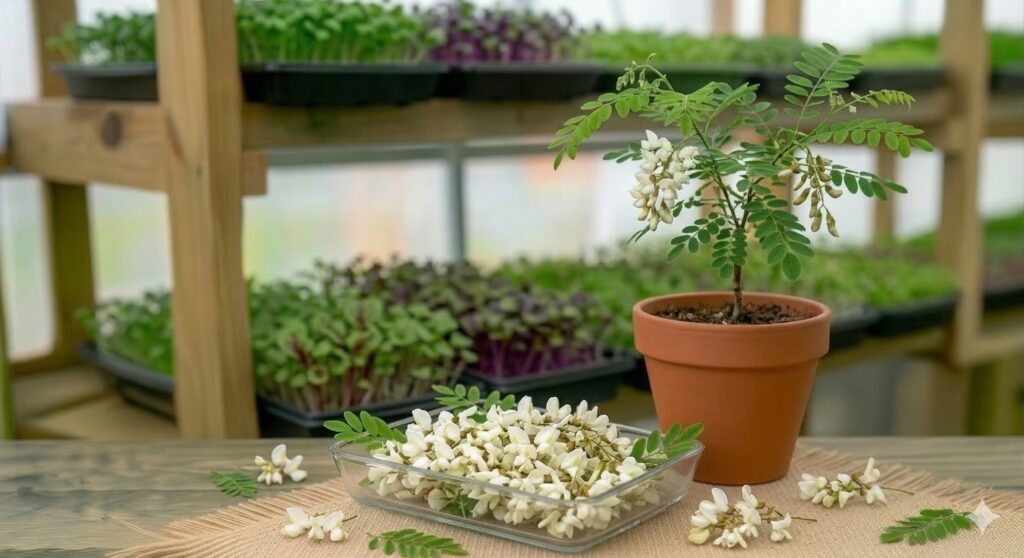
- ✅ Flower bunches (inflorescences) are completely edible
- ✅ Separate flower petals
- ❌ Leaves - contain toxic robin protein (robinin)
- ❌ Bark and branches - contain robin in a concentrated form
- ❌ Seeds and pods are toxic
- ❌ The roots are toxic
Acacia flowers are used fresh or fried in batter. Only inflorescences without leaves, twigs and seeds.
Critical warning: Robinia pseudoacacia contains robin — toxalbumin, a poisonous protein present in all parts of the plant except flowers. Poisoning is accompanied by nausea, vomiting, abdominal pain. Flowers are safe when collected correctly (only inflorescences, without leaves and twigs).
Do not confuse: Yellow acacia (Caragana arborescens) is a different plant, not robinia. Its edibility has not been confirmed - do not use.
Heat treatment: Frying in batter is a traditional and safe method. The aroma is partially preserved. The cluster keeps its shape and gives a tender juicy core under a crispy crust.
This information is general in nature and is not medical advice. Sources: USDA FoodData Central, EFSA.
Culinary use
Acacia is a purely sweet and seasonal ingredient. Its honey-vanilla aroma is too intense for savory dishes, so it is mainly used as a dessert or drink. The key feature is exceptional aromaticity: even a small amount of flowers noticeably affects the taste of a dish or drink. The traditional method of consumption in Ukraine is grapes fried in sweet batter, sprinkled with powdered sugar.
Frying in batter (fritters)
a whole bunch is dipped in liquid batter and fried in heated oil for 2–3 minutes on each side. The technique requires fresh bunches with open flowers — closed buds give worse results.
Infusion for syrup
fresh bunches are poured with hot sugar syrup (1:1 water/sugar) and left overnight under the lid. The aroma completely passes into the liquid. The flowers are then removed.
Candy making
individual flowers (not whole bunches) are treated with egg white and fine sugar. Dry at low temperature (40–50°C) or at room temperature for a day.
Drying for teas
freshly picked bunches are dried in the shade with good ventilation. Not in the sun - the color and part of the aromatic oils are lost. The shelf life of dry flowers is up to 1 year.
Fresh decor
a whole inflorescence or individual flowers are placed on a ready-made dish without preparation. Use immediately - acacia wilts very quickly after cutting.
Insisting in water
bunches are immersed in cold water for 2–4 hours; the water acquires a delicate floral aroma. Base for refreshing lemonades and floral water.
- Do not use any parts other than flowers - leaves, bark, seeds, roots of acacia contain toxalbumin robin and can cause poisoning
- Do not collect flowers near roads, industrial zones or railways - trees actively absorb heavy metals and pollutants
- Do not store freshly picked bunches for longer than 12-24 hours, even in the refrigerator - the aroma disappears, the flowers turn brown; cook or process into syrup immediately after harvesting
- Do not confuse with yellow acacia (Caragana arborescens) - looks similar, but this is a different plant without confirmed edibility
Perfect pairings
acacia honey, vanilla ice cream, panna cotta, butter cream — the floral note strengthens the sweet base and gives dishes a distinct spring character.
pancakes, waffles, fritters, yeast dough - fried acacia bunches are a traditional regional dish, similar to the French beignets de fleurs d'acacia.
lemon, orange, grapefruit - the acid perfectly balances the sweetness of honey and emphasizes the floral aroma in drinks and desserts.
panna cotta, crème brûlée, ice cream — a neutral creamy base becomes the background for an intense floral aroma.
arugula, spinach, young cabbage - fresh bunches of acacia as a floral accent; the floral aroma refreshes the green salad, and the delicate sweetness balances the bitterness of the leaves.
salty spicy base and sweet-floral aroma of acacia — a classic contrast; especially good in Greek salads and toasted appetizers.
How to select & store
- Flower clusters are completely open - tightly closed buds have not yet ripened
- The color is white or slightly creamy, without brown spots and darkening
- The aroma is bright and strong - it is felt immediately when approaching
- No insect damage, no wet or slippery areas
Where to buy is important: Collect only from trees that grow far from roads, parking lots and industrial zones. Optimal — garden or forest. Do not harvest from trees treated with chemicals. If there are doubts about the source - do not collect.
Freshness after cutting: 2–3 days
- Fresh bunches - maximum 12-24 hours in the refrigerator in an airtight container
- Do not wash before direct use - moisture accelerates darkening
- For longer storage, immediately process into syrup or dry
- Dry flowers - in a paper bag or glass jar, dark dry place, up to 1 year
Composition & properties
White acacia flowers contain essential oils, which cause a pronounced aroma, as well as flavonoids and simple sugars. The nutrient profile is modest — acacia is used for aroma and taste, not for trace elements.
| Nutrient | Value (per 100 g) |
|---|---|
| Flavonoids (acacetin, robinin glycosides in flowers) | are present |
| Essential oils (linalool, geraniol) | are present |
| Simple sugars (nectar) | a moderate amount |
| Vitamin C | traces |
| Calcium | traces |
| Caloric content | ~40–50 kcal (approximately) |
Acacia honey — one of the most popular monofloral honeys in Ukraine and Hungary — is produced by bees mainly from robinia nectar. It is light, liquid, slowly crystallizes. Acacia flower flavonoids (mainly acacetin) are being studied in scientific research as potential antioxidants.
It is important to understand: the toxic robin protein contained in the leaves, bark and seeds is either absent in the flowers, or present in harmless trace amounts - this is what makes the flowers edible when collected correctly (only the inflorescences without leaves and petioles).
There are few detailed laboratory data on the composition of Robinia pseudoacacia flowers. The given values are indicative. Sources: USDA FoodData Central, EFSA.