When and how available
| the moon | Accessibility |
|---|---|
| January — April | ❌ Not the season |
| May — June | ✅ The beginning of flowering, the first flowers |
| July — August | ✅ Peak - abundant flowering, best quality |
| September | ✅ The end of the season, the quality decreases |
| October — December | ❌ Not the season |
Chamomile is an annual, but it self-sows well and returns to the same place year after year. City farms can supply fresh chamomile in wider time frames. Dried chamomile is available year-round.
| Form | Features of use |
|---|---|
| fresh | Decoration of dishes and desserts, infusions in creams and syrups; period of 1-2 days |
| dry | The main form is tea, tinctures, pastries, syrups; the taste lasts up to 12 months |
| Kandovan | The decor of cakes and desserts — the small size gives a minimalistic accent |
| Frozen in ice | Cocktails, lemonades - white and yellow in an ice cube |
| Syrup | Flowers are infused or brewed with sugar and water; basis for drinks, jellies, glazes |
| Infusion in cream or milk | Flavored base for creams, panna cotta, ice cream |
Taste, aroma & texture
Soft, slightly sweet, floral-herbal - with a subtle taste of apple and honey. A fresh flower is more delicate than a dried one. The yellow center gives a slightly more intense and slightly bitter taste - this is the concentration of essential oils. An important culinary detail: with too long brewing or boiling, the aroma "breaks" and a sharp, unpleasant bitterness appears. Chamomile needs gentle heating - hot water, but not boiling water.
Warm, apple-honey - recognizable and familiar. One of the few herbal aromas that reads equally well in a sweet and salty context. When heated, it opens more fully. Dried chamomile smells more concentrated, fresh - more subtle and floral.
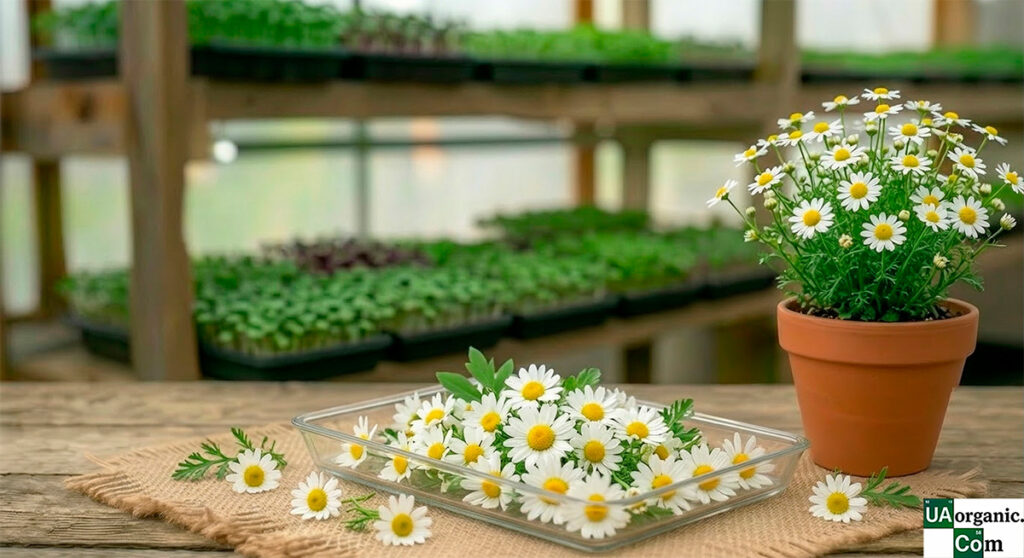
The flowers are small - up to 2-3 cm in diameter, which makes them one of the smallest edible flowers in the catalog. Petals are thin, papery, light. The yellow middle is denser and sticky to the touch. After drying, the petals become fragile, the middle holds its shape better.
Safety & edibility
Edible flowers are not the same as florist flowers. Only flowers grown specifically for food use without synthetic pesticides are suitable.
- ✅ The whole flower is whole
- ✅ Petals separately - for delicate decoration
- ✅ Yellow middle - for infusions (concentrated taste)
- ✅ Young leaves - in small quantities, taste herbal
- ❌ Stems - do not use
Are all varieties edible: Two main types are suitable for cooking:
- Matricaria chamomilla (apothecary chamomile, German chamomile) is the best culinary choice, sweet and mild taste
- Chamaemelum nobile (Roman chamomile) - edible, but more bitter; less common in Ukraine
Do not confuse:
- Anthemis spp. (umbilical cord) - similar in appearance, but either odorless or with a sharp unpleasant aroma; some species are toxic. Rule: no apple flavor - no chamomile, don't eat.
- Matricaria discoidea (scented chamomile, "pineapple weed") - without white petals, only a yellow middle; edible, smells of pineapple and chamomile, but a separate species.
Heat treatment: It is better not to heat fresh flowers for decoration - they lose their shape. For infusions and syrups — hot water (90–95°C), not boiling. Boiling destroys the aroma and gives bitterness.
- Chamomile belongs to the Asteraceae family (Asteraceae) — people with a confirmed allergy to ragweed, mugwort or chrysanthemums should be careful: there is a high probability of a cross-reaction
- Not recommended for pregnant women use in large quantities: Roman chamomile (Chamaemelum nobile) can stimulate uterine contractions; regarding pharmacy data is not enough — it is better to avoid
- Contact with the plant may cause a skin reaction in sensitive people
- Chamomile may interact with blood thinners — people taking them should consult their doctor before regular use
This information is general in nature and is not medical advice. Sources: USDA FoodData Central, EFSA.
Culinary use
Chamomile is an aromatic ingredient in the first place, a decorative one in the second. The small size of the flower limits it as a color accent, but the apple-honey aroma is well transferred to the liquid — and it is in the form of infusion, syrup or flavored cream that the chamomile is revealed to the maximum. In confectionery, it provides a warm, recognizable floral background without a dominant note - an ideal partner for honey, lemon, vanilla and berries.
Insisting in cream or milk
the flowers are heated together with the cream to 85–90°C without boiling, left for 20–30 minutes and strained. Basic technique for creams, ice cream and panna cotta.
Cooking syrup
flowers are brewed in hot, but not boiling water for 10 minutes, strained, sugar or honey and lemon juice are added. Golden-yellow syrup for drinks and confectionery.
Insisting in alcohol
the flowers are infused in vodka, gin or vermouth from a day to a week. Chamomile is a classic botanical ingredient in vermouth and some gins.
Candy making
the flowers are covered with egg white and fine sugar, dried. A small size gives a sophisticated point decor.
Freezing in ice
the flower is placed in an ice cube tray. White and yellow keep well in a transparent cube.
Drying
collected in dry weather, dried in a dark, ventilated place. Dry flowers retain their fragrance for up to 12 months. For drying, it is important not to overdry - the flowers should remain whole and not turn black.
- Do not collect flowers along roads, on cultivated roadsides and fields - chamomile easily absorbs chemicals; only clean meadows and fields far from the tracks
- Do not boil chamomile - boiling water destroys the aroma and gives unpleasant bitterness; brew with water 90–95°C and keep for no more than 10 minutes
- Do not use flowers without identification by aroma - similar plants of the genus Anthemis odorless or foul-smelling are not chamomile and some are toxic
- Do not store fresh flowers for more than 1-2 days, even in the refrigerator - they quickly wither; store dried chamomile in a glass jar
Perfect pairings
the classic triad — chamomile, honey, vanilla creates a warm, enveloping aroma in desserts; none of the notes interrupts the other.
acid emphasizes the floral aroma of chamomile and refreshes; together - the basis for lemonades, syrups and light creams.
panna cotta, crème brûlée, mousse, whipped cream — infusion in cream conveys aroma without visible flowers; thin floral background in bold.
oatmeal, granola, pancakes - chamomile syrup or tea in the dough gives a warm morning character without sugary sweetness.
the fruity apple aroma of chamomile resonates with the aroma of peach and pear; together — a delicate fruit-floral duet in tarts and compotes.
apple pie, pear tart, fruit salads - chamomile aroma enhances the natural sweetness of stone and seed fruits; apple and chamomile is a classic folk combination.
How to select & store
- Pronounced apple-honey aroma - without it, it is not a culinary chamomile
- Petals are white and elastic, slightly bent back or horizontal, but not yet hanging down - a sign of freshness
- The yellow center is convex, dense, without darkening
- Flowers are collected in dry weather; wet or sticky - spoil quickly
Buy edible chamomile flowers only from proven producers, grown specifically for food use. If you collect on your own - only in clean places, far from roads and cultivated fields, and necessarily after identification by aroma. Chamomile from supermarkets and flower shops not suitable for consumption.
Freshness after cutting: 2–3 days
- Fresh flowers — airtight container with a paper towel, refrigerator +4...+6°C, term 1–2 days
- Do not wash before use - moisture accelerates wilting
- Dried chamomile - a glass jar with a lid, a dark, cool place, up to 12 months; after a year, the aroma noticeably weakens
Composition & properties
Chamomile is one of the oldest medicinal plants in Eurasia, which has been used continuously since ancient Egypt and Greece until today. The chemical composition of flowers is complex: more than 120 active components were found in the essential oil at the same time.
| Component | Meaning |
|---|---|
| Essential oil | 0.3–1.5% of the mass of dry flowers |
| Khamazulen | in distilled oil - gives a blue color; antioxidant properties are being investigated |
| Bisabolol | up to 33% essential oil; studied in the context of anti-inflammatory properties |
| Flavonoids (apigenin, quercetin, luteolin) | present in considerable numbers |
| Coumarins | are present |
| Vitamin C | present in fresh flowers |
| Caloric content | minimal - used in small quantities |
Chamomile is one of the oldest documented food and medicinal plants. It was used in ancient Egypt, Greece and Rome; In the Middle Ages, it was a mandatory component of monastic apothecary gardens throughout Europe. Name Matricaria comes from Latin matrix — matrix, uterus: the plant was traditionally used for spasms related to women's health.
Hamazulene, the component that gives distilled chamomile oil its characteristic blue color, is a product of distillation and is not present in that form in fresh flowers. It is the subject of active research.
Chamomile is a classic botanical ingredient in vermouth and some gins—the floral-apple note is recognizable in many well-known recipes.
No accurate table data for chamomile has been published in the USDA FoodData Central database. Data on the chemical composition are based on scientific publications about Matricaria chamomilla. Sources: USDA FoodData Central, scientific research of composition Matricaria chamomilla.