When and how available
| the moon | Accessibility |
|---|---|
| January — April | ❌ Not the season |
| May | ✅ Young shoots and leaves - the spring season of picking greens |
| June | ✅ The beginning of flowering, the first flowers from the bottom of the inflorescence |
| July | ✅ The peak of flowering - the most flowers, maximum quality |
| August | ✅ Flowering continues, but the inflorescences gradually "go to fluff" |
| September — December | ❌ Not the season |
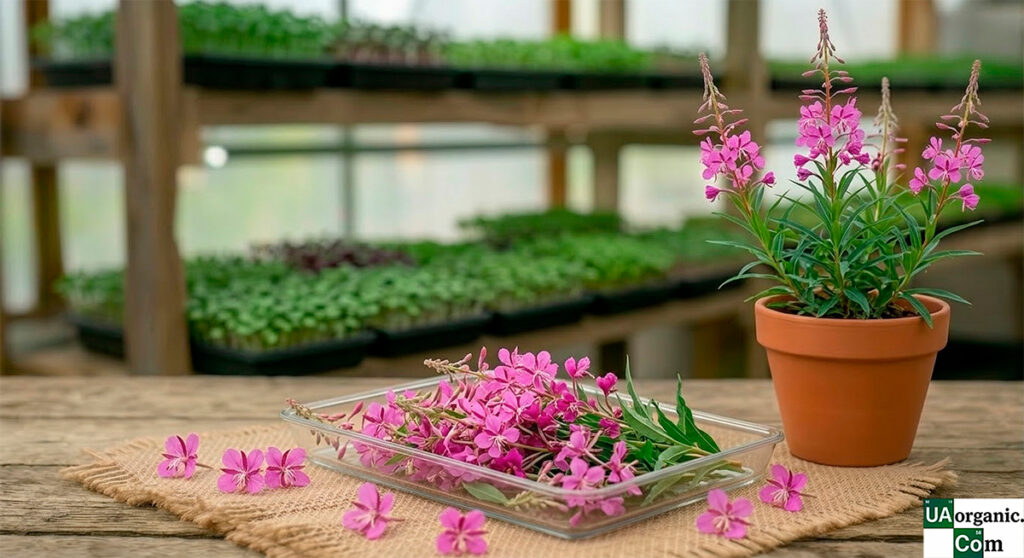
An interesting feature of Ivan tea: the inflorescence blooms from the bottom up. The lower flowers have already bloomed, the upper ones are still buds. For collection, choose the middle part of the inflorescence. City Farms can supply yarrow flowers and leaves over a wider timeframe when grown under controlled conditions.
| Form | Features of use |
|---|---|
| fresh | For restaurants — decoration of dishes, salads, desserts, cocktails; period of 1-2 days |
| dry | For brewing tea, tinctures, syrups; taste and aroma are preserved for months |
| Fermented (leaves) | The analogue of traditional "Kopor tea" is a more complex, deeper taste |
| Kandovan | Decor of desserts and cakes - keeps its shape for weeks |
| Frozen in ice | Cocktails, lemonades - a pink-purple accent in the drink |
| Syrup | Flowers are infused with sugar and water - the basis for drinks, jellies and glazes |
Taste, aroma & texture
Soft, delicately sweet, with a subtle floral and herbal undertone. The flowers are much softer and sweeter than the leaves - without bitterness and sharpness. Young leaves have a slight acidity and a slightly astringent aftertaste; shoots in the spring are juicy and almost neutral. The core of the stems tastes like a cucumber or a fresh zucchini.
Delicate, floral-honey - perceptible upon direct contact or upon brewing. Not dominant: Ivan tea does not overpower the other ingredients of the dish, but only adds a subtle field background. When heated, the aroma unfolds more fully and becomes warmer.
Petals are thin, velvety, slightly papery — a typical texture for flowers of the onager family. Wilt very quickly after cutting. The buds are denser and hold their shape better in the decor. The leaves are tender and soft when young, becoming tougher and fibrous with age.
Safety & edibility
Edible flowers are not the same as florist flowers. Only flowers grown specifically for food use without synthetic pesticides are suitable.
- ✅ Flowers and buds
- ✅ Young leaves (before flowering is best)
- ✅ Young shoots in the spring (like asparagus)
- ✅ Core of young stems (eat raw or cooked)
- ❌ Old leaves and stems - become hard and fibrous, become bitter
- ❌ Ripe fibrous stems - do not use
Are all varieties edible: Yes. Chamerion angustifolium (the same Epilobium angustifolium) is the only species that is called Ivan tea in the culinary context. All natural forms of the plant are edible. Not to be confused with other types of Cyprius (Epilobium spp.) — smaller relatives, common in gardens as weeds; their edibility is less well documented.
Heat treatment: It is better not to heat the flowers - they lose their color and fine texture. They are added to the dish at the last moment or used as a decoration of the finished dish. Young shoots and leaves tolerate blanching, boiling and stewing well. For syrup and jelly, boiling flowers in water is the best technique for extracting color and aroma.
- John's wort in large quantities can have a mild laxative effect - this has been confirmed for loose leaf tea; use sparingly with sensitive digestion
- Pregnant women should avoid large doses, as there is insufficient data on the safety of consuming large amounts
- Allergies are rare, but when using for the first time, start with a small amount
This information is general in nature and is not medical advice. Sources: USDA FoodData Central, EFSA.
Culinary use
Ivan tea is a flower with two culinary roles. The first is the decor: bright pink-purple inflorescences look impressive and give color without taste interference. The second is the basis for liquid preparations: syrup, jelly, tincture, tea. Ivan tea is revealed more fully here — the delicate flower-honey aroma lingers in the liquid and gives drinks and sauces a characteristic field character.
Insistence
flowers are infused in cold or hot water, milk, cream or alcohol. The liquid acquires a pink-lilac shade and a delicate floral aroma. Basic technique for syrups and drinks.
Cooking syrup
the flowers are brewed in water, strained, sugar is added and, if desired, lemon juice. The color of the syrup can vary from pink to lilac-purple depending on the pH.
Candy making
flowers or buds are covered with egg white and sugar, dried. They keep their shape and color for weeks; the best option for a pastry shop.
Freezing in ice
a flower or individual petals are placed in an ice cube tray. A spectacular presentation for botanical cocktails and lemonades.
Leaf fermentation
the traditional technique of preparing "Kopor tea": the leaves are wilted, twisted, fermented for several days, then dried. Leaf tea with a deeper taste than that of fresh leaves is obtained.
Drying
flowers and leaves are dried for storage and brewing. The taste in dried form is more concentrated and slightly changed compared to fresh.
- Do not collect yarrow along roads, railways and in industrial zones - the plant accumulates heavy metals and residues of roadside processing
- Do not use flowers from florist shops - even if they are, they are treated with chemicals and are not suitable for consumption
- Do not add fresh petals to a hot dish in advance - they wither and lose color instantly; decorate the finished dish immediately before serving
- Do not collect inflorescences that have already "gone to fluff" - such flowers are tasteless and unsuitable for serving
Perfect pairings
ricotta, goat cheese, burrata — the delicate acidity of the leaves and floral sweetness cut through the creamy base; a classic combination in Scandinavian cuisine.
strawberries, blueberries, raspberries - Ivan tea and wild berries have a common "field" character; together form a complete image in desserts and drinks.
salmon, trout, scallops - the delicate aroma of flowers does not interrupt the delicate taste of the fish, but adds a color and botanical accent to the presentation.
lemon, lime - emphasize the floral aroma and make the syrup or drink brighter and fresher.
gin, champagne, honey liqueurs - Ivan tea is a classic ingredient for botanical cocktails; its rosy hue and field aroma pair well with floral distillates.
panna cotta, yogurt, cream cheese - soft pink Ivan-tea petals as a field decoration; the honey-floral aroma is combined with the milky base.
How to select & store
- Petals are bright, elastic, uniformly pink-purple — without darkening or signs of wilting
- Inflorescences in the stage of active flowering: the lower flowers have not fallen off yet, the upper ones are open or in bud
- The smell is fresh, delicate, floral and herbal - without extraneous
- Collect in dry weather, in the morning after the dew has dried
Buy edible John's wort flowers only from proven producers that are grown specifically for food use. If you collect on your own - only in clean places, far from roads and cultivated fields. Flowers collected along the tracks or in populated areas, not suitable for consumption.
Freshness after cutting: 2–3 days
- Fresh flowers — airtight container with a paper towel, refrigerator +4...+6°C, term 1–2 days (withers quickly)
- Do not wash before use - moisture accelerates wilting
- Dry Ivan-tea - hermetically sealed jar or bag, dark cool place, shelf life up to 12 months
Composition & properties
John's wort is a plant with a notable nutrient profile, especially when fresh. Young leaves and shoots are one of the best wild sources of vitamin C among temperate plants.
| Nutrient | Value (per 100 g of fresh leaves and flowers) |
|---|---|
| Caloric content | ~30–40 kcal |
| Vitamin C | 98–388 mg is one of the best wild plant sources |
| Vitamin A (beta-carotene) | ~3 mg |
| Vitamin B6 | present |
| Folic acid | is present |
| iron | ~2 mg |
| Calcium | ~300 mg |
| Magnesium | ~100 mg |
| Polyphenols and flavonoids | present in considerable numbers |
John's wort is one of the richest plant sources of vitamin C among temperate wild plants—especially fresh. The leaves, according to Wikipedia with reference to Ukrainian studies, contain from 98 to 388 mg% of vitamin C, depending on the growing conditions. For comparison: lemon has about 50 mg%.
The plant is rich in polyphenols, in particular halotannin and oenothein B — compounds that are the subject of scientific research. It is traditionally widely used in the folk medicine of Russia, Ukraine, Scandinavia and the indigenous peoples of North America.
Fermented Ivan tea leaves, known as "Kopor tea", were a popular drink in pre-revolutionary Russia and Ukraine, a cheap alternative to imported tea. After fermentation, the taste becomes deeper and more complex, and the content of some compounds changes.
The exact data for John's wort flowers in the USDA FoodData Central database is not separately highlighted. Values are given for young leaves and shoots based on scientific publications. Sources: USDA FoodData Central, scientific research of composition Chamerion angustifolium.