When and how available
| the moon | Accessibility |
|---|---|
| January — April | ❌ Off season (open soil) |
| May — June | ❌ Plant growth, before flowering |
| July — August | ✅ Beginning of flowering |
| September — October | ✅ The peak is the largest calixiu, maximum quality |
| November — December | ❌ Not the season |
Controlled environment urban farms and dried rosella suppliers can provide hibiscus year round regardless of the season.
| Form | Features of use |
|---|---|
| dry | The main form is syrups, teas, tinctures, jellies; color and taste are preserved for months |
| fresh | For restaurants — decor and ingredients of dishes, a period of 2–3 days |
| Kandovan | Desserts, cakes, cocktails — spectacular ruby "crystals" |
| Frozen in ice | Cocktails, lemonades - a bright presentation |
| Syrup | The most common culinary form is the base for drinks, glazes, and dressings |
Taste, aroma & texture
Pronounced fruity sourness - similar to cranberry or pomegranate, but with a floral undertone. A fresh flower is sweeter than a dried calyx. During heat treatment, the sourness intensifies and becomes sharper - that is why hibiscus keeps well in hot dishes and does not dissolve in the background.
Floral and fruity, with a slight astringency. Perceptible when brewing or infusing — oil and water extract the aroma equally well. The fresh flower smells more delicate, the dried calyx is more concentrated and slightly resinous.
Petals are thin, slightly silky when raw, soften quickly in liquid. The calyx (calyx) is denser - when cooked, it becomes soft and slightly gelatinous due to natural pectin. It is this texture that makes hibiscus so interesting in jams and gels.
Safety & edibility
Edible flowers are not the same as florist flowers. Only flowers grown specifically for food use without synthetic pesticides are suitable.
- ✅ Calyx (calyx-rosette after flowering) is the main edible part
- ✅ Fresh flower petals
- ✅ Young leaves (used as greens, sour taste)
- ✅ Seeds (used for oil and as an additive)
- ❌ Woody stem - not used
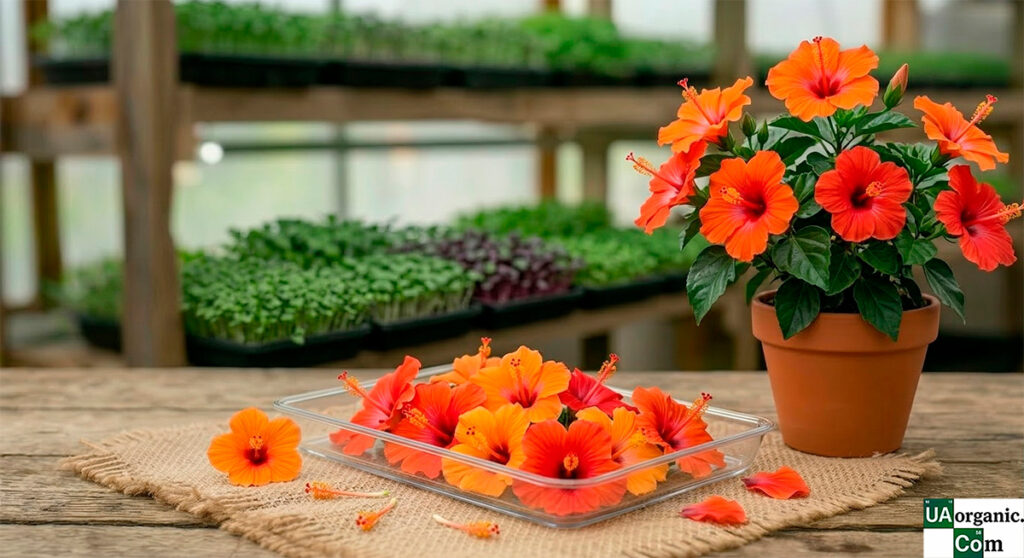
Are all varieties edible: No. It is primarily suitable for culinary use Hibiscus sabdariffa (rosela). Decorative Hibiscus rosa-sinensis — a common indoor and garden species — is not used for food: it does not have the required taste, color and is not confirmed as edible in culinary practice. Hibiscus syriacus (Syrian rose, althea) — also decorative, not for food.
Heat treatment: Unlike most edible flowers, hibiscus tolerates heat well. Boiling and brewing reveal the taste and release the color. For raw serving, petals are added to the dish at the last moment.
- Pregnant women should avoid using in large quantities - some studies indicate a possible effect on the hormonal background
- People taking drugs to lower blood pressure or thin the blood should consult a doctor before taking large doses regularly
- Hibiscus has pronounced acidity - it is better for people with a sensitive stomach to use it with food, not on an empty stomach
- Allergies to hibiscus are rare, but start with a small amount when using for the first time
This information is general in nature and is not medical advice. Sources: USDA FoodData Central, EFSA.
Culinary use
Hibiscus is one of the few edible floral ingredients that performs two functions equally well: coloring and flavoring. Its ruby pigment is activated in the liquid almost instantly, and the acidity remains in the dish even after heat treatment. Therefore, hibiscus is not just a decoration: it changes the balance of taste in the same way as lemon juice or vinegar.
Insistence
hot or cold extraction in water, milk, cream, oil or alcohol. Basic technique: the liquid acquires the color and taste of hibiscus.
Cooking syrup
calixia is boiled with water and sugar. Concentrated syrup for drinks, glazes, dressings is obtained.
Candy making
fresh or soaked calixiu are boiled in sugar syrup until caramelized. Stored for weeks, used for decoration.
Freezing in ice
the flower or petals are placed in an ice cube tray. Spectacular presentation for cocktails and drinks.
Pickling
fresh calixiu are marinated in vinegar with salt and spices; it turns out a piquant addition to salads and meat dishes.
Drying
petals or whole inflorescences are dried at 40–50°C or in the shade; dry hibiscus is the basis for karkade tea; concentrated sour taste and rich burgundy color are preserved for up to 12 months.
- Do not replace Hibiscus sabdariffa decorative indoor hibiscus - the taste, color and culinary properties are fundamentally different
- Do not buy flowers from florists - even if they look bright and fresh, they have been treated with products that are not intended for consumption
- Do not add fresh petals to a hot dish in advance - they lose their color and structure; put at the very end or use as a decoration before serving
- Do not use calixia after flowering without checking - a dense, elastic cup is suitable, flabby and darkened - no
Perfect pairings
ricotta, mascarpone, panna cotta, whipped cream, goat cheese - the acidity of the hibiscus cuts through the oiliness and adds contrast without unnecessary sour notes.
dark and milk chocolate, ganache - the fruity acidity of the hibiscus emphasizes the chocolate bitterness, together they give a complex berry finish.
lemon, lime, orange - strengthen acidity and add aroma; together, a bright base for drinks and sauces is obtained.
gin, tequila, champagne, rum - hibiscus is a classic ingredient in cocktail cuisine; color and acidity make the drink visually complete without additional effort.
Sour hibiscus sauce for duck or pork is the same principle as cranberry sauce for turkey.
raspberry, strawberry, mango, passion fruit - tart berry acidity of hibiscus and tropical sweetness of fruits; a classic combination in Mexican and Caribbean cuisine.
How to select & store
- The calyx is elastic, of a rich dark red or burgundy color
- No traces of darkening, stains or slime
- The smell is fresh, sour-floral - without muddy or sour extraneous notes
- For dried: even color, whole calixiu without crumbling
Buy edible hibiscus only from growers who grow it specifically for food use. Dried Hibiscus sabdariffa in the supermarket - in the tea section - may be suitable for tinctures, but order fresh for culinary use from proven suppliers. Flowers from florist shops and markets do not fit.
Freshness after cutting: 2–3 days
- Fresh calixiu — airtight container with a paper towel, refrigerator +4...+6°C, term 2–3 days
- Do not wash before use - moisture accelerates wilting and spoilage
- Dry hibiscus - airtight bag or jar, dark cool place, shelf life up to 12 months
Composition & properties
Hibiscus (Hibiscus sabdariffa) is one of the richest natural sources of anthocyanins among edible flowers. The ruby color and acidity are not just aesthetics, but a direct reflection of its chemical composition.
| Nutrient | Value (per 100 g of raw calyx) |
|---|---|
| Vitamin C | ~12 mg |
| Calcium | ~215 mg |
| iron | ~1.48 mg |
| Magnesium | ~51 mg |
| Potassium | ~208 mg |
| Anthocyanins (delphinidin, cyanidin) | present in considerable numbers |
| Organic acids (citric, malic, tartaric) | are present |
| Vitamin A (beta-carotene) | present |
| Vitamins B1, B2, B3 | are present |
| Caloric content | ~49 kcal |
Hibiscus is one of the richest plant sources of anthocyanins, the pigments that give it its characteristic dark red color. These compounds are actively studied by scientists in the context of antioxidant properties and are traditionally used in folk medicine of many cultures — from Egypt and Sudan to Mexico and Thailand.
Due to natural pectin in the composition of the calyx, hibiscus forms a gel when cooked - this makes it a valuable ingredient for jams, jellies and confectionery fillings without the addition of thickeners.
Contains organic acids — citric, malic and tartaric — that give it a characteristic sourness. They make hibiscus a natural acidifier in cooking: it can replace lemon juice or vinegar where both taste and color are important.
Composition data: USDA FoodData Central. Numerical values are given for the fresh calyx of Hibiscus sabdariffa.