When and how available
| the moon | Accessibility |
|---|---|
| January — April | ❌ Off season (open soil) |
| May — June | ✅ The beginning of the season, the first flowers |
| July — September | ✅ Peak - abundant flowering, best quality |
| October | ✅ Completion of the season, before the first frost |
| November — December | ❌ Not the season |
City farms with controlled environments can supply nasturtiums year round regardless of the season.
| Form | Features of use |
|---|---|
| fresh | The main form for restaurants is the maximum color and taste, the term is 2–3 days |
| dry | For the decoration of desserts and pastries, the taste is partially lost |
| Kandovan | Desserts, cakes - keeps its shape and color for weeks |
| Frozen in ice | Cocktails, lemonades - a spectacular presentation |
| Marinated (buds) | A substitute for capers in savory dishes |
Taste, aroma & texture
Pronounced peppery with a hint of mustard - similar to watercress or radish, but softer and with a floral sweetness. Nectar with a honey-sweet taste accumulates in the spur (long tail of the flower) - the complete opposite of the petals. The leaves are sharper than the flower, the seeds are the most intense.
Thin, floral-mustard. Not intense - it is felt on direct contact, and not from afar. Does not interfere with other ingredients of the dish.
Petals are thin, velvety, soft. They melt in your mouth almost immediately. The central part of the flower is denser. The leaves are crisp, juicy — more like greens than flowers.
Safety & edibility
Edible flowers are not the same as florist flowers. Only flowers grown specifically for food use without synthetic pesticides are suitable.
- ✅ Petals and the whole flower
- ✅ Leaves (peppery taste, like greens)
- ✅ Buds (pickled like capers)
- ✅ Young seeds (pickled or eaten fresh)
- ❌ Ripe hard seeds are tasteless, they are not used
Are all varieties edible: Yes - all varieties Tropaeolum majus edible Not to be confused with Nasturtium officinale (watercress) is another plant.
- Buds contain an increased amount of oxalic acid - people with sensitive kidneys should use it sparingly
- Allergies to nasturtium are rare, but when using for the first time, it is better to start with a small amount
- Pregnant women are recommended to use in moderation
Heat treatment: Not recommended — the petals lose their color, texture and most of their flavor when heated. Nasturtium is added to the dish at the last moment or served raw.
This information is general in nature and is not medical advice. Sources: USDA FoodData Central, EFSA.
Culinary use
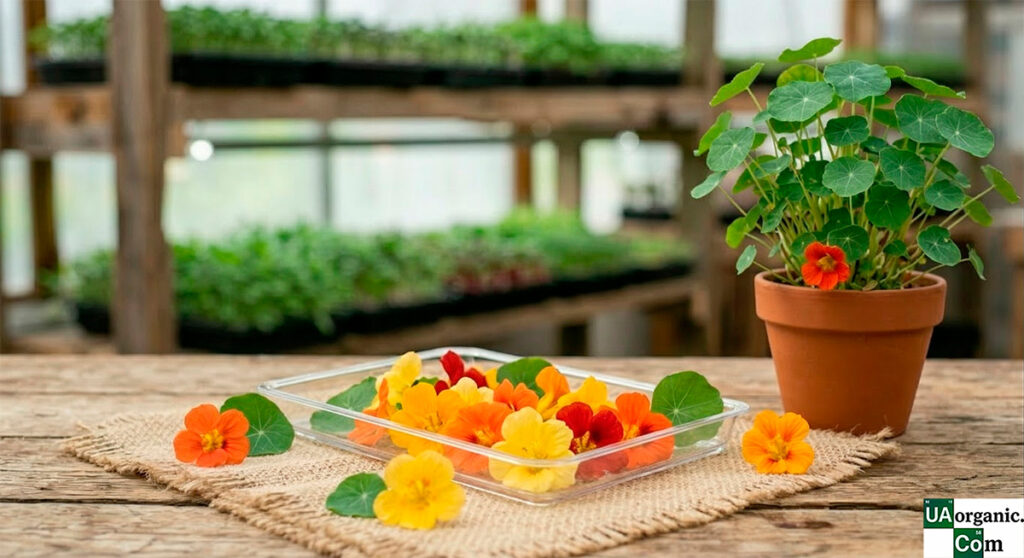
Nasturtium is a rare case when a flower is a full-fledged ingredient and not just a decoration. Pepper flavor works actively in the dish: it replaces radishes, watercress, and mustard. At the same time, it is one of the brightest color accents among edible flowers.
Candy making
the flowers are covered with egg white and sugar, dried. They keep their shape and color for weeks and are used to decorate desserts and cakes.
Freezing in ice
the flower is placed in an ice cube tray, filled with water and frozen. Effective serving of cocktails and lemonades.
Pickling buds
buds collected before opening are marinated in vinegar and salt. They get a substitute for capers with a brighter color and a similar taste.
Insistence
the petals are infused in olive oil, vinegar or alcohol (vodka, gin). The oil acquires a yellow-orange color and a light peppery aroma.
Oil with nasturtium
grind the petals and mix them in the butter. Gives color and taste, is used for finishing dishes and as a spread.
Stuffing
the whole flower is filled with cream cheese with greens or soft pate; served as a canape. The easiest way to serve nasturtium is as an independent snack.
- Do not add to hot dishes - the petals instantly lose their color and turn into a shapeless mass; nasturtium only for cold dishes or finishing
- Do not store cut flowers for more than 2-3 days, even in the refrigerator - they quickly wither; order for a specific serving
- Do not wash under a strong stream - carefully immerse in cold water and dry immediately; the pressure damages the thin petals
- Do not use flowers from a flower shop or market - they are treated with chemicals and are not suitable for consumption
Perfect pairings
salmon, tuna, scallops, herring—the peppery bite of nasturtium works as a classic contrast to fatty and salty. Replaces capers or watercress in serving.
ricotta, cream cheese, burrata, goat cheese — the floral sweetness and peppery finish balance the creamy base.
poached eggs, omelet, egg salad — nasturtium here is both a decoration and a taste accent at the same time.
arugula, spinach, watercress — strengthens the pepper line, adds color and visual complexity without unnecessary ingredients.
lemon vinaigrette, orange dressing - the acid emphasizes the floral aroma and softens the pepper's spiciness.
avocado toast, guacamole, avocado salsa — the peppery bite of nasturtium perfectly contrasts with the fattiness of avocado; a classic pair of modern cuisine.
How to select & store
- Petals are elastic, without darkening and traces of wilting
- The color is saturated and uniform
- The center of the flower is dry, without mucus
- Without extraneous odors
Where to buy is important: Buy edible flowers only from proven producers who grow them specifically for the food industry. Flowers from flower shops, supermarkets and regular markets not suitable for consumption — even if they look fresh.
Freshness after cutting: 2–3 days
- Fresh flowers — airtight container with a paper towel, refrigerator +4...+6°C, term 2–3 days
- Do not wash before use - moisture accelerates wilting
- For a restaurant: order for a specific day of service
Composition & properties
Nasturtium is one of the few edible flowers with notable vitamin C and iron content, setting it apart among ornamental flowers that typically have a modest nutrient profile.
| Nutrient | Value (per 100 g) |
|---|---|
| Vitamin C | ~71 mg (≈78% of daily norm) |
| Vitamin A (beta-carotene) | present |
| iron | ~2.9 mg |
| B vitamins (B1, B2, B3) | are present |
| Flavonoids and antioxidants | are present |
| Potassium, Calcium, Magnesium | are present |
| Caloric content | ~28 kcal |
Nasturtium is a source of vitamin C — one of the few edible flowers with appreciable vitamin C content. It was traditionally used in the folk medicine of South America, where it originates from.
Contains flavonoids - plant compounds that are the subject of scientific research in the context of antioxidant properties. Suitable as part of a varied diet for those interested in plant-based nutrition.
Leaves and flowers have a similar nutrient profile, but leaves are used in larger quantities — they are more filling and closer to greens in terms of their role in the diet.
The information is general in nature and does not constitute medical advice. Composition data: USDA FoodData Central.