When and how available
| the moon | Accessibility |
|---|---|
| January — April | ❌ Off season (open soil) |
| May | ✅ Beginning of flowering |
| June — September | ✅ Peak - abundant continuous flowering |
| October | ✅ The end of the season |
| November — December | ❌ Not the season |
Borago blooms continuously throughout the season — one of the longest "windows" among edible flowers. City farms with controlled environments can supply flowers year round.
| Form | Features of use |
|---|---|
| fresh | Maximum taste and beauty; the period of 1–2 days is one of the most delicate flowers in terms of dormancy |
| Frozen in ice | A classic technique for cocktails and lemonades - the flower is stored in a cube for months |
| Kandovan | Decoration of desserts and cakes; keeps its shape and blue color for weeks |
| dry | For tea mixtures and floral infusions; the color fades a little when it dries |
Taste, aroma & texture
A borage flower and a microgreen borage leaf are two different flavors of the same plant. While the microgreens produce a rich clean cucumber, the flower has a sweeter, honey-cucumber profile—lighter, more floral, with almost no characteristic "green" note. This makes the flower suitable where the taste of microgreens would be too sharp - in desserts, delicate cocktails, in combination with sweet creams.
Thin, fresh - cucumber freshness with a barely perceptible honey shade. Not perfumed and not heavy. Thanks to the aroma, the flower placed in the drink gives it freshness without slicing a cucumber.
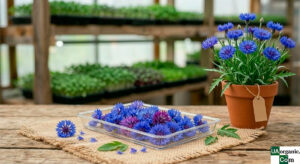
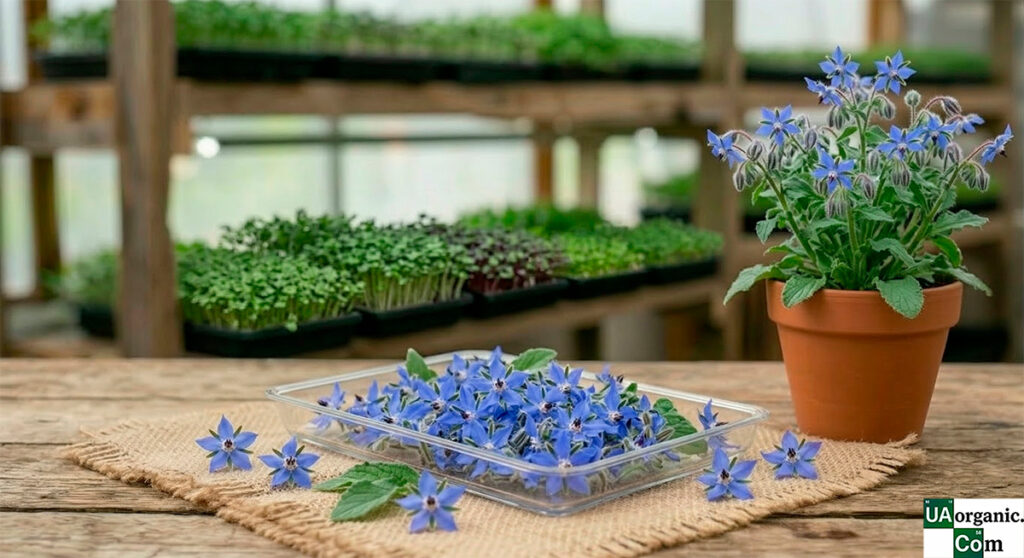
Five thin petals and a small star shape - delicate, thinner than most edible flowers. Melts quickly, does not give chewing. The central column (stamens) is slightly compacted - it can be left or removed.
Safety & edibility
Edible flowers are not the same as florist flowers. Only flowers grown specifically for food use without synthetic pesticides are suitable.
- ✅ Petals are the main culinary part
- ✅ The entire flower is whole (together with the stamens) - in most culinary sources it is used whole
- ⚠️ Green cup-sepal - technically edible, but slightly hairy and bitter; most bosses clean up
- ❌ Leaves for culinary use as an "edible flower" are not relevant in this context
Are all varieties edible: All varieties Borago officinalis (blue, white, pink) edible. Not to be confused with the ornamental plants of the family Boraginaceae, which look similar but are not borages.
Heat treatment: Flowers are used exclusively fresh or candied. When heated, they instantly lose their shape, color and taste. No heat treatment.
Flowers are used exclusively fresh or candied. A few flowers as a decoration or side dish is safe for healthy adults.
Pyrrolizidine alkaloids (PA) — what is important to know:
Borago produces pyrrolizidine alkaloids (PAs), natural substances common to the entire Boraginaceae family. This also applies to flowers.
What this means in practice:
- A few flowers as a decoration or garnish (standard culinary use) — considered safe for healthy adults
- PA concentration in flowers higher, than in the leaves of an adult plant
- The EU has set maximum PA levels for borage food products (EU Regulation 2023/915), but the regulations apply mainly to the leaves, not the flowers – an active area of regulatory attention
- Regular use in large quantities is not recommended
- Pregnant and lactating women should avoid borage in any form
- People with liver diseases should consult a doctor
This information is general in nature and is not medical advice. Sources: USDA FoodData Central, EFSA.
Culinary use
Borago is a flower that "lives" better in drinks than on a plate. A blue star frozen in an ice cube is one of the most recognizable images of modern mixology. But it is not lost on the plate either: the cucumber taste makes it a meaningful addition to fish dishes, seafood and fresh salads, and not just a color stain.
Traditionally, borage is a flower garnish for Pimm's Cup, a classic British summer drink. Today, it is one of the botanical ingredients of some artisanal gins (in particular, Gilpin's Westmorland Extra Dry Gin).
Freezing in ice
the most popular technique for borago. Put the flower in an ice cube tray, fill it half full with water, freeze. Then top up to the edges and freeze again - the two-stage freeze centers the flower inside the cube. The blue color lasts for months.
Candy making
cover with whipped egg white, sprinkle with fine sugar, dry at room temperature for 12–24 hours. You will get a stable decor for cakes and pastries that lasts up to several weeks.
Floral water (infusion)
fresh flowers, soaked in cold water for 2-4 hours in the refrigerator, give flavored water with a delicate cucumber taste for making cocktails and lemonades.
Drying
with proper drying, flowers retain their shape and partly their color; used in tea mixtures and as a dry decoration.
Fresh decor
borage flowers are used freshly picked: one flower per cocktail or dish just before serving. After cutting, they wilt quickly - a maximum of 2–3 hours.
Infusion in vinegar
immerse the flowers in white wine or rice vinegar for 24–48 hours; vinegar acquires a delicate bluish-pink color and a floral shade. For dressings and marinades.
- Do not buy borage from florists or garden stores - only certified edible flowers; this applies to all edible flowers, but is particularly important for borage because of pesticide and PA issues
- Do not add to hot dishes - the flowers will instantly wither; exclusively cold serving or finishing decoration
- Do not use in large quantities every day - borage is an edible flower for a culinary accent, not a daily diet
- Do not substitute microgreen borage leaves for the flower - different flavors for different situations; the flower is sweeter and more delicate, the microgreens are brighter and "greener"
Perfect pairings
gin and tonic, Pimm's Cup, lemonades, sparkling water - the flower is either frozen in ice or fresh on the surface of the drink; conveys a cucumber-honey aroma and gives a blue color accent.
salmon, tuna, sea bass, tartar — the fresh cucumber taste of the flower emphasizes the marine profile of the dish in the same way as an ordinary cucumber, but more delicately.
burrata, ricotta, goat cheese - floral freshness and a honey note of borage balance well the creamy fatness; a classic for cheese plates and bruschetta.
panna cotta, mousses, cakes with butter cream - the sweet honey note of the flower fits organically into desserts; especially impressive visually on a white background.
gazpacho, okroshka, fresh salads - borago enhances the cucumber accent without excess moisture from vegetables.
cucumber canapés, tartlets with cream cheese, rolls - one borage flower for each portion; the cucumber undertone of the flower resonates with the filling.
How to select & store
- Five bright blue petals, evenly opened in the shape of a star
- Stamens are dense, dark - a sign of freshness
- Without darkening, flabby petals, traces of moisture
Exclusively from producers who grow flowers specifically for food purposes with confirmation of the absence of chemical processing. Borage is one of the flowers where the question of source is particularly important, given the plant's natural PA content.
Freshness after cutting: 2–3 days
- Fresh flowers - one of the most tender edible flowers: the term is only 1-2 days even in the refrigerator. Hermetic container with a paper towel, +4...+6°C
- Frozen in ice - indefinitely in the freezer
- Candies are hermetically sealed at room temperature for up to several weeks
- Do not wash before use
Composition & properties
Borago is a plant that is grown not only for flowers. Gives seeds borage oil — the richest plant source of gamma-linolenic acid (GLA, omega-6) among known plants. The flowers themselves have a moderate nutrient profile.
| Nutrient | Value (per 100 g of fresh flowers) |
|---|---|
| Caloric content | ~25–35 kcal |
| Vitamin C | ~35 mg |
| Vitamin A (beta-carotene) | present |
| Vitamin K | present |
| Polyphenols and antioxidants | are present |
| Pyrrolizidine alkaloids (PA) | present — safe in cooking amounts for healthy adults |
| Gamma-linolenic acid (GLA) | traces in flowers; the main concentration is in seed oil |
| Potassium, Calcium, Iron | traces |
Borage flowers are a source of vitamin C and have been traditionally used in Mediterranean cooking for centuries in Frankfurt (Grüne Soße), Liguria (ravioli filling), Great Britain (Pimm's Cup) and Spain. The plant has a long-standing reputation as a "flower of joy" - John Gerard in his "Herball" (1597) wrote about its ability to "raise the spirits and drive away sadness."
The main industrial value of borage is the seed oil, which is the richest plant source of GLA and is widely used in food supplements and cosmetics.
The information is general in nature and does not constitute medical advice. Composition data: USDA FoodData Central.