When and how available
| the moon | Accessibility |
|---|---|
| January — April | ❌ Not the season |
| May — June | ✅ The beginning of flowering, buds - the best moment for collection |
| July | ✅ Peak — abundant flowering, maximum bud quality |
| August | ✅ Completion of flowering, quality decreases |
| September — December | ❌ Not the season for fresh flowers |
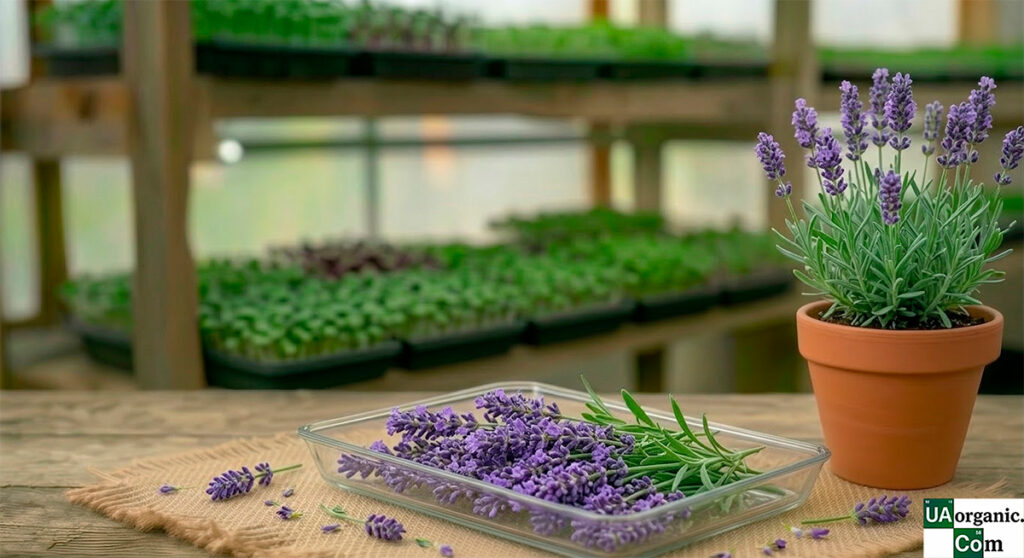
Dried culinary lavender (L. angustifolia) is available all year round. It is best to collect the buds at the beginning of flowering - when they are still half-open: the concentration of essential oils is the highest at this moment, and the taste is the mildest. Fully opened flowers have less fragrance and more pollen.
| Form | Features of use |
|---|---|
| Dry (buds) | The main culinary form is syrups, pastries, meat dishes, tea; stored up to 12 months |
| fresh | Decor and flavoring; term 1–2 days; the taste is softer than dry |
| Aromatic sugar | Buds are sprinkled with sugar - sugar acquires aroma; base for baking |
| Syrup | Buds are brewed with sugar and water; for drinks, glazes, panna cotta |
| Kandovan | Dessert decor — purple buds keep their color for weeks |
| Frozen in ice | Cocktails, lemonades - a purple-blue accent in the drink |
Taste, aroma & texture
Floral-spicy, with subtle sweetness and herbal undertones. English lavender has a low camphor content, so the taste is soft, floral, with a slight citrus or even minty note, depending on the variety. Different cultivars give different accents: 'Hidcote' is more fruity, 'Munstead' is more herbal and floral, 'Melissa' is slightly peppery. An important culinary axiom: if a dish tastes like soap or perfume, either the wrong kind is used (*lavandin*, *stoechas*), or there is too much lavender. The right lavender in the right amount feels "almost imperceptible, but without it something would be missing."
One of the most recognizable herbal aromas in the world is a floral-herbal one with a camphor undertone in the background. In English lavender, this undertone is minimal and not dominant. When heated, the aroma opens and becomes warmer. Dried buds smell more concentrated than fresh ones - and have the same effect in dishes.
The buds are small — 2–5 mm, hard when dry. When fresh, they are softer, slightly sticky from resinous oils. For dishes, the buds can be left whole (decoration) or chopped (even distribution of taste). Stems and leaves are tough, fibrous; they do not go into the dish, but are suitable for marinades and grilling.
Safety & edibility
Edible flowers are not the same as florist flowers. Only flowers grown specifically for food use without synthetic pesticides are suitable.
- ✅ Flower buds and flowers L. angustifolia — the main culinary part
- ✅ Young leaves — in small quantities, for marinades and herbal mixtures
- ⚠️ Woody stems - not eaten, but used as skewers for grilling or in marinades (remove before serving)
- ❌ Flowers L. × intermedia (lavandine), L. stoechas (Spanish), L. dentata (French) — not for culinary use due to high camphor content
- ❌ Lavender essential oil - never added to food
Are all varieties edible: No. Only for cooking Lavandula angustifolia (English, "real", "real lavender"). Recommended Culinary Cultivars: 'Royal Velvet', 'Hidcote', 'Munstead', 'Folgate', 'Melissa', 'Buena Vista'. Do not use: L. × intermedia (lavandine), L. stoechas, L. latifolia, L. dentata.
Heat treatment: Lavender is one of the few edible flowers that tolerate moderate heat well. It is added to dough for baking, marinades, sauces and even to meat. With prolonged boiling, the aroma is destroyed - for infusions, hot water without boiling is better. For candiing — without heating.
- Lavender belongs to the Lamiaceae family — the same as mint, rosemary, and thyme; people with sensitivity to these plants should be careful
- Not recommended for pregnant women use in large quantities - some data indicate a possible effect on the hormonal background
- Lavender can interact with drugs that depress the central nervous system - with regular use in large doses, you should consult a doctor
- An allergy to lavender is common; when using for the first time, start with the minimum amount
This information is general in nature and is not medical advice. Sources: USDA FoodData Central, EFSA.
Culinary use
Lavender in cooking is a spice, not a flower for decoration. It acts like rosemary or thyme: invisible to the eye, but perceptible in the aroma and final taste. A small amount lifts the dish - an excess kills it. That is why they work with lavender differently than with most edible flowers: not "add on top", but "build into the base" through infusion, aromatic sugar or marinade.
Aromatic sugar
the simplest and most reliable technique: the buds and sugar are poured into a jar, closed and kept for a week to a month. Sugar acquires aroma and is used in any baking instead of the usual one.
Insisting in cream or milk
heat the buds together with the cream to 80°C (do not boil), leave for 20–30 minutes, drain. Flavored base for creams, panna cotta and ice cream.
Cooking syrup
brew the buds in hot (not boiling) water, infuse for 10–15 minutes, strain, add sugar and lemon juice. Golden-purple syrup for drinks and confectionery.
Insisting in alcohol
the buds are infused in vodka, gin or vermouth from 2–3 days to a week. Flavored base for cocktails and sauces.
Candy making
buds or small inflorescences are covered with egg white and fine sugar, dried. The purple color lasts for weeks.
Marinade and rub
dry buds are crushed and added to the marinade for meat along with other Provencal herbs. You can also put a stem of lavender on the coals when grilling - the smoke will acquire a floral aroma.
- Do not use lavandin (L. × intermedia) or Spanish lavender (L. stoechas) — even if they look identical to English; a higher camphor content will make the dish soapy and bitter
- Do not add lavender essential oil to food - it is ten times more concentrated than flowers and is not a food product
- Do not exceed the dose - "less is more" with lavender is an axiom; start with half the indicated amount and adjust; if you feel the soap, it's too much
- Don't buy flowers from florists or garden centers - even organic-looking plants can be treated with systemic pesticides
Perfect pairings
panna cotta, crème brûlée, mousse, whipped cream, ice cream — infusion in cream conveys aroma without visible buds; the floral background in the fat base is a classic of Provençal confectionery.
lavender + honey + lemon — the most stable taste triad for drinks and glazes; acid emphasizes the floral aroma, honey softens the spiciness.
lamb, duck, chicken - lavender is part of the classic Provençal marinade along with rosemary, thyme and garlic; the floral spiciness balances the fattiness of the meat.
blueberry, blackberry, fig, peach - lavender emphasizes dark berry aromas and adds a floral undertone to tarts, jams and compotes.
dark chocolate and ganache — lavender and bitter chocolate are a proven duo; the floral flavor softens the chocolate bitterness.
gin, champagne, Provencal vermouth — lavender is a classic botanical ingredient; syrup in cocktails gives a floral-purple accent.
How to select & store
- The buds are dense, of a saturated violet-blue color - without darkening and yellowing
- A pronounced pleasant floral-herbal aroma — without soapy, harsh or camphor notes
- For drying: collect at the beginning of flowering, when most of the buds are still closed
- Pink and white options L. angustifolia — edible, but the dried form is less appetizing (grey); for cooking, it is better to choose dark purple
Buy culinary lavender only from growers who grow it Lavandula angustifolia specially for food use. Dried lavender in the "tea section" of the supermarket may be suitable for infusions, but be sure to check the type of plant. Flowers from garden centers and flower shops not suitable for consumption.
Freshness after cutting: 2–3 days
- Fresh flowers — airtight container with a paper towel, refrigerator +4...+6°C, term 1–2 days
- Do not wash before use - moisture accelerates wilting
- Dry buds - sealed glass jar, dark cool place, shelf life up to 12 months; after a year, the aroma noticeably weakens
- Aromatic sugar - a closed jar, the term is several months
Composition & properties
Lavender is one of the most researched aromatic plants in the world — primarily because of its essential oil. In cooking, it is not the oil that matters, but the flower buds themselves and their chemical composition, which determines the aroma and taste.
| Component | Meaning |
|---|---|
| Linalool | up to 40% essential oil L. angustifolia; soft floral fragrance |
| Linalyl acetate | up to 50%; sweet floral ester |
| Camphor | < 0.5% in L. angustifolia (vs. 10–15% in lavandin) |
| Flavonoids (luteolin, apigenin) | are present |
| Ursolic and rosmarinic acids | are present |
| Vitamin A (beta-carotene) | present |
| Calcium, Iron | are present in the letter |
| Caloric content | minimal - used in small quantities |
Lavender is a Mediterranean plant with a documented culinary and medicinal tradition of more than 2,500 years. The ancient Egyptians used it for mummification, the Greeks and Romans - for flavoring baths, food and wine. In the Middle Ages, it became mandatory in the monastic medicinal gardens of Europe.
The main aromatic components of lavender - linalool and linalyl acetate - are the subject of scientific research in the context of soothing properties. It is because of these compounds that lavender aromatherapy is so popular.
Lavender is part of a classic Provencal herbal blend Herbes de Provence — together with rosemary, thyme, oregano and marjoram. In this context, it acts as one of the spices, not the dominant flavor.
Accurate tabular data for lavender flowers are not published by USDA FoodData Central as a separate line. Data on the composition of the essential oil: scientific publications, PMC/NCBI.