When and how available
| the moon | Accessibility |
|---|---|
| February — March | ✅ V. odorata (fragrant violet) - early spring, the first flowers |
| April — May | ✅ Peak — V. odorata, the first pansies; best quality and fragrance |
| June | ✅ Pansies continue to bloom in cool conditions |
| July — August | ❌ Heat - most species stop flowering or worsen |
| September — October | ✅ Autumn flowering of large pansies (V. × wittrockiana) |
| November — January | ❌ Not the season |
Viola and pansies are cool-loving plants of spring and autumn. Temperature-controlled urban farms can supply them in a wider seasonal window. Viola odorata can bloom twice - in spring and at the end of August-September.
| Form | Features of use |
|---|---|
| fresh | The main form is the decoration of cakes, desserts, salads, cocktails; period of 1-2 days |
| Kandovan | A classic of the Victorian confectionary — keeps its shape and color for weeks |
| Pressed (dried under pressure) | Decor of soap, jelly and resin products; accurate preservation of the flower pattern |
| Frozen in ice | Cocktails, lemonades are a colorful and elegant accent |
| Syrup (V. odorata) | Flowers are infused with sugar and water; violet-blue color, floral aroma |
| dry | For teas and tinctures, the taste partially disappears, the aroma remains V. odorata is stored |
Taste, aroma & texture
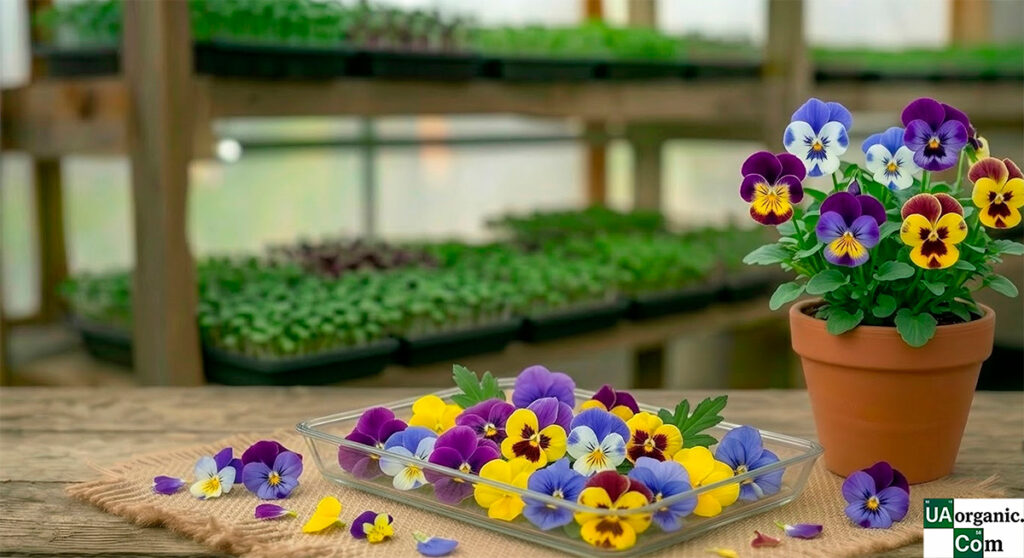
Delicate, slightly sweet, herbaceous-floral, large pansies (*V. × wittrockiana*) are described as resembling young lettuce or fresh greens with a floral undertone and a hint of winter green. Small pansies (*V. tricolor*) have a slightly more distinct and slightly sour taste. *Viola odorata* — fragrant violet — is distinguished by the brightest aroma among all species: floral-sweet, similar to violet perfume. An important detail: the white or light base of the petal at the point of attachment is always more bitter - it is cut or torn off before serving.
Varies significantly between species. Large pansies (*V. × wittrockiana*) have a barely perceptible or almost no aroma. *Viola tricolor* ("Ivanka") is a light herb. *Viola odorata* (fragrant violet) is one of the most recognizable floral aromas in Europe: sweet, powdery, floral, "violet" in the perfume sense. It is *V. odorata* was the basis of the famous French violet candies and Toulouse perfumes.
Petals are velvety, thin, delicate - one of the most velvety textures among edible flowers. Large pansies are convenient for laying whole and for candiing due to their size. Small *Viola tricolor* and *V. odorata* — for spot decoration and infusions. The petals melt in your mouth almost instantly.
Safety & edibility
Edible flowers are not the same as florist flowers. Only flowers grown specifically for food use without synthetic pesticides are suitable.
- ✅ The flowers are whole - without the bitter base of the petal
- ✅ Young leaves - especially in V. odorata; slightly slimy, eaten in salads
- ❌ Roots Viola odorata - strong laxative effect, do not use
- ❌ Stems - do not use
- ❌ The bitter white or yellowish base of the petal is removed before serving
Are all varieties edible: Yes, all the listed culinary types are edible:
- Viola tricolor (pansies, "Ivanka", heartsease) ✅
- Viola × wittrockiana (big pansies, pansy) ✅
- Viola odorata (fragrant violet, sweet violet) ✅
- Viola cornuta (horned barberry) ✅
- Viola odorata 'Parma' (Parma violet) ✅
The taste and aroma differ significantly between species - large pansies are used for confectionery decoration, for flavoring - V. odorata.
Heat treatment: It is better not to heat fresh flowers - they lose the shape and "face" of the flower. For syrup and infusion V. odorata brew in hot water. Leaves withstand light blanching.
- Root part V. odorata contains compounds with a strong laxative effect - do not use
- Viola allergy is rare; when using for the first time, start with a few flowers
- Pregnant women are recommended to consume in moderation, especially large amounts V. odorata
This information is general in nature and is not medical advice. Sources: USDA FoodData Central, EFSA.
Culinary use
Viola is primarily a color and decorative instrument. The "face" of the flower with a characteristic pattern, velvety texture and a wide palette of colors make it one of the most versatile edible flowers for confectioners. U Viola odorata there is also an aromatic function: the floral-sweet aroma is transferred to the liquid and forms the basis of French violet syrups, candies and lollipops. In the remaining types, taste and aroma are the background, not the main thing.
Candy making
the most popular technique for the viola. The flower is covered with a thin layer of egg white with the help of a brush, sprinkled with fine sugar and dried at room temperature for several hours. The shape, pattern and color are preserved for weeks.
Pressing
flowers are placed between sheets of paper under weight for several days. The pressed flower perfectly retains its shape and is used to decorate products made of jelly, resin or lollipops.
Cooking syrup
flowers V. odorata brew in hot water, strain and add sugar and lemon juice. Lemon juice activates a color change: from blue to pink-purple depending on the pH - this is a natural "chemical" effect detail.
Aromatic sugar
flowers V. odorata sprinkle with sugar in a closed jar for a week. The sugar acquires a floral aroma and a light purple hue.
Freezing in ice
the flower is placed in an ice cube tray. The bright drawing of the "face" is perfectly kept in a transparent cube.
Insisting in alcohol
flowers V. odorata infused in vodka or gin. The aroma is transferred to the drink.
- Do not buy pansies and violets from flower shops - they are treated with chemicals and are not suitable for consumption, even if they look fresh
- Do not forget to remove the bitter base of the petal - the light "nail" at the point of attachment to the calyx is always bitterer than the rest of the flower; remove before serving
- Do not use the roots Viola odorata - it is a strong laxative; the edible part is only flowers and young leaves
- Do not expect a bright taste from large pansies - their main value is color and decoration; choose for aroma and taste V. odorata
Perfect pairings
cakes, pastries, panna cotta, mousse, creme brulee - viola is a classic confectionery decoration; velvet petals on a white or cream background look natural and elegant.
ricotta, goat cheese, cream cheese - flowers on top of cheese spread on bruschetta or on a plate with cheese; color and delicate texture without competing with the taste of the cheese.
strawberries, raspberries, blueberries, citrus fruits - small flowers as a decoration emphasize the color scheme and add a botanical character without excessive taste.
a flower in a glass or frozen in ice — the purple-yellow range looks advantageous in a transparent drink.
syrup V. odorata combined with honey and citrus acid — a classic Toulouse tradition; together they give a warm, floral-sweet drink.
bright tricolor viola petals as an elegant decoration in dishes with salmon, sea scallops or carpaccio; violet-yellow note on a pink and orange background.
How to select & store
- Petals are elastic, velvety, without signs of wilting or darkening
- The color is saturated and uniform; the "face" of the flower is clear and expressive
- V. odorata: pronounced pleasant floral-sweet aroma - without it the aroma cannot be transmitted
- Flowers without traces of insects and mechanical damage; perfect flowers are needed for candying
Buy edible flowers only from growers who grow them specifically for food use. Pansies and violets from flower shops and garden centers not suitable for consumption. If you grow it yourself, make sure that the plant has not been treated with chemicals.
Freshness after cutting: 2–3 days
- Fresh flowers — airtight container with a paper towel, refrigerator +4...+6°C, term 1–2 days
- Do not wash before use - moisture accelerates wilting
- Candied flowers — in a dry place at room temperature, up to 2–4 weeks
- Pressed flowers - between sheets of paper in a dark place, period of months
Composition & properties
Genus Viola has 525–600 species and is one of the most studied edible flowers from the point of view of phytochemistry. Viola odorata in particular, it is studied by scientists in the context of the antioxidant properties of its flavonoids and anthocyanins — pigments that give the flower its characteristic purple color.
| Component | Meaning |
|---|---|
| Vitamin C | present in flowers and leaves (264 mg per 100 g of leaves V. odorata — according to some sources) |
| Anthocyanins | ~92 mg of cyanidin-3-glucoside per 100 g of extract V. odorata |
| Flavonoids (rutin, kaempferol, luteolin) | up to 1.1% of the mass of dry flowers |
| Phenolic acids | are present |
| Methyl salicylate | present in the leaf is a characteristic aroma note |
| Anthocyanins (cyanidin, delphinidin, petunidin) | in flowers — provide color and antioxidant properties |
| Cyclotides | present are unique cyclic peptides studied in a medical context |
| Caloric content | minimal - used in small quantities |
Viola odorata used in cooking and folk medicine since ancient Greece and Rome - more than 2000 years. The Romans added violet flowers to wine. In the Middle Ages, monastic apothecaries made violet syrups to treat coughs. In Toulouse (France), the violet tradition was not interrupted: the city is famous for its violet candies (violettes de Toulouse) and violet syrup from the 19th century to the present day.
Flowers Viola tricolor contain a significant amount of rutin, a flavonoid that is actively studied. Anthocyanins in flowers are responsible for the violet-blue color and are pigments with antioxidant properties documented in scientific studies.
Viola odorata interesting to researchers also due to cyclotides — unique stable cyclic peptides, more than 30 varieties of which have been found in the plant. Their biological properties continue to be studied.
The data are based on scientific publications. Accurate tabular data for flowers Viola not published in the USDA FoodData Central database. Sources: USDA FoodData Central, PMC/NCBI (scientific publications about Viola odorata and Viola tricolor).