When and how available
| the moon | Accessibility |
|---|---|
| January — February | ✅ Flowering of indoor plants in warm conditions |
| March — April | ✅ Active flowering indoors |
| May — September | ✅ Peak - open soil and balconies, abundant flowering |
| October — November | ✅ Flowering indoors with sufficient lighting |
| December | ✅ Flowering is possible at home |
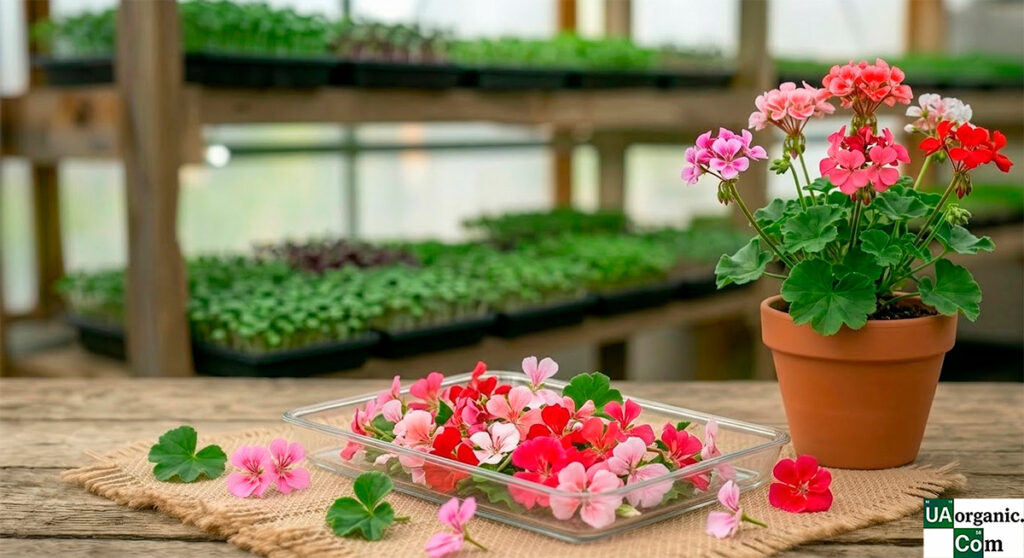
Fragrant pelargonium is one of the few edible flowers that can bloom year round when growing indoors or on a city farm. That makes her especially valuable to the Chiefs in the offseason.
| Form | Features of use |
|---|---|
| fresh | Decor and aromatization of dishes — a maximum of smell and color; period of 1-2 days |
| Aromatic sugar | Leaves or flowers are sprinkled with sugar - the sugar acquires aroma; keeps for weeks |
| Kandovan | Decor of desserts and cakes - keeps its shape and color for weeks |
| Infusion in oil or vinegar | Flavored oil and vinegar for dressings and marinades |
| Syrup | Flowers and leaves are infused with sugar and water - the basis for drinks and confectionery |
| Frozen in ice | Cocktails, lemonades - a floral accent in the drink |
Taste, aroma & texture
Gentle, floral-aromatic — but noticeably weaker than the fragrance. Petals give a subtle taste of rose or citrus (depending on the variety), without sharpness and bitterness. The leaves taste more intense and sharper, but are less suitable for direct consumption - they are more often used for flavoring, removing them before serving. Important: the aroma does not always correspond to the taste - some varieties smell brighter than they taste.
This is the main asset of pelargonium in cooking. Depending on the variety — rose (*P. graveolens*), lemon (*P. crispum*), mint (*P. tomentosum*), apple, nutmeg, cinnamon. The aroma is released upon contact, heating, or infusion in a liquid. Quite stable: keeps in syrup, baking and infused sugar even after cooling.
The petals are thin, soft, slightly velvety. Smaller than most edible flowers - from 1 to 3 cm, depending on the variety. The leaves are covered with fine hairs, a little rough to the touch, they are rarely eaten whole.
Safety & edibility
Edible flowers are not the same as florist flowers. Only flowers grown specifically for food use without synthetic pesticides are suitable.
- ✅ Flowers and petals of fragrant varieties
- ✅ Leaves of fragrant varieties - for flavoring (removed before serving) or in small quantities
- ❌ Flowers and leaves of decorative zonal, ivy-leaved and royal varieties are not for consumption
- ❌ Leaves in large quantities - can cause irritation in some people
Are all varieties edible: No — and this is the key feature of pelargonium. Only suitable for culinary use fragrant pelargoniums (Scented-leaved Pelargonium):
- P. graveolens — pink, aroma of rose and mint
- P. crispum — lemon flavor
- P. tomentosum — the aroma of peppermint
- P. 'Lady Scarborough' — aroma of strawberry and lemon
- P. 'Lime' — the aroma of lime
Common decorative varieties (P. × hortorum — zonal, P. × domesticum - royal, ivy) not edible.
Heat treatment: It is better not to heat the flowers - they lose their delicate texture and color. The leaves tolerate aromatic heating well: they are put under a biscuit before baking or in milk when heating for cream. After heating, the leaves are removed - they transferred the aroma.
- Pelargonium is toxic to cats, dogs and horses - keep the plant out of their reach
- Some people may experience contact skin irritation from the leaves due to the content of essential oils - check for a reaction on first contact
- Pregnant women are advised to use in moderation - data on the safety of regular use in large quantities is limited
- Allergies to pelargonium are rare, but when using for the first time, start with a small amount
This information is general in nature and is not medical advice. Sources: USDA FoodData Central, EFSA.
Culinary use
Pelargonium is primarily an aromatic ingredient, not a color accent. Its main function is to transfer the aroma: rose, lemon or mint to places where it is difficult to get it otherwise. At the same time, the flowers give a delicate pink-lilac decoration. It is in confectionery that pelargonium reveals itself to the fullest: fragrant sugar, biscuit "under the leaves", infused cream - techniques where the aroma becomes the main thing.
Aromatic sugar
leaves and flowers alternate layers with sugar in a closed jar, kept for a week to a month. The most popular technique — gives a persistent aroma without moisture.
Insisting in cream or milk
leaves and flowers are heated together with cream for 5–10 minutes, without bringing to a boil, then kept closed for 20–30 minutes and strained. Base for creams, panna cotta, ice cream.
Insisting in alcohol
the leaves are infused in vodka, gin or wine for a day to a week. They get flavored alcohol for cocktails and sauces.
Infusion in vinegar or oil
flavored salad dressings. Vinegar acquires a floral-herbal character, oil - a more delicate aroma.
Candy making
the flowers are covered with egg white and sugar, dried. The small size of the flowers gives an elegant decor for the confectionery.
Syrup
flowers and leaves are brewed in water, strained, and sugar is added. Base for cocktails, lemonades and glazes.
- Do not use the plant if you are not sure of the variety - decorative zonal and royal pelargoniums that grow on every balcony are not edible; smell and rub the leaf - the edible variety has a pronounced pleasant aroma
- Do not buy flowers from florists or from the market - even fragrant varieties in the trade are usually treated with products not intended for consumption
- Do not use whole leaves in large quantities - they are intended for flavoring, not for direct consumption; remove after imparting fragrance
- Do not expect a bright taste from the flower - the aroma of pelargonium is always stronger than the taste; if a pronounced flavor is desired, use infusions rather than raw petals
Perfect pairings
panna cotta, crème brûlée, mousse, whipped cream - fragrant pelargonium transfers the smell to the fatty base during infusion; a delicate floral background without synthetic fragrances is obtained.
the leaves are placed on the bottom of the mold before pouring the dough - after baking, the biscuit acquires the aroma of a rose or lemon; classic Victorian technique.
strawberry, raspberry, blackberry - the flowers and leaves of the pelargonium rose emphasize the berry aroma and add a floral undertone in desserts and jams.
gin, vodka, champagne - leaves and flowers are infused in alcohol for cocktails; the aroma of rose or lemon is transferred to the drink cleanly and without residue.
the lemon pelargonium variety enhances the citrus note in doughs, creams and drinks - where lemon flavor is needed without its acidity.
fragrant pelargonium leaves are added when brewing black or green tea; the leaves are placed in hot water for 5 minutes, then removed - the tea acquires a floral aroma of rose or lemon; a traditional usage known since the Victorian era.
How to select & store
- Petals are elastic, bright, without signs of wilting and darkening
- A pronounced characteristic aroma when lightly touched - if there is no smell, it is not a culinary variety
- The leaves are dense, green, without spots and traces of pests
- Both flowers and leaves are suitable for aromatic sugar - both parts have an aroma
Buy edible pelargonium flowers only from growers who grow fragrant varieties specifically for food use. If you grow it yourself, make sure that the plant is a fragrant variety (Scented-leaved Pelargonium) and was not chemically treated. Flowers from ordinary flower shops not suitable for consumption.
Freshness after cutting: 2–3 days
- Fresh flowers — airtight container with a paper towel, refrigerator +4...+6°C, term 1–2 days
- Do not wash before use - moisture accelerates wilting
- Leaves for flavoring — keep better than flowers, up to 5 days in the refrigerator in a damp towel
- Aromatic sugar - stored in a closed jar for several months
Composition & properties
Fragrant pelargonium (P. graveolens) contains a complex of volatile essential oils that determine its characteristic aroma and taste. Thanks to these compounds, the plant has long been used not only in cooking, but also in the perfumery industry as a substitute for rose oil.
| Component | Meaning |
|---|---|
| Geraniol | the main aromatic component, up to 40% essential oil |
| Citronellol | the second key component of fragrance |
| Linalool | floral terpene, softens the aroma |
| Isomentone | mint note in some varieties |
| Flavonoids | are present |
| Vitamin C | present in the letter |
| Caloric content | minimal - used in small quantities |
Essential oil Pelargonium graveolens is the subject of active scientific research in the context of antimicrobial and antioxidant properties. Traditionally, the plant was used in folk medicine in South Africa, where it originates, as well as in Victorian cooking in Great Britain, where pelargonium leaves flavored cakes and jams before the advent of synthetic flavorings.
The content of geraniol and citronellol in the leaves and flowers is the reason for the characteristic floral aroma. The same compounds are used by the perfumery industry as a natural analogue and partial replacement for expensive rose oil.
The plant is year-round indoors, making it one of the few edible flower ingredients available in any season without a city farm.
Accurate data for pelargonium flowers in the USDA FoodData Central database is not published as a separate line. Data on the composition of essential oils: PMC/NCBI.