When and how available
| the moon | Accessibility |
|---|---|
| January — April | ❌ Off season (open soil) |
| May | ✅ The beginning of the season, the first flowers |
| June — August | ✅ Peak - abundant flowering, the best quality and color |
| September | ✅ The end of the season |
| October — December | ❌ Not the season |
Urban farms with controlled environments can supply corn year round regardless of the season.
| Form | Features of use |
|---|---|
| fresh | Maximum color and delicacy, term 2–3 days; basic form for restaurants |
| dry | Keeps its color for months - popular for tea mixes, baking, dessert decoration |
| Kandovan | Cakes, pastries - keeps its shape and bright blue color for weeks |
| Frozen in ice | Cocktails, lemonades — a spectacular blue accent in the glass |
Taste, aroma & texture
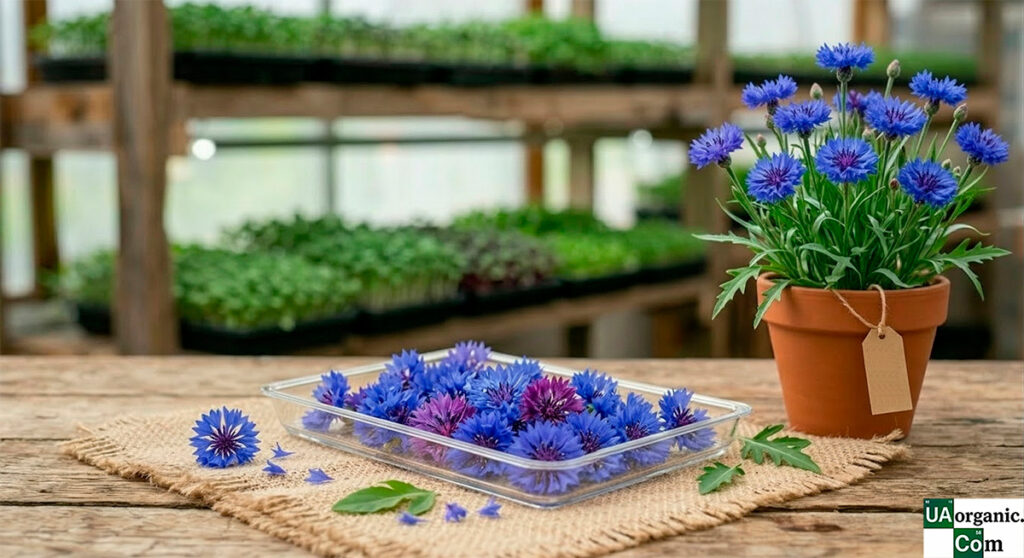
Very soft, slightly grassy with barely perceptible bitterness and a note reminiscent of cloves or light spiciness. Some describe it as "floral neutral" - cornflower hardly affects the taste of the dish, but completely draws attention to itself. In large quantities, a slight astringency appears from the green part of the inflorescence - that's why only the marginal petals are used.
Weak, grassy and floral. Not pronounced and not intense - unlike rose or lavender, cornflower does not flavor the dish and does not compete with other smells. This makes it a convenient decorative ingredient for complex dishes.
The petals are thin, delicate, slightly tubular. Soft to the touch, melts at first contact. They do not give any crunch and do not have a significant mass - an exclusively visual and light tactile effect.
Safety & edibility
Edible flowers are not the same as florist flowers. Only flowers grown specifically for food use without synthetic pesticides are suitable.
- ✅ Marginal tubular petals are the main edible part
- ❌ The green parts of the inflorescence (receptacles, bracts) are bitter and cannot be used
- ❌ Leaves and stems are not edible in the culinary sense
Important: For serving, separate only the blue petals from the green base of the inflorescence. The green part gives unwanted bitterness.
Are all varieties edible: All varieties Centaurea cyanus edible There are varieties with white, pink and purple flowers - they are also edible, but the blue color is most valued in cooking. Not to be confused with other species of the genus Centaurea (black skink, meadow cornflower) - they are not culinary.
Heat treatment: Not recommended - the blue color quickly disappears when heated. Cornflower is added exclusively to cold dishes or as a finishing decoration. In its dry form, it withstands baking, if added only for decoration on top.
- People with allergies to plants of the Asteraceae family (chamomile, yarrow, chrysanthemum) should be careful - a cross-allergic reaction is possible
- Pregnant women are recommended to use in moderation
This information is general in nature and is not medical advice. Sources: USDA FoodData Central, EFSA.
Culinary use
Cornflower is primarily a chef's color tool. Deep blue, which is almost absent in ordinary products, instantly distinguishes the dish visually. At the same time, the taste is neutral - the flower does not change the taste profile of the dish and is combined with any concept. This makes it one of the most "convenient" edible flowers for restaurant use.
Candy making
cover the petals with egg white and fine sugar, dry at room temperature. Keeps a bright blue color for weeks, resistant to moisture when serving desserts.
Drying
cornflower retains its color when dried better than most edible flowers. Dry petals are used in teas, pastries (add on top before baking), decoration.
Freezing in ice
a flower or individual petals are placed in an ice cube tray, filled with water and frozen. A blue accent in a cocktail or lemonade.
Natural coloring
infusion of petals in warm water gives a pale blue or gray-blue color. They are used for coloring glazes, creams, and pasta. In an acidic environment, the color shifts to pink.
Fresh decor
inflorescences or individual cornflower flowers are placed on the dish immediately before serving; rich blue color is one of the rarest in nature, very impressive on neutral backgrounds.
Infusion in vinegar
cornflower flowers in white or apple vinegar for 24–48 hours; vinegar acquires a delicate blue-violet shade; for dressings and marinades with a color effect.
- Do not buy cornflowers from florists or at the flower market - they are unsuitable for consumption; only food certified flowers
- Do not use the green part of the inflorescence - separate only the blue petals, the rest gives unwanted bitterness
- Do not add to hot dishes - the blue color disappears when heated; cornflower only for cold serving or finishing decoration
- Do not combine with strongly acidic dressings immediately before serving - anthocyanins can change color; if acid is needed, add flowers at the last moment
Perfect pairings
soft cheeses - burrata, ricotta, goat cheese, cream cheese - a white or cream background emphasizes the blue color of the petals as much as possible. A classic combination in cheese plates and canapés.
cakes, pastries, macaroons, panna cotta - cornflower is one of the most popular flower decorations in confectionery due to the fact that it retains its color when dried and candied.
dry cornflower petals are a classic ingredient in Earl Gray and numerous herbal blends. They give a delicate floral aroma and an attractive appearance of loose tea.
lemonades, gin and tonics, sparkling water - fresh or frozen cornflower gives a blue accent in a clear drink. In an acidic environment, it may change color slightly - take this into account when planning serving.
any green salad, seasonal vegetable mix, carpaccio — the petals add a contrasting color accent without affecting the taste.
the bright blue color of cornflower contrasts with pink salmon or tuna; a few flowers as decoration in Scandinavian fish dishes or carpaccio.
How to select & store
- The petals are bright blue, elastic, without darkening or signs of wilting
- The flower is fully opened, but not overbloomed
- Without extraneous odors and traces of moisture in the center
Exclusively from producers who grow flowers specifically for the food industry with confirmation of the absence of chemical processing. Cornflowers from florist shops, supermarkets and brick-and-mortar markets - even if they look identical - not suitable for consumption.
Freshness after cutting: 2–3 days
- Fresh flowers — airtight container with a paper towel, refrigerator +4...+6°C, term 2–3 days
- Dry petals - airtight jar, dark place, shelf life up to 12 months
- Do not wash before use - moisture accelerates fading and discoloration
Composition & properties
Cornflower is one of the record holders among edible flowers for the content of anthocyanins: it is they that give it its characteristic blue color and are the basis of the nutrient profile of the flower. According to scientific research, the content of anthocyanins in cornflower is one of the highest among the analyzed edible flowers — higher than nasturtium, calendula and marigold.
| Nutrient | Value (per 100 g) |
|---|---|
| Caloric content | ~30–40 kcal |
| Anthocyanins (protocyanin, etc.) | ~1012 mg/kg is one of the highest indicators among edible flowers |
| Vitamin C (ascorbic acid) | ~129.7 mg (≈144% of the daily norm) |
| Folate (vitamin B9) | present |
| Biotin (vitamin B7) | present |
| Flavonoids and polyphenols | are present |
| Tannins (tannins) | are present |
| Calcium, Potassium, Magnesium | traces |
Cornflower is a source of anthocyanins, plant pigments that are also found in blueberries, red cabbage, and cherries. It is anthocyanins that are responsible for the characteristic blue color of the flower and are the subject of scientific research in the context of the antioxidant properties of plant products.
The flower contains vitamin C in a noticeable concentration — according to research, more than nasturtium. It is suitable as part of a varied diet for those who focus on plant-based nutrition and want to expand the palette of colored products.
Dry cornflower petals are traditionally used in tea mixtures — for example, as a component of Earl Gray and author's herbal teas. In this form, the flower is a completely safe food ingredient according to the conclusion of the EU regulatory authorities.
The information is general in nature and does not constitute medical advice. Composition data: USDA FoodData Central, scientific research: PMC — Edible Flower Species as a Promising Source of Specialized Metabolites.