When and how available
| the moon | Accessibility |
|---|---|
| January — April | ❌ Off season (open soil) |
| May | ✅ The beginning of the season, the first flowers |
| June — October | ✅ Peak - abundant flowering until frost |
| November — December | ❌ Not the season |
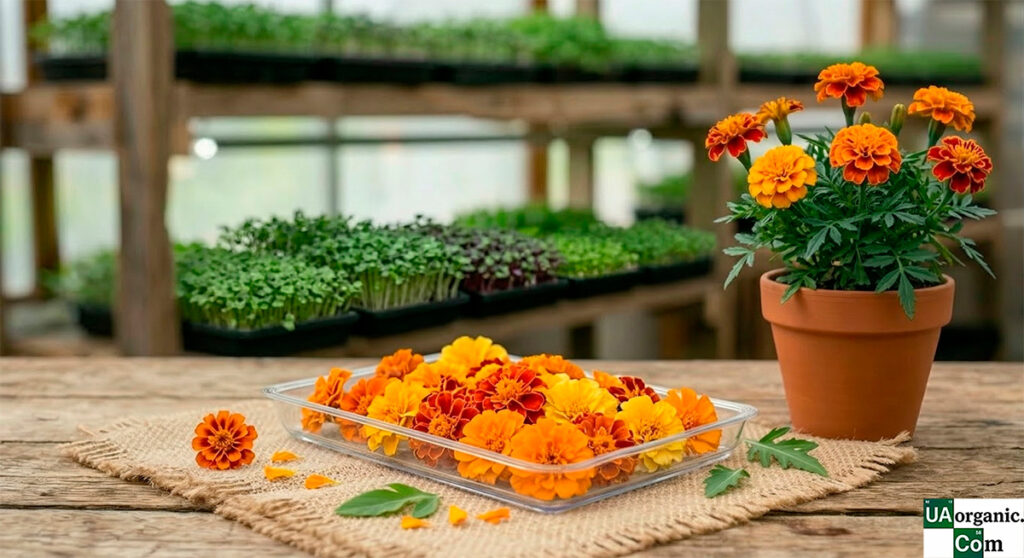
Marigolds have the longest season among most edible flowers — bloom from May to October inclusive. City farms with a controlled environment can supply them year-round.
| Form | Features of use |
|---|---|
| fresh | Maximum aroma and taste, 2-4 days; basic form for restaurants |
| dry | Keeps color and taste for months; popular for teas, spices, dry marinades |
| Petals in oil | Infusing the petals in neutral oil gives a golden oil with a citrus-spicy aroma |
| Kandovan | Cakes and pastries - keeps its shape and bright color for weeks |
| Powder (dry ground petals) | Substitute saffron for coloring risotto, pasta, baking; gives a golden color |
Taste, aroma & texture
Expressive and complex — citrus (lemon, tangerine) with spicy bitterness and notes reminiscent of cloves or black pepper. Different varieties differ: marigolds (*T. tenuifolia* — "Lemon Gem", "Tangerine Gem") are the most citrusy and least bitter, considered the best for cooking; French (*T. patula*) are more spicy and spicy; the African ones (*T. erecta*) are the most intense, but also the worst—they are generally used only for coloring, not for flavor. In all variants, the green base of the inflorescence gives an undesirable sharp bitterness - only the petals are used.
Strong, characteristic - spicy-citrus with a light musk note. The aroma of marigolds is noticeable even from a distance, which leads to their reputation as a "flower with character." When dried, the aroma becomes softer and more concentrated.
Petals are denser than those of cornflowers or nasturtiums - noticeable on the tooth, slightly chewy. Give a tangible presence in the mouth, not just a visual effect.
Safety & edibility
Edible flowers are not the same as florist flowers. Only flowers grown specifically for food use without synthetic pesticides are suitable.
- ✅ Petals (marginal florets) are the main edible part
- ❌ The green base of the inflorescence (receptacle, bracts) is bitter, not used
- ❌ Leaves and stems - have a sharp smell, are not a culinary part of the plant
Important: Before serving, carefully separate the petals from the green base - it is this that gives the unwanted sharp bitterness, which is often mistakenly attributed to the flower as a whole.
Are all varieties edible: Most species of the genus Tagetes technically edible, but they are primarily considered culinary valuable T. tenuifolia (signet), T. patula (French) and T. erecta (African). Not to be confused with calendula (Calendula officinalis) — it is sometimes called "pot marigold", but it is a completely different plant with a different taste and use.
Heat treatment: Petals withstand moderate heat - they can be added to warm dishes, risotto, soups at the end of cooking. With strong heating, the aroma weakens, the color remains. Dry ground petals are stable when baked.
- People with allergies to plants of the Asteraceae family (chamomile, sunflower, chrysanthemum) should start with a small amount - cross-allergy is possible
- When used in large quantities, the African variety (T. erecta) can cause slight discomfort in the stomach
- Moderate use by pregnant women
This information is general in nature and is not medical advice. Sources: USDA FoodData Central, EFSA.
Culinary use
Marigolds are a rare case when an edible flower is equally strong as a flavor ingredient and as a decoration. The citrus-spicy flavor of the petals really changes the profile of the dish, and the bright yellow-orange color rivals saffron in visual impact. That is why tagetes has long been called "poor man's saffron" - and is used for natural coloring of risotto, pasta, oils and pastries.
Insisting in oil
1–2 handfuls of fresh or dry petals per 200 ml of neutral oil, 3–5 days in a dark place. The result is a golden aromatic oil for dressings, serving and marinades.
Drying and grinding
dry petals are ground into powder and used as a substitute for saffron. They give a rich yellow-golden color to risotto, paella, pasta, butter and pastries. Can be stored up to 12 months in an airtight jar.
Candy making
the petals are covered with whipped protein and fine sugar, dried at room temperature. For decorating cakes and pastries.
Infusion for drinks
fresh petals are infused in cold water for 2–4 hours in the refrigerator; get flavored water with a light citrus taste for lemonades and cocktails.
Marinade
chopped fresh petals with olive oil, salt and lemon juice; marinade for chicken, fish, grilled vegetables.
Candied flowers
the whole inflorescence or individual petals are covered with egg white and fine sugar; spectacular decoration for cakes and pastries with a warm orange-yellow color.
- Do not buy marigolds from florists, garden stores or the market - they are not intended for consumption; only certified edible flowers
- Do not use the green base of the inflorescence - separate only the petals; the green part gives a sharp unpleasant bitterness
- Do not add the African variety (T. erecta) in large quantities - it is the most bitter; for taste, signet or French is better
- Do not confuse with calendula - similar appearance, but completely different taste and use
Perfect pairings
salmon, tuna, sea bass, mussels - the citrus-spicy note of the petals emphasizes the taste of the sea; especially good in tartare, carpaccio and cold appetizers.
chicken, duck - petals are added to the marinade or sprinkled on top when serving; the combination is mature and not pretentious.
ricotta, goat cheese, burrata — the bitter spiciness of tagetes balances the fatty creamy base; a good combination for bruschetta and toast.
lemon, orange, mandarin — strengthen the citrus notes of the petals; together they give a distinct but not sharp accent in desserts and drinks.
risotto, paella, couscous — the ground dry petals color the grain golden, like saffron, and add a spicy flavor at a much lower price.
mixed into the dough or sprinkled on top - dry marigold petals color bread and focaccia in a golden tone and give a light spicy aroma; traditional use in Georgian cuisine.
How to select & store
- The petals are bright (yellow, orange or two-color), elastic, without darkening
- The flower is completely or almost completely opened
- A characteristic spicy-citrus smell when touched is a sign of freshness and saturation of the aroma
- No traces of moisture, mold or insect damage
Exclusively from producers who grow flowers specifically for the food industry with confirmation of the absence of chemical processing. Marigolds from florist shops, garden centers and regular markets not suitable for consumption — even if they look the same.
Freshness after cutting: 2–3 days
- Fresh flowers — airtight container with a paper towel, refrigerator +4...+6°C, term 2–4 days
- Dry petals - airtight jar, dark place, shelf life up to 12 months
- Ground powder — in a dark hermetic jar, up to 6 months
- Do not wash before use - moisture accelerates withering; if necessary, shake off the pollen slightly before serving
Composition & properties
Marigolds are the record holder among edible flowers in terms of content lutein: according to research, up to 1062 mcg/g fresh weight - more than any other edible flower studied. This is why the industrial extract of tagetes petals is the main commercial source of lutein for food additives worldwide - it is recognized and evaluated by JECFA (Joint FAO/WHO Expert Committee on Food Additives).
| Nutrient | Value (per 100 g of fresh petals) |
|---|---|
| Caloric content | ~25–40 kcal |
| Lutein | ~106 mg (~1062 μg/g) is a record among edible flowers |
| Zeaxanthin | ~3–10 mg (2–9% of total carotenoids) |
| β-carotene | ~0.5–2 mg |
| Flavonoids (quercetin) | ~50–200 mg |
| Vitamin C | ~20–40 mg |
| Vitamin E | ~1–3 mg |
Marigold petals are the richest food source lutein among flowers - carotenoid, which is also found in spinach, egg yolk and corn. The industrial processing of tagetes for lutein is a global industry in its own right: the flower extract is used in nutritional supplements, with billions of doses produced annually.
The bright yellow-orange color of the petals is caused precisely by carotenoids — the same pigments that are responsible for the color of carrots and pumpkins. The same pigments give the effect of a natural dye: ground marigold petals have long been used to dye fabrics, poultry feathers (which gives bright yellow egg yolks and chicken skin) and food products instead of saffron.
The flavonoids of the flower, in particular quercetin, are the subject of scientific research in food chemistry. Tagetes is included in the list of herbal ingredients allowed as food additives in the EU and USA.
The information is general in nature and does not constitute medical advice. Composition data: USDA FoodData Central, scientific sources: PMC — Edible Flower Species as a Source of Specialized Metabolites, FAO/JECFA — Lutein from Tagetes erecta.