
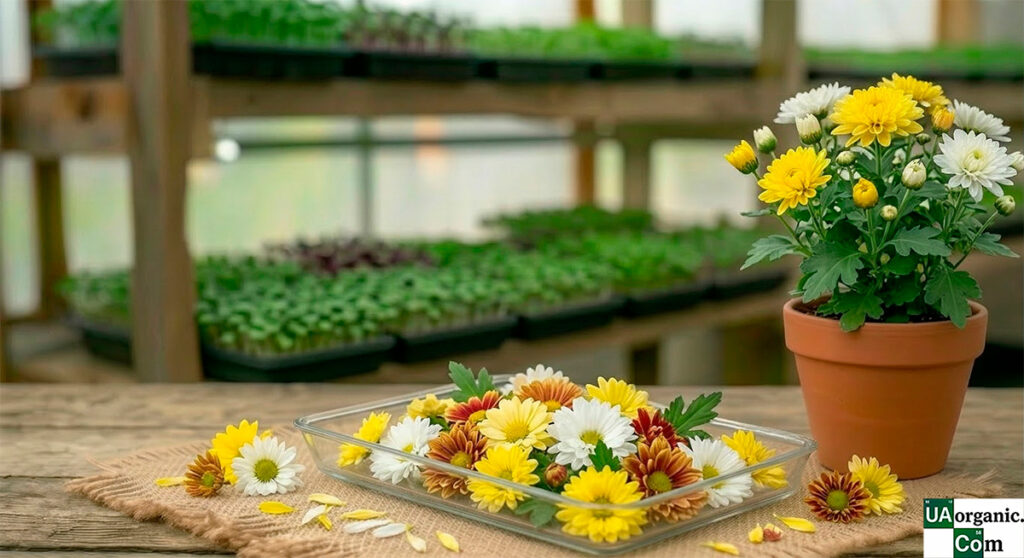
When and how available
| the moon | Accessibility |
|---|---|
| January — April | ❌ Not the season for flowers |
| April — June | ✅ Glebionis coronaria (shungiku) — spring harvest of leaves and flowers |
| July — August | ❌ A pause in the heat — the quality of greens decreases, becomes bitter |
| September — October | ✅ The peak is autumn flowering C. morifolium, the best quality of flowers |
| November | ✅ Glebionis — the autumn harvest of greens |
| December | ❌ Not the season |
Chrysanthemum is a cool-loving plant. Glebionis coronaria (shungiku) gives two harvests of greenery and flowers per year: in spring and autumn. In the summer, in the heat, it becomes bitter and goes to the arrow. Temperature-controlled city farms can supply shungika year-round.
| Form | Features of use |
|---|---|
| Fresh (petals) | Decor of dishes, garnish for sashimi and cold dishes; period of 1-2 days |
| Fresh (shungiku greens) | Japanese greens for hot pot, stir-fry, salads; period of 2-3 days |
| dry | The main form for tea júhuā chá; taste and aroma are preserved for months |
| Kandovan | The decoration of desserts and cakes is an autumn confectionary accent |
| Frozen in ice | Cocktails and lemonades — yellow or white in a cube |
| Syrup | Flowers are infused with sugar and water; soft flower-honey taste |
Taste, aroma & texture
Yellow and white varieties *C. morifolium* are the softest: slightly sweet, floral-herbaceous, with a subtle earthy undertone. Some describe it as a mixture of chamomile and slightly bitter greens. Bright decorative hybrids are noticeably more bitter and peppery. Green shungiku (*Glebionis*) has a separate taste profile: slightly bitter, fresh, spicy-herbal, some feel a citrus-carrot undertone. An important detail: the white or yellow base of the petal is always more bitter than the rest - it is cut or torn off before use.
Floral-herbal, slightly resinous, with a light autumnal note - typical of the entire genus. Yellow varieties smell softer and honeyier, brightly colored ones - more spicy. When brewed, the aroma becomes warmer and more floral. Green shungiku smells more intense: spicy, slightly sharp, very vegetal.
Petals are thin and delicate in small varieties, denser and more fibrous in large decorative ones. After blanching, they become soft and keep their shape. Shungiku greens are juicy and crunchy when fresh, slightly sticky after quick blanching.
Safety & edibility
Edible flowers are not the same as florist flowers. Only flowers grown specifically for food use without synthetic pesticides are suitable.
- ✅ Petals C. morifolium and C. indicum — without a bitter base
- ✅ Leaves and young shoots Glebionis coronaria (shungiku) - like greens
- ✅ Flowers Glebionis coronaria — fresh or for tea
- ✅ Buds - for infusions and drying
- ❌ The base of the petal (white or yellow "marigold") is bitter, it is removed
- ❌ Stems and roots are not used
- ❌ Flowers Chrysanthemum cinerariaefolium (Dalmatian chamomile, pyrethrum) — source of natural insecticide pyrethrin, not for food
Are all varieties edible: Technically, all chrysanthemums of the genus Chrysanthemum are considered non-toxic to humans. But the taste varies from pleasant to inedibly bitter. Recommended for cooking:
- Chrysanthemum morifolium — yellow and white varieties; tea, decor, garnish
- Chrysanthemum indicum — close to the previous one; tea and cooking
- Glebionis coronaria (shungiku) — edible greens and flowers; Japanese cuisine
Avoid: Chrysanthemum cinerariaefolium — a source of pyrethrin (insecticide).
Heat treatment: It is better not to heat the petals for decoration - they lose their color and shape. For tea, brew in hot water without boiling. Green shungiku tolerates rapid blanching and stir-fry well - but do not overcook: they are added last to the dish.
- Chrysanthemum belongs to the Asteraceae family (Asteraceae) — people with allergies to ragweed, wormwood or chamomile should be careful: a cross-reaction is possible
- Chrysanthemum toxic to cats and dogs — pyrethrin and sesquiterpene lactones cause coughing, vomiting, and tremors in animals. Keep the plant out of their reach
- When in contact with the plant, contact dermatitis is possible in sensitive people - gloves are recommended when working with large volumes
- Pregnant women are recommended to use in moderation
This information is general in nature and is not medical advice. Sources: USDA FoodData Central, EFSA.
Culinary use
Chrysanthemum performs different roles depending on which part of the plant is used. Petals C. morifolium is primarily a decor and aromatic accent in Japanese and Chinese cuisine. Green shungiku (Glebionis) is a complete vegetable ingredient, indispensable in hot pot and stir fry. Dried flowers are the basis of classic Chinese tea júhuā chá. In modern restaurant kitchens outside of Asia, chrysanthemum is most often used as an autumn decorative accent.
Brewing tea
dry buds or flowers are brewed with water at 85–90°C, not boiling. 3–5 minutes of infusion. Classic: yellow or white buds C. morifolium, honey, goji berries.
Blanching petals
the petals are immersed in boiling water for 5–10 seconds and immediately transferred to cold water. They retain their color and become softer; equipment for side dishes and salads.
Insisting in alcohol
the buds are infused in rice wine (mirin, sake), vodka or gin. Korean rice wine with chrysanthemum — gukhwaju — a traditional drink.
Candy making
the petals are covered with egg white and fine sugar, dried. Yellow and white is a classic autumn decor for a pastry shop.
Drying
buds or half-opened flowers are dried in the shade with good ventilation. Store in a glass jar for up to 12 months.
Cooking syrup
flowers are brewed in water, strained, honey or sugar and lemon juice are added. Soft flower-honey syrup for drinks.
- Do not buy chrysanthemums from florists, shops or markets - even if they look fresh; do not wash off systemic pesticides
- Do not use brightly colored decorative hybrids without a preliminary taste test - most of them are more bitter than the classic yellow and white varieties; always try one petal first
- Do not forget to remove the base of the petal - the white or yellow "nail" at the point of attachment is always bitter; remove before use
- Do not overcook the shungiku greens - they are added last to the dish and need only a few seconds or a minute of blanching; becomes bitter and darkens from excessive heating
Perfect pairings
Sashimi, Tuna, Salmon - chrysanthemum petals are a classic Japanese side dish for sashimi - a delicate floral aroma enhances the delicate taste of raw fish without competition.
Sesame oil, soy sauce, tofu - shungiku greens are blanched and served with sesame oil and soy sauce - a Japanese offering where bitter-spicy greens and nutty sesame find the perfect balance.
Honey, lemon, ginger - in tea and syrup, chrysanthemum goes well with honey and citrus acid - a classic addition to Chinese júhuā chá.
in Japanese and Chinese cuisine, chrysanthemum petals are added to rice dishes and tofu soups for flavor and color.
a traditional dish of the state of Assam (India) is chrysanthemum petals fried with duck eggs and rice.
chrysanthemum petals are boiled in light chicken or fish broth; a floral note ennobles the taste; traditional use in Japanese and Chinese cuisine.
How to select & store
- The petals are elastic, the color is saturated and uniform - without darkening or signs of wilting
- The smell is pleasant, floral and herbal - without chemical or harsh notes
- Yellow and white varieties - for a milder taste; bright - only after a preliminary test
- Green shungiku: the leaves are bright green, crisp, without yellowing or signs of decay
Buy edible chrysanthemum flowers and greens only from growers who grow them specifically for food use. Chrysanthemums from flower shops, supermarkets and markets not suitable for consumption. Shungika can be found in season at Asian grocery stores—but make sure it's chemical-free.
Freshness after cutting: 2–3 days
- Fresh petals — airtight container with a paper towel, refrigerator +4...+6°C, term 1–2 days
- Do not wash before use - moisture accelerates wilting
- Fresh shungiku greens — in a damp towel in the refrigerator, 2–3 days
- Dry flowers - glass jar, dark place, up to 12 months
Composition & properties
Chrysanthemums have been cultivated for food and tea in China and Japan for over 2,500 years. Modern science studies its composition — primarily flavonoids and specific terpenes — in the context of antioxidant and anti-inflammatory properties. Green shungiku (Glebionis coronaria) has a notable nutrient profile as a leafy vegetable.
| Nutrient | Value (per 100 g of fresh flowers/greens) |
|---|---|
| Caloric content | ~20–30 kcal |
| Potassium | ~610 mg |
| Carotene (provitamin A) | ~3.4 mg |
| Vitamin C | ~30–50 mg |
| Calcium | ~70–100 mg |
| iron | ~1.5–2.5 mg |
| Lutein | ~1–3 mg |
| Flavonoids (apigenin, luteolin) | ~0.5–2% of dry mass of flowers |
Chrysanthemum in Chinese culture is a symbol of longevity and autumn. Chrysanthemum tea (júhuā chá) is one of the most common herbal drinks in China and has been consumed continuously for at least 1,500 years. It is traditionally considered a "cooling" drink in the Chinese medicine system.
Shungiku green is an important leafy vegetable in Japanese, Chinese, Korean and Vietnamese cuisine. In Japan, it is a mandatory ingredient in sukiyaki and nabemono (hot pot). In Crete, young shoots of a similar species are eaten fresh or boiled under the local name mantilla — a Mediterranean tradition dating back to ancient times.
Chrysanthemum flowers are also the raw material for the natural insecticide pyrethrin — but only a specific species C. cinerariaefolium; culinary varieties do not contain it in significant quantities.
Data for shungiku: Wikipedia with reference to scientific sources; for flowers C. morifolium individual data in the USDA FoodData Central database have not been published. Sources: USDA FoodData Central, scientific publications about Chrysanthemum morifolium and Glebionis coronaria.