When and how available
| the moon | Accessibility |
|---|---|
| January — April | ❌ Not the season |
| May — June | ❌ Plant growth, before flowering |
| July — August | ✅ Beginning of flowering |
| September — October | ✅ Peak - the most flowers, maximum quality |
| November | ❌ The end of the season, the first frosts |
| December | ❌ Not the season |
Potatoes are harvested in autumn after the first frosts - their taste becomes softer and sweeter after storage. City Farms can supply dahlia petals year-round under controlled conditions.
| Form | Features of use |
|---|---|
| fresh | The main form for restaurants is the decoration of dishes, salads, desserts; period of 1-2 days |
| dry | For the decoration of confectionery; the taste practically disappears, the color remains |
| Kandovan | Cakes, desserts - keeps its shape and color for weeks |
| Frozen in ice | Cocktails, lemonades - spectacular color presentation |
| Potatoes are fresh / boiled | A separate ingredient — instead of potatoes or water walnut in dishes |
Taste, aroma & texture
Petals of most varieties are neutral or slightly sweetish, with a faint floral flavor. Some varieties give a distinct radish or spicy note, others are slightly bitter. That is why the dahlia wins where the main thing is color and shape, not taste. Potatoes are a separate story: crispy, juicy, with a taste from neutral to similar to water walnut, celery or carrot root, depending on the variety and storage time.
Very weak or absent in most varieties. Some simple varieties have a barely perceptible floral-herbal aroma upon direct contact. Dahlia does not interfere with other ingredients - this makes it convenient in complex dishes.
Petals are velvety, soft, thin - quickly wither after cutting. The central part of the flower is denser, with tubular petals that add volume to the decor. Potatoes are crunchy in raw form, similar to water walnut; after cooking, they become softer, but retain their structure better than potatoes.
Safety & edibility
Edible flowers are not the same as florist flowers. Only flowers grown specifically for food use without synthetic pesticides are suitable.
- ✅ Petals and the whole flower
- ✅ Potatoes (boiled, fried, raw young)
- ❌ Leaves and stems - can cause irritation; are not used
Are all varieties edible: Yes, all varieties of the genus Dahlia are considered edible. However, the taste of the petals varies dramatically: from pleasant to bitter. Simple varieties or proven culinary selections are recommended for culinary use (D. coccinea, D. pinnata / D. x variabilis, 'Yellow Gem'). Lush decorative hybrids are better to try first - to taste, and then decide whether it is worth serving them.
Heat treatment: It is better not to subject the petals to heat treatment - they lose their structure and color. They are added to the dish at the last moment or used to decorate the finished dish. Potatoes, on the contrary, tolerate boiling, frying and baking well.
- Dahlia tubers contain a significant amount of inulin, a soluble dietary fiber. People with sensitive digestion should start with small portions: excess inulin can cause bloating
- Dahlia allergy is rare, but it belongs to the Asteraceae family (Asteraceae) — those who are sensitive to chrysanthemums, chamomile or ragweed should be careful
- When using for the first time, start with a small amount
This information is general in nature and is not medical advice. Sources: USDA FoodData Central, EFSA.
Culinary use
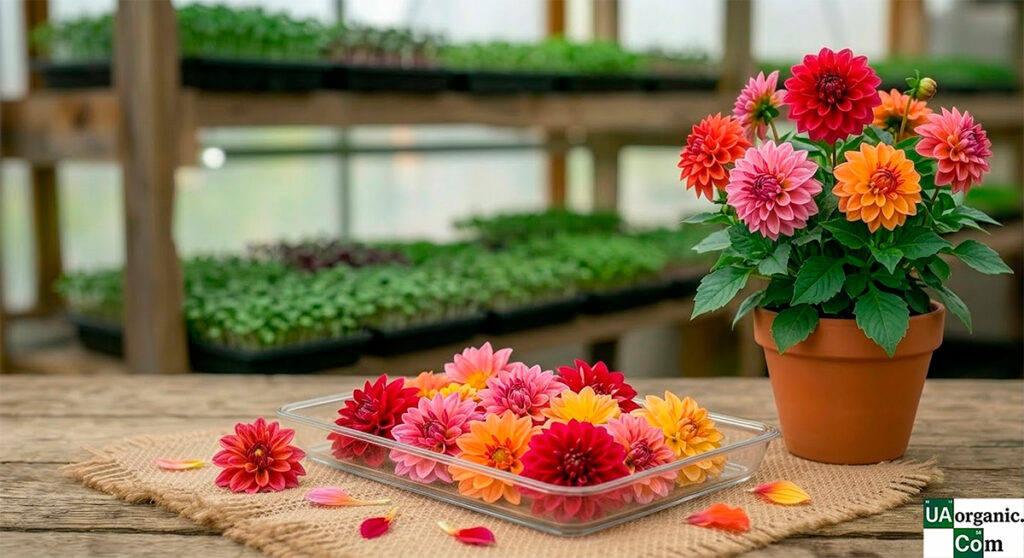
Dahlia is primarily a color and visual tool. A wide range of shades (from creamy white to almost black-burgundy), the large size of the flower and the velvety texture of the petals make it one of the most spectacular edible flowers for serving. The flavor contribution is secondary and depends on the variety. That is why dahlia feels best where a bright accent is needed without competing with other flavors.
Candy making
petals or whole flowers are covered with egg white and sugar, dried. The shape and color are preserved for weeks. The most effective technique for large varieties of dahlias.
Freezing in ice
a flower or individual petals are placed in an ice cube tray. The bright color keeps well in frozen form.
Insisting in oil
the petals are infused in olive or neutral oil for a day. The oil acquires a light floral aroma and color; for dressings and serving.
Oil with petals
finely chopped petals are mixed with butter. Color and aromatic accent for finishing hot dishes.
Preparation of tubers
boil for 15–20 minutes, bake in cubes at 200°C, grate for growth or cut into a salad raw.
Fresh decor
individual petals or a small inflorescence are placed on the dish before serving; the large diameter of the dahlia flower gives a large-scale decorative effect.
- Do not buy dahlias from a flower shop or market - even the most beautiful ones are treated with products that are not intended for consumption
- Do not use lush decorative hybrids without a preliminary taste test - many of them are bitter; it is better to try one petal first
- Do not add petals to a hot dish in advance - they instantly wither and darken; put at the very end or already on a plate
- Do not eat the leaves and stems - the edible part of the dahlia is the petals and tubers, the rest - not
Perfect pairings
ricotta, mascarpone, burrata, cream cheese — the petals act as a decoration and a light taste contrast to the fatty milk base.
arugula, spinach, watercress, microgreens — dahlia adds color and volume without excessive flavor load; greens keep the main flavor line.
cakes, panna cotta, mousse, creme brulee - petals as decor or candied accent; large "dinner plate" flowers give an effortless effect.
ceviche, scallops, salmon tartare — the petals add a color contrast without competing with the taste of the fish; large forms are impressive in a neutral presentation.
apple, pear, mango, citrus fruits - dahlia tubers are crunchy and slightly sweet, fit well in fruit salads; decorate the petals.
bright dahlia petals as decoration in a glass or ice cube; large flowers give a spectacular three-dimensional element in a cocktail serving.
How to select & store
- Petals are elastic, without signs of wilting, darkening or damage
- The color is saturated and uniform - dahlias fade quickly after cutting
- The center of the flower is dry, without mucus and extraneous odors
- Give preference to flowers with a specifically named variety - then there is a chance to know the taste profile in advance
Buy edible flowers only from growers who grow them specifically for food use. Dahlias in flower shops, supermarkets or natural markets not suitable for consumption — even if they look fresh and attractive.
Freshness after cutting: 2–3 days
- Fresh flowers — airtight container with a paper towel, refrigerator +4...+6°C, term 1–2 days (dahlia is kept shorter than most edible flowers)
- Do not wash before use - moisture accelerates wilting
- Potatoes — in a dry, cool place or in a peat substrate; last several months
Composition & properties
Dahlia is a plant with double culinary potential: the petals provide color and decoration, the tubers are a complete food ingredient with its own nutrient profile. The main feature of tubers is a high concentration of inulin, a soluble dietary fiber, which is one of the highest among edible plants.
| Nutrient | Value (potatoes, per 100 g raw) |
|---|---|
| Water | ~80.8% |
| Carbohydrates | ~14.6% (mainly inulin) |
| Inulin | up to 20% of the raw weight |
| Squirrel | ~1% |
| Fats | minimally |
| Vitamin C | present |
| Vitamins of group B | are present |
| Potassium, Calcium | are present |
| Calorie content of tubers | ~60–70 kcal |
Dahlia tubers are one of the richest natural sources of inulin, a dietary fiber that the body does not digest in the small intestine. Inulin is a prebiotic: it nourishes the beneficial bacteria of the large intestine. It is because of the high content of inulin that the taste of dahlia tubers becomes sweeter after long-term storage: inulin gradually turns into fructose.
The plant belongs to the Aster family (Asteraceae) — the same as sunflower and Jerusalem artichoke. Dahlia tubers have a similar nutrient profile to Jerusalem artichoke, but usually have a more neutral flavor.
Petals contain antioxidant pigments - flavonoids and carotenoids, which determine the bright color of flowers.
Data on the composition are given on the basis of scientific research on the composition of tubers of Dahlia spp. No separate USDA FoodData Central data has been published for dahlia petals. Sources: USDA FoodData Central, scientific publications on the composition of tubers of Dahlia spp.