When and how available
| the moon | Accessibility |
|---|---|
| January — April | ❌ Off season (open soil) |
| May | ✅ Beginning of flowering |
| June — October | ✅ Peak - continuous abundant flowering |
| November | ⚠️ Completion - the first frost destroys the plant |
| December | ❌ Not the season |
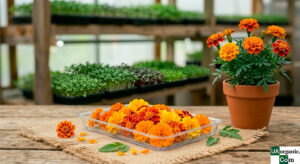
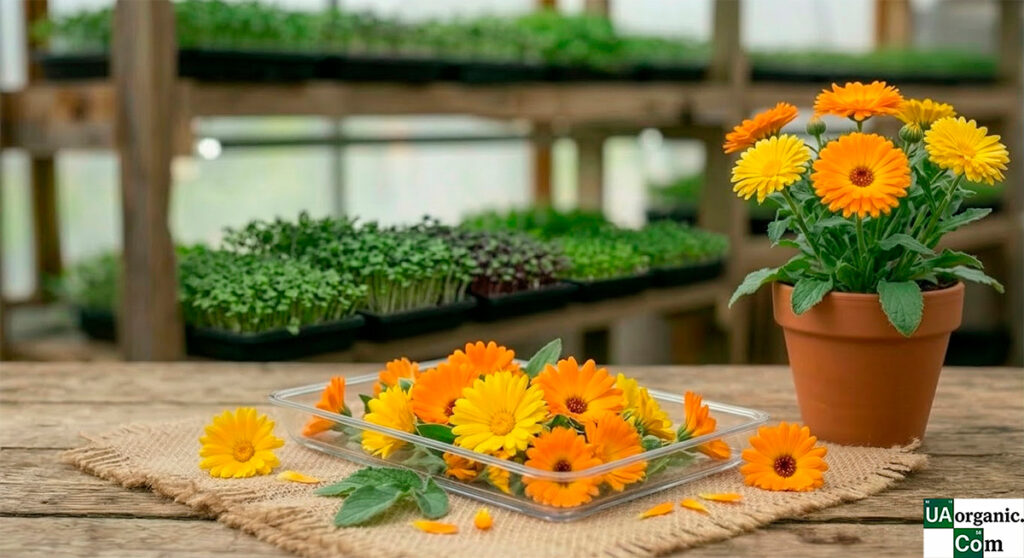
Calendula is the record holder among edible flowers for the duration of the season: from May until the first frost, it blooms continuously, and the more flowers are plucked, the more new ones. Controlled environment city farms deliver year round.
| Form | Features of use |
|---|---|
| Fresh (whole flower) | Maximum color and taste; used immediately after collection |
| Fresh petals | A convenient format for restaurants — already separated from the bitter base |
| Dry petals | The most common form; stored for months; for teas, seasonings, pastries |
| Food coloring (infusion) | Petals filled with warm water or oil give a bright yellow-orange color |
Taste, aroma & texture
Difficult and not obvious for those who meet calendula for the first time. The base tone is slightly spicy, bitter-tart, similar to a mixture of saffron, field chamomile and light pepper. The undertone is honey-earthy, especially in a fresh flower. Dried petals give a more concentrated, richer taste with a more pronounced bitterness.
Spicy, slightly resinous - a characteristic aroma that distinguishes real calendula from decorative marigolds, which it visually resembles. Some varieties are almost odorless, others are distinctly aromatic. Fresh petals smell more delicate than dry ones.
Long, narrow petals-rays are thin and delicate when fresh. They tear easily, so for decoration it is better to put it right before serving. Dry petals are fragile, but keep their shape and color much longer.
Safety & edibility
Edible flowers are not the same as florist flowers. Only flowers grown specifically for food use without synthetic pesticides are suitable.
- ✅ Petals-rays (ligulate florets) - the main edible part
- ⚠️ The tubular flowers of the center are technically edible, but more bitter; most bosses don't use it
- ❌ Green calyx (sepals) and stem are bitter, not used
Important: not to be confused with marigolds (Tagetes)
Calendula (Calendula officinalis) and marigolds (Tagetes spp.) look similar, but they are different plants. Both are edible but have different taste and usage profile. Decorative marigolds without the "edible" label should not be used.
Use only the ray petals, tearing them from the green cup. They are used fresh, dried or in the form of an infusion.
Allergy and special groups:
- Calendula belongs to the Asteraceae family. People with an allergy to chamomile, arnica, yarrow — a possible cross-reaction; use carefully
- Pregnant — it is better to avoid in large quantities: the plant is traditionally considered a stimulator of uterine contractions
- Calendula GRAS (Generally Recognized As Safe) according to the FDA list — one of the few ingredients with such a status among edible flowers
Heat treatment: Petals withstand moderate heat - they are added to soups, risotto, and baked goods. But with prolonged cooking, the color fades. For maximum color effect, add at the end of cooking.
This information is general in nature and is not medical advice. Sources: USDA FoodData Central, EFSA.
Culinary use
Calendula is one of the few edible flowers that plays a double role at the same time: coloring and flavoring ingredient. The yellow-orange pigment of carotenoids dissolves in fats and alcohols, so the tincture of the petals in olive oil or butter paints them in a sunny color and conveys the taste. It is this property that made calendula the "poor man's saffron" in medieval Europe.
Unlike purely decorative flowers, calendula not only decorates, but also tastes — its spicy, slightly bitter profile is noticeable in the dish and needs balance.
Separation of petals
pull each petal separately from the green base; the base is bitter, not used. It's fast, but requires attention.
Infusion in fat
petals + warm oil or softened butter; close the container and insist from 2 hours to 2 weeks, depending on the intensity of the desired color and taste.
Infusion in liquid
petals + warm water or broth; 15–30 minutes; color and flavor transfer to the cooking liquid.
Drying
at temperatures up to 40°C (natural drying or dehydrator); retain color and most of the aroma; dry petals are stored for up to 1 year in a dark place.
Candy making
like other edible flowers, petals or whole flowers are treated with egg white and sugar; for desserts and cakes.
Freezing in ice
separate petals or inflorescences in a mold for ice cubes; bright orange color is well preserved after freezing; spectacular decor in lemonades and cold drinks.
- Do not use the green base of the inflorescence - it is bitter and spoils the dish
- Not to be confused with decorative marigolds without edibility marking
- Do not buy from florists - only food certified flowers
- Do not add to the dish long before serving - fresh petals darken and wither; put immediately before serving or at the end of cooking
Perfect pairings
risotto, pilaf, couscous - the petals color the dish and give it a spicy undertone; a classic replacement for saffron in budget versions of recipes.
yogurt, ricotta, butter, soft goat cheese - olive infusion of petals or mixed fresh petals give both color and taste.
bean soups, minestrone, pumpkin cream soups - petals are added at the end of cooking; traditional use in Mediterranean cuisine.
omelet, scrambled eggs, casseroles - fresh or dry petals; an ancient tradition of improving egg yolk color.
mixed into the dough or sprinkled on top - give both color and a slightly spicy taste.
fresh petals as a finishing decoration; combined with bitter greens (arugula, endive), balancing flavor profiles.
How to select & store
- Petals are bright orange or yellow, evenly opened, without darkening or signs of wilting
- The center of the flower is dense - a sign of freshness
- The aroma is slightly spicy; the absence of a smell or an unpleasant smell is a sign of an old flower
Only from producers who grow for food purposes without synthetic chemistry. Calendula is one of the flowers where the issue of "organic" is the most fundamental: thanks to the wide availability of seeds and ease of cultivation, it is mass-grown as an ornamental plant with chemical protection.
Freshness after cutting: 2–3 days
- Fresh flowers or petals — a sealed container with a paper towel, +4...+6°C, 2–4 days (lasts longer than borago, but shorter than denser flowers)
- Dry petals - airtight packaging, dark place, room temperature, up to 12 months
- Oil with petals - a dark, cool place or a refrigerator, 2–4 weeks
- Do not wash before use; wash the petals immediately before use
Composition & properties
Calendula is the record holder for carotenoid composition among edible flowers. The total content of carotenoids in the petals, depending on the variety, is 0.7–2.7% of dry mass is exceptionally high for vegetable raw materials. The main carotenoids of the flower: flavoxanthin and auroxanthin (in petals and pollen), lutein and beta-carotene (mainly in leaves and stems).
| Nutrient | Value (per 100 g of fresh petals) |
|---|---|
| Caloric content | ~40–50 kcal |
| Total carotenoids | 0.7–2.7% of dry weight is a record among edible flowers |
| Lutein | ~29.8 mg/100 g |
| Beta-carotene (provitamin A) | present |
| Flavoxanthin, auroxanthin | the main carotenoids of the petals |
| Flavonoids (quercetin, isorhamnetin) | 0.8–1.7% of dry weight |
| Triterpenes and saponins | are present |
| Potassium, Calcium, Magnesium | traces |
Calendula — GRAS (Generally Recognized As Safe) according to the US FDA list. This is one of the few official "permissions" among edible flowers on the market. The plant has been used in the food industry for natural coloring of butter, cheese and margarine for centuries.
Flavonoids and carotenoids in the petals are powerful antioxidants. Lutein—the same pigment found in significant amounts in marigolds and used in nutritional supplements for eye health—is also present in calendula, although in lower concentrations than in commercial varieties of tagetes.
The external application of the flower extract is widely known — in creams, oils and ointments for skin healing and reducing inflammation (certified by the European Medical Agency EMA as a means for external use).
The information is general in nature and does not constitute medical advice. Composition data: USDA FoodData Central.