When and how available
| the moon | Accessibility |
|---|---|
| January — April | ✅ J. sambac blooms almost year-round in warm conditions |
| May — October | ✅ Peak — J. officinale blooms in summer; J. sambac most active in the warm season |
| November — December | ✅ J. sambac continues to bloom indoors with sufficient lighting |
Jasminum sambac — a tropical plant that blooms in waves almost all year round in warm conditions. This makes it one of the few edible flowers available out of season. Critical detail: flowers J. sambac are revealed at night and collect them on dawn — before the heat causes it to lose its flavor. Collected flowers lose their smell very quickly after opening.
| Form | Features of use |
|---|---|
| Fresh (picked before opening) | Classic technique for flavoring tea; period of several hours |
| fresh (opened) | Decor of food and drinks; the aroma is less, but there is; term up to 1 day |
| dry | For teas, tinctures and aromatic sugar; the aroma lasts for months |
| Aromatic sugar | Flowers and sugar — sugar takes on the aroma of jasmine; for baking and drinks |
| Syrup | Flowers are infused with sugar and water; for cocktails, desserts and drinks |
| Infusion in cream or milk | Base for creams, panna cotta and ice cream |
Taste, aroma & texture
Delicate, floral-sweet, with a honey undertone and barely perceptible bitterness in the finale. An important detail: the taste of jasmine is much weaker than its aroma - when used directly, the petals give a delicate floral taste without bright expressiveness. Instead, in infusions - in tea, syrup or cream - the aroma is transmitted cleanly and concentrated. That is why jasmine is almost always used to flavor liquids, and not as a direct flavoring ingredient.
One of the most complex and recognizable floral fragrances in the world. Sweet, floral, with a warm honey background and a characteristic "indole" note - it is this that gives jasmine a depth and sensuality that is not found in other floral fragrances. The aroma is strongest in buds and newly opened flowers. When heated, it becomes warmer and softer. The key feature of *J. sambac*: the flowers open at night and smell the most at night - by dawn the aroma gradually weakens.
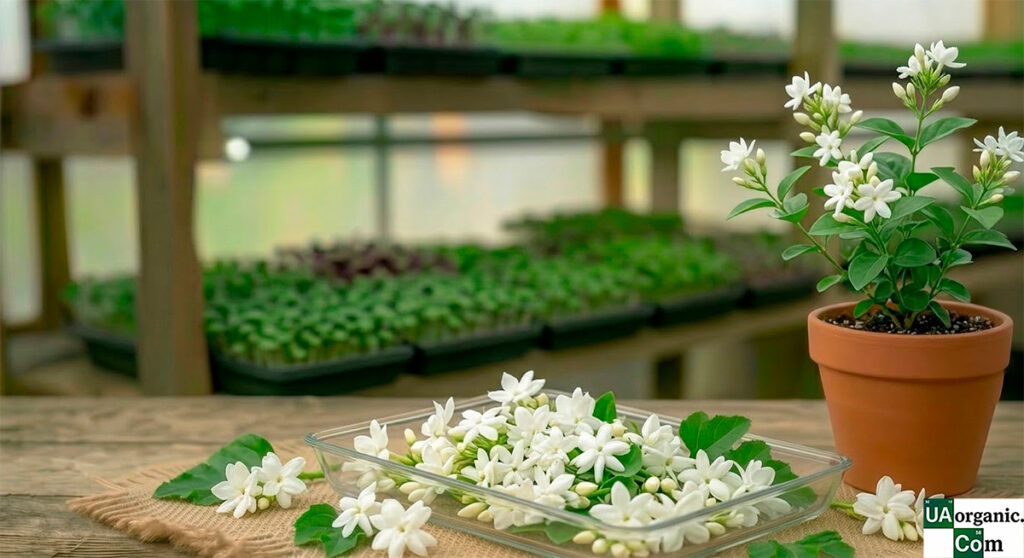
The flowers are small — 1–3 cm, five to six petals around a yellow center. Tender, waxy, white or cream. They blacken and wither very quickly after being cut or opened - jasmine is one of the shortest-lived edible flowers. It should be used immediately after collection.
Safety & edibility
Edible flowers are not the same as florist flowers. Only flowers grown specifically for food use without synthetic pesticides are suitable.
- ✅ Flowers Jasminum sambac and Jasminum officinale
- ❌ Leaves and stems — contain iridoid glycosides in higher concentrations; are not used
- ❌ Any parts of Carolina jasmine (Gelsemium sempervirens) are fatally toxic
- ❌ Any parts of star jasmine (Trachelospermum jasminoides) — edibility has not been confirmed
- ❌ Flowers of any kind with undetermined botanical identification
Are all varieties edible: No — and this is the most critical difference in the entire catalog. Only:
- Jasminum sambac (Arabian jasmine) ✅ — tropical bush, white fragrant flowers, open at night; used for jasmine tea in Asia
- Jasminum officinale (ordinary jasmine, poet's jasmine) ✅ — leafy liana, small white flowers, blooms in summer; FDA classifies as GRAS (Generally Recognized as Safe)
The rest of the plants with "jasmine" in the name are not edible or have not been confirmed as safe.
Heat treatment: Fresh flowers are not heated - they lose their color and structure. To flavor the tea, the flowers are layered together with the tea leaves without heating - natural absorption of aromatic oils. For syrup, brew in warm, but not boiling water. Boiling destroys the delicate aroma.
- Jasmine leaves and stems contain iridoid glycosides in concentrations that can cause indigestion—do not consume anything other than the flowers
- Jasminum sambac traditionally used in India to suppress lactation—pregnant and nursing mothers should avoid regular use in large quantities
- An allergy to the aroma of jasmine occurs; for people with sensitivity to strong floral fragrances, start with a small amount
- Never use jasmine without botanical identification—Carolina jasmine (Gelsemium) is one of the most toxic plants of a temperate climate
This information is general in nature and is not medical advice. Sources: USDA FoodData Central, EFSA.
Culinary use
Jasmine is an exclusively aromatic ingredient. The direct consumption of the petals gives a delicate floral flavor, but the true power of jasmine lies in the transmission of the aroma into the liquid. Jasmine tea is the most striking example: neither the taste nor the color of the tea changes noticeably, but the aroma transforms the drink completely. The same logic works in syrup, cream and infusion in cream. Jasmine is a perfume in a plate.
Layering with tea leaves (cold scenting)
the basic technique of jasmine tea: fresh buds and tea leaves are alternated in layers in a closed container and left for 8–24 hours. The tea absorbs the essential oils without heating. Buds are removed and the process is repeated up to 7 times for premium tea.
Insisting in liquids
buds or flowers are infused in warm water (70–85°C), milk, cream or coconut milk. Do not boil. Time: 20–30 minutes. Strain and use the liquid as a flavored base.
Aromatic sugar
buds and sugar in a closed jar, keep for a week. Jasmine flavored sugar for baking, coffee and cocktails.
Insisting in alcohol
the buds are infused in vodka, gin or rice wine from 2–3 days to a week. Flavored alcohol for cocktails and sauces.
Cooking syrup
buds or flowers are brewed in water at 70–80°C, infused for 20–30 minutes, strained, and sugar is added. Clear syrup with a persistent jasmine aroma.
Candy making
small flowers are covered with egg white and sugar, dried. The small size gives a minimalist elegant decor.
- Never use jasmine without botanical identification — Carolina jasmine (Gelsemium sempervirens) is fatally toxic and is found in gardens; a good smell is not a guarantee of safety
- Do not use star jasmine (Trachelospermum jasminoides) or other plants with "jasmine" in the name without confirmed species identification
- Do not boil the flowers - at the boiling temperature, the delicate aroma is destroyed and only a bitter herbal aftertaste remains; the maximum infusion temperature is 80–85°C
- Do not pick the flowers after they have begun to darken - jasmine turns black in a few hours after fully opening; a collected and darkened flower will not give taste
Perfect pairings
a classic combination — jasmine aromatizes delicate tea leaves without competition; black tea gives too strong its own taste and interrupts the floral aroma.
panna cotta, mousse, crème brûlée, ice cream — infusion in cream conveys the aroma of jasmine as the main and only floral accent in a neutral cream base.
Indian and Thai tradition — flowers flavor coconut milk or rice when infused; jasmine and coconut are a stable tropical combination.
jasmine syrup with honey and lemon juice - the basis of botanical lemonades and cocktails; acid emphasizes the floral aroma.
white and milk chocolate, ganache, truffles — the jasmine aroma in the chocolate base gives a complex floral-sweet result; a common technique in artisanal chocolatiers.
gin, rice wine, champagne — jasmine is a classic botanical ingredient; the aroma is transferred to alcohol cleanly and persistently.
How to select & store
- Buds or newly opened flowers are white or creamy white, without any signs of darkening
- A pronounced pleasant floral-sweet aroma is strongest at dawn and at night
- Collect at the beginning of opening or in the bud stage - for maximum aroma
- Check the botanical identification of the plant before picking — don't rely on the name or smell
Buy edible jasmine flowers only from growers who grow certified edible varieties (J. sambac or J. officinale) specially for food use. If you grow it yourself, make sure of the type of plant before starting culinary use. Flowers from garden centers and flower shops not suitable for consumption — and especially dangerous confusion with other species.
Freshness after cutting: 2–3 days
- Fresh flowers - use on the day of collection; a few hours at most; jasmine has the shortest shelf life among edible flowers
- Do not wash before use - moisture accelerates darkening
- To flavor tea or sugar, the buds are planted immediately after collection
- Dry flowers - airtight jar, dark place, up to 12 months; the aroma is preserved
Composition & properties
Jasmine is one of the oldest aromatic ingredients in cooking, medicine and perfumery. flowers Jasminum sambac are used to produce one of the most expensive natural essential oils in the perfume industry.
| Component | Meaning |
|---|---|
| Benzyl acetate | the main aromatic component, up to 65% essential oil |
| Linalool | floral terpene, softens the aroma |
| Benzyl alcohol | honey-sweet note |
| Indole | a characteristic "deep" note of jasmine aroma |
| Farnesol | sesquiterpene, floral background |
| Flavonoids | are present |
| Iridoid glycosides | present in leaves and stems (do not use) |
| Caloric content | minimal - used in small quantities |
Jasminum sambac is the national flower of the Philippines (Sampaguita), Indonesia (Melati putih) and Tunisia. In India, jasmine garlands are an integral part of wedding traditions and religious offerings — the plant has been cultivated there for thousands of years.
Jasmine tea with green leaves appeared in China around the 3rd century AD and is one of the most common types of tea in the world. Tens of thousands of tons of jasmine tea are produced every year in China alone, mostly from J. sambac.
Jasmine essential oil is one of the most expensive in the perfume industry: to obtain 1 kg of absolute, it is necessary to process from 600 to 800 kg of flowers, hand-picked before dawn. The main producers are Egypt (Nile Valley), India (Manyar and Mavrur), Morocco and Spain (Granada).
Accurate tabular data for jasmine flowers are not published by USDA FoodData Central as a separate line. Data on the composition of essential oil - according to scientific publications. Sources: USDA FoodData Central, PMC/NCBI.