When and how available
| the moon | Accessibility |
|---|---|
| January — April | ❌ Not the season |
| May | ✅ The beginning of flowering - the first inflorescences |
| June | ✅ Peak - abundant flowering, maximum quality and aroma |
| July | ✅ Completion of flowering; berries begin to form |
| August — September | ✅ Ripe berries are a separate seasonal product |
| October — December | ❌ Not the season |
Flowers are collected in dry weather, in the morning after the dew has dried. Narrow window: from the beginning to the end of flowering - about 2-3 weeks. City farms can extend the season by growing under controlled conditions.
| Form | Features of use |
|---|---|
| fresh | Frying, decoration, infusion - without washing; term 1 day |
| Cordial / syrup | Classic form — for drinks, cocktails, glazes; stored for 2–4 months |
| dry | For teas and tinctures; the aroma lasts up to 12 months |
| Fermented ("champagne") | A low-alcohol sparkling drink based on natural flower yeast |
| Kandovan | Dessert decor — small flowers keep their shape for weeks |
| Frozen in ice | Cocktails, lemonades - a white openwork accent in the drink |
Taste, aroma & texture
Nutmeg-honey, slightly sweet with a floral undertone - some describe it as lychee or amaretto, but lighter and fresher. In fresh flowers, there is a faint bitterness from the central part of the inflorescence and stems - therefore, the stems are always removed. Syrup and cordial concentrate the aroma and give a much brighter effect than raw flowers. Berries (after heat treatment) are sweet and sour, dark, with a characteristic "elder" taste, similar to blueberries with a spicy undertone.
One of the most expressive and persistent among all edible flowers. Nutmeg-honey, floral-sweet, with a hay and slightly nutty shade. It is released very well in cold water during infusion - elderberry cordial does not even need to be heated: it is enough to pour warm sugar syrup and leave for 24-48 hours. An important detail: pollen and natural yeast are the carriers of a significant part of the aroma - therefore, the inflorescences are **not washed** before infusing, but only gently shaken.
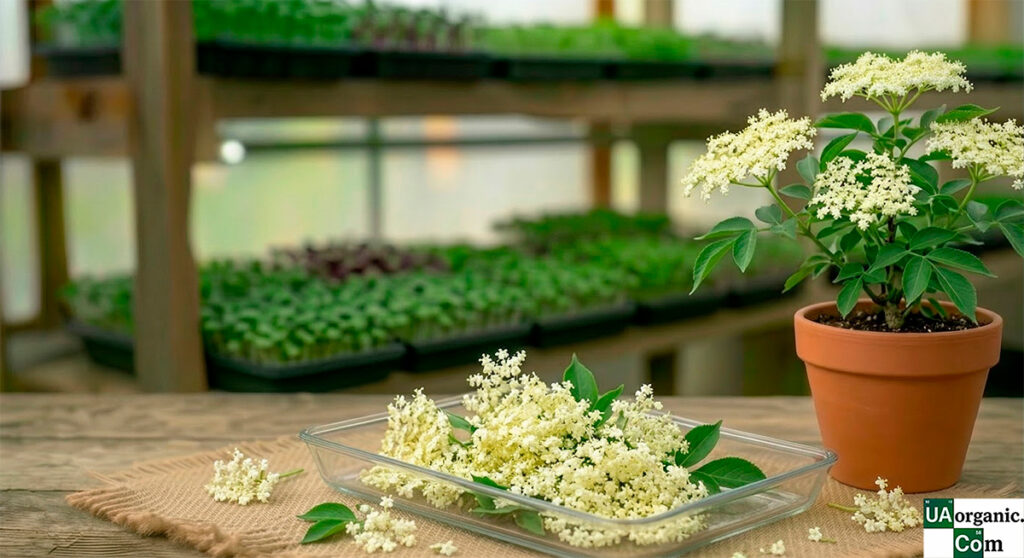
Umbrella inflorescences consist of hundreds of small flowers of 5–6 mm each. The petals are thin, delicate, creamy white. In the decor, the inflorescence gives an openwork, light effect. When fried, the whole inflorescence turns into a crispy cloud with a floral aroma inside.
Safety & edibility
Edible flowers are not the same as florist flowers. Only flowers grown specifically for food use without synthetic pesticides are suitable.
- ✅ Flowers — without stems, leaves and the central axis of the inflorescence
- ✅ Ripe dark purple/black berries — only after heat treatment
- ❌ Raw berries - contain sambunigrin; cause nausea, vomiting, diarrhea
- ❌ Leaves, stems, bark, roots — toxic due to cyanogenic glycosides
- ❌ Berries Sambucus racemosa (red elderberry) — toxic, not edible
- ❌ Any parts Sambucus ebulus (elder grass) — toxic
Are all varieties edible: Only for cooking Sambucus nigra (black elderberry). Decorative cultivars S. nigra (for example, 'Black Lace' with dark purple leaves) are also edible - both flowers and berries after processing. Do not use: S. ebulus (herbaceous, toxic), S. racemosa (red berries are toxic).
Heat treatment: The flowers can be consumed raw in small amounts or infused in cold/warm water and are safe for most people. However, some sources recommend a short-term heat treatment to neutralize minimal sambunigrin residues in the flowers. Berries — must be heat treated: boiling completely destroys sambunigrin.
- Allergy to elder occurs; when using for the first time, start with a small amount
- People with sensitive digestion should avoid large amounts of raw flowers - use in the form of syrup or cordial
- Pregnant women are recommended to consume in moderation, especially in large quantities
This information is general in nature and is not medical advice. Sources: USDA FoodData Central, EFSA.
Culinary use
Elderberry is primarily an aromatic ingredient for liquid preparations: cordial, syrup, "champagne", liqueur St-Germain. In these forms, the flower opens up to the maximum and transforms any drink. In confectionery and cooking, elderberry acts as a delicate floral background in creams, jellies and sauces. Deep-fried fresh flowers are a separate classic technique, where the dough preserves the aroma of the flower.
Cold water infusion ("cordial")
unwashed inflorescences are poured with warm (not hot) sugar syrup with lemon slices and citric acid; close and leave at room temperature for 24–48 hours; strain through a cloth. The main and most common technique.
Cooking syrup
the inflorescences are brewed in water, strained, sugar and lemon juice are added. The fastest option is 20–30 minutes; less aromatic than cold brew, but more convenient.
Fermentation ("champagne")
inflorescences, sugar, lemon and cider vinegar or citric acid; the flowers' natural yeast initiates silent fermentation. The result is a sparkling drink of 1–3% alcohol in 5–7 days. Do not wash the inflorescences - the yeast will be washed away.
Candy making
individual small flowers are separated from the inflorescence, covered with egg white and sugar, and dried. Openwork small decor for cakes.
Insisting in cream or milk
the inflorescences are heated together with cream to 80°C, kept for 20–30 minutes and strained. Base for creams and panna cotta.
Frying
a whole inflorescence is held by the stem, dipped in a liquid batter (egg, flour, beer or soda) and fried in heated oil until golden. Serve immediately - softens quickly.
- Do not wash the inflorescences before infusion - pollen and natural yeast are the carriers of a significant part of the aroma; to get rid of insects, gently shake the inflorescence over a piece of paper
- Do not collect inflorescences that have already begun to turn yellow or darken - they have a musty "mouse" taste that spoils the whole infusion
- Do not confuse with elder grass (S. ebulus): check the aroma (pleasant and honey- S. nigra; sharp and unpleasant - S. ebulus) and plant height (shrub vs. herbaceous plant)
- Do not use raw berries - only flowers can be used raw or infused; berries require mandatory heating
Perfect pairings
Hugo cocktail - prosecco, elderberry syrup, soda, mint and lime - is probably the most famous cocktail with edible flowers in Central Europe. Elderberry and sparkling are a classic duet.
lemon juice activates and emphasizes the muscat aroma of elderberry; together - the basis of all elderberry cordials and lemonades.
strawberry, gooseberry, gooseberry, raspberry - elderberry and strawberry are one of the most stable flavor combinations in British cuisine; gooseberry jam with elderberry is a classic.
panna cotta, mousse, crème brûlée — elderberry syrup or infusions in cream give a delicate floral background without sugary sweetness.
flower cordial as a base for a sauce for salmon or seafood - a Scandinavian technique where the muscat flavor of elderberry balances the fattiness of the fish.
the delicate nutmeg-floral aroma of elderberry is suitable for soft fresh cheeses; panna cotta with elderberry syrup and goat cheese with petals is a classic British and Scandinavian combination.
How to select & store
- Inflorescence fully opened or at the beginning of opening — creamy white, without yellowish-brown areas
- Expressed pleasant nutmeg-honey aroma; if it smells unpleasant or sharp, it is not this plant
- Collect in dry weather in the morning; not after rain - pollen and yeast are washed away
- Without traces of insects, slugs and mechanical damage; check inflorescences for insects before use
Buy edible elderflowers only from growers who grow them specifically for food use. If you collect on your own - only in clean places, far from roads and industrial zones, and only after confident identification of the species. Inflorescences from bushes along tracks and railways not suitable for consumption.
Freshness after cutting: 2–3 days
- Fresh inflorescences - to be used on the day of collection; a maximum of 1 day in the refrigerator in a paper bag
- Do not wash before use - pollen is part of the aroma
- For long-term storage — cordial or dry flowers
- Dry flowers - airtight jar, dark place, up to 12 months
- Cordial — refrigerator, 2–4 months
Composition & properties
Black elderberry (Sambucus nigra) has one of the longest documented culinary and medicinal traditions in Europe — traces of cultivation have been found at Stone Age sites in Italy and Switzerland. The Germanic peoples called elderberry "the pharmacy of the gods."
| Nutrient | Value (per 100 g of fresh flowers) |
|---|---|
| Caloric content | ~30–40 kcal |
| Vitamin C | ~20–30 mg |
| Vitamin A (beta-carotene) | present |
| Flavonoids (rutin, isoquercetin, kaempferol) | ~1–3% of dry weight are the main antioxidants |
| Essential oils (linalool, α-terpineol, farnesol) | present — form a characteristic nutmeg aroma |
| Mucous polysaccharides | are present - mitigating action |
| Potassium | ~100–150 mg |
| Iron, Calcium | traces |
Black elderberry is one of the oldest and most studied medicinal plants in Europe. Flowers and berries have traditionally been used for colds and flu in folk medicine from Britain to the Balkans and Turkey. Current clinical studies are examining berry extract in the context of its effect on the duration of flu-like illnesses, but the results are ambiguous and require further confirmation.
Berries are one of the richest plant sources of anthocyanins among temperate berry crops. It is anthocyanins that give the berries a rich dark purple color and are the subject of active scientific research.
Elder flowers are a source of essential oils, in particular linalool and α-terpineol, which determine the characteristic nutmeg-floral aroma. Natural yeast on the surface of flowers is a practically unique property among edible flowers: it is thanks to them that you can make "champagne" without adding starter cultures.
Exact data for elderflower are not published by USDA FoodData Central as a separate line. Data for berries: USDA FoodData Central. Data for flowers are based on scientific publications.