When and how available
| the moon | Accessibility |
|---|---|
| December — February | ⚠️ In mild winters, the first flowers are already in February |
| March — April | ✅ Peak - abundant flowering, best quality |
| May | ✅ Continues to bloom in cool conditions |
| June — August | ❌ Flowering fades with the onset of heat |
| September — October | ⚠️ Re-blooming is possible in cool autumn |
| November | ❌ Not the season |
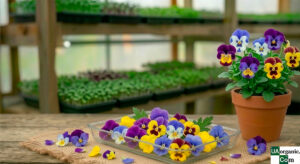
Primula is a typical early spring flower with one of the longest natural seasons of any winter-spring flower, blooming from February to May under favorable conditions. Sheets are practically available year round - they are stored in the outlet even in winter. City farms can supply flowers in the autumn and winter off-season.
| Form | Features of use |
|---|---|
| fresh | The main form is the maximum color and aroma, the term is 3–5 days |
| Kandovan | Classics of Victorian confectionery - cakes, pastries, cupcakes; keeps its shape for months |
| dry | For floral teas and decor; the color fades, but the aroma is partially preserved |
| Frozen in ice | Cocktails and lemonades - a delicate yellow flower in a transparent cube |
| Canned food and syrups | A traditional Elizabethan use is to boil the petals with sugar and lemon juice |
Taste, aroma & texture
Very delicate, sweetish, almost neutral - closer to "nothing with a pleasant touch" than to a distinct taste. It has been compared to very soft honey or delicate sugar with a floral undertone. No bitterness, sharpness or viscosity. The leaves differ much more - they have a light spicy anise shade and a slightly hard texture. That is why the flower and leaf of primrose are used differently in cooking: the flower is a decoration and subtle accent, the leaf is green with taste.
Thin, honey-floral - one of the most tender among edible flowers. It is felt by direct contact and in heat more than in cold. In the dish, the aroma is barely perceptible, but pleasant and does not interrupt anything around.
The petals are thin, velvety, with a slight "meatiness" — a pleasant sensation on the tongue. They don't melt instantly like flax or forget-me-nots — there's a light chew that adds a tactile element to the serving. The leaves are hardened and slightly pubescent - they are best used young or after light blanching.
Safety & edibility
Edible flowers are not the same as florist flowers. Only flowers grown specifically for food use without synthetic pesticides are suitable.
- ✅ Flowers and petals are the main edible part for decoration
- ✅ Young leaves are edible raw or cooked as greens; young people are better
- ✅ Buds - can be used in syrups and preserves
- ❌ Root - not used; contains the highest concentration of saponins
- ❌ Stem - not used
Are all varieties edible: Suitable for cooking Primula vulgaris (common primrose). Attention - do not confuse with:
- Primula obconica ("poison primrose") is an ornamental species well known as a cause of severe contact dermatitis; NOT edible
- Primula veris (spring primrose / cuckoo shoes) — also edible, but less often used in cooking; has bell-shaped flowers on a common stem — differs from P. vulgaris by form
- Garden primrose hybrids (Primula × polyantha) — in large quantities are not used for consumption; use only a confirmed species from a food source
Heat treatment: Petals are best served raw - heating destroys color and aroma. The leaves tolerate short blanching and cooking in soups. Syrups and preserves made from flowers are cooked on low heat - the aroma is partially preserved.
- It is not recommended for pregnant women: primrose contains salicylates, which can affect the tone of the uterus; authoritative sources (Plants for a Future, Eatweeds.co.uk, Hatfield's Herbal) explicitly mention this caveat
- People taking blood thinners (warfarin and analogues) - not recommended due to the content of salicylates
- With sensitivity to aspirin — not recommended; salicylates are a natural analogue of aspirin
- Contact dermatitis: some people react to the touch of plants of the genus Primula rash on the skin; The British Journal of Dermatology confirms this reaction. At first contact with the plant, handle with care. This is a reaction to touch, not consumption, but worth knowing
- Allergy during use is rare; start with a small amount
This information is general in nature and is not medical advice. Sources: USDA FoodData Central, EFSA.
Culinary use
Primrose is a flower of spring mood and quiet elegant image. It does not carry a load of taste and does not pretend to be an ingredient that changes the dish - it changes the feeling of it. A pale yellow or cream flower on a white dessert says "spring" and "tenderness" without any additional words. It is especially valuable in restaurant serving: a single flower of primrose transforms panna cotta from an ordinary dessert into a seasonal statement.
Candy making
the most traditional technique for primrose: the flowers are covered with egg white and fine sugar, dried. Primrose petals are the perfect thickness for candiing—thin enough to whip up the egg whites well, and thick enough to hold their shape. Store in a dry place for up to 6 months.
Syrup
petals are poured with boiling water, infused for 12–24 hours, filtered and boiled with sugar and lemon juice to the consistency of syrup. Golden yellow, with a subtle floral aroma. Store in the refrigerator for up to 2 weeks.
Freezing in ice
a flower in an ice form with distilled water; the transparent cube emphasizes the pastel yellow tone.
Drying
flowers are dried between sheets of paper in the shade. The aroma is partially preserved; used in floral tea mixtures.
Insisting in water
primrose petals in cold water for 2–4 hours; a delicate floral aroma passes into the water; base for floral lemonades and cocktails.
Fresh decor
whole inflorescences or individual primrose flowers are placed on the dish before serving; yellow and cream colors look good on milky and green backgrounds.
- Do not collect primroses from natural places, parks or flower beds - in the UK the collection of wild primroses is even restricted by law; in Ukraine, the plant is also under pressure due to excessive collection; only a verified food manufacturer
- Do not confuse with Primula obconica ("poisonous primrose") is a popular indoor species with bright flowers; causes severe contact dermatitis and is not edible
- Do not use if pregnant, taking blood thinners or sensitive to aspirin - the content of salicylates makes primrose contraindicated for these groups
- Do not add to hot dishes - the petals lose their color and aroma when heated; exclusively cold serving or finishing decoration
Perfect pairings
panna cotta, vanilla mousse, crème brûlée, rice pudding — a pastel yellow flower on a white or cream base; a classic of gentle spring servings.
young peas, spinach, microgreens, cucumber - primrose adds a yellow accent and a spring look without taste interference.
cakes, cupcakes, tarts, meringues - candied primrose keeps its shape for months and is a classic decoration of British confectionery since the 19th century.
lemon curd, orange mousse, grapefruit panna cotta - the acid emphasizes the subtle sweet aroma of the flower.
the delicate sweet taste of primrose is combined with honey and flower teas; traditional spring use in Britain - the flowers were brewed in tea or infused with honey.
strawberries, raspberries, rhubarb - sweet and sour spring berries and delicate yellow primrose flowers as a seasonal duet; classic spring salad or dessert.
How to select & store
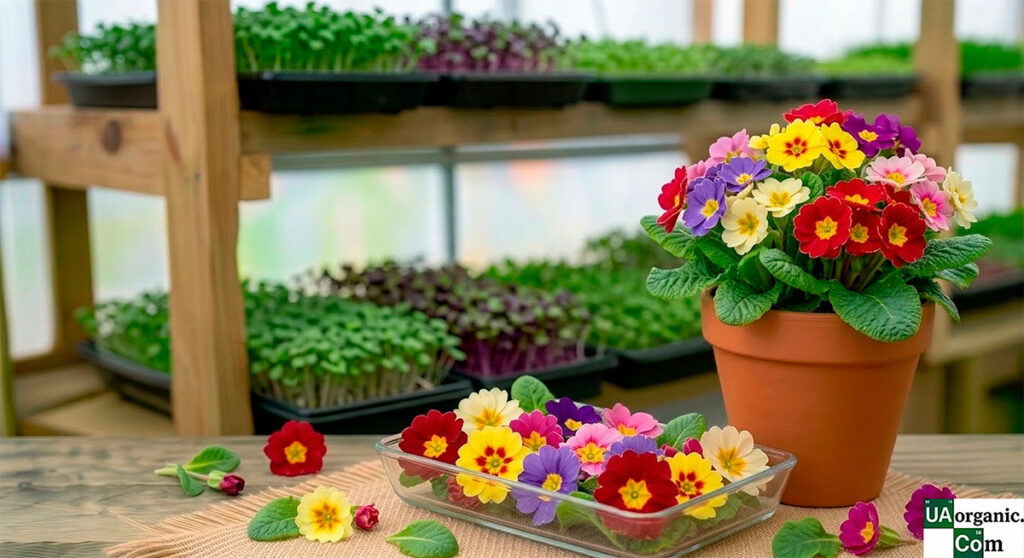
- Petals are pale yellow (or cream, pink - depending on the variety), elastic, without yellowing and spots
- The dark yellow center is bright and clear
- The flower is fully opened and symmetrical
- The aroma is gentle, honey-floral — without extraneous odors
Where to buy is important: Buy primrose only from proven producers who grow it specifically for the food industry. Primrose in flower shops and garden centers is a decorative product treated with protective agents. Wild primrose, despite its culinary tradition, is harvested from natural sites, which harms populations.
Freshness after cutting: 2–3 days
- Fresh flowers — airtight container with a paper towel, refrigerator +4...+6°C, term 3–5 days
- Do not wash before use - moisture accelerates the withering of velvet petals
- Leaves are stored in a damp towel in the refrigerator for up to a week
- For the restaurant: primrose tolerates storage well - you can order several days in advance
Composition & properties
Primrose is a plant with a thoroughly researched phytochemical profile. The scientific base concerns mainly the whole plant, not just the flowers — in particular, the study of saponins and flavonoids is the subject of pharmaceutical science.
| Nutrient | Value (per 100 g of fresh flowers) |
|---|---|
| Caloric content | ~20–30 kcal |
| Vitamin C | Leaves — ~150–200 mg (~167–222% of the daily norm); in flowers - below |
| Flavonoids | Quercetin, kaempferol, isorhamnetin, luteolin, apigenin — ~3% of dry weight (BioResources 2023) |
| Triterpene saponins | Primulasaponin I and II — mainly in the root; there are traces in the flowers |
| Salicylates | ~0.5–1.5 mg/g — a natural analogue of aspirin; reason for caution for pregnant women |
| Phenolic glycosides | Primverine, primulaverine are characteristic of the genus Primula |
| Anthocyanins | In pink and red varieties |
Primrose is a plant with a several-thousand-year tradition of use in Europe. In Elizabethan England, it was used to make wine, preserves, and pies. In the 19th century, candied primrose flowers decorated cakes at royal receptions. This is one of the few edible flowers with a confirmed culinary culture, and not just a modern food trend.
The flowers contain flavonoids - quercetin, kaempferol, isorhamnetin - plant compounds that are the subject of scientific research in the context of antioxidant properties. The leaves are a source of vitamin C and have traditionally been used for vitamin C deficiency in the diet. Saponins, concentrated mainly in the root, are the subject of pharmaceutical research on wound healing (Kahraman et al., 2022, Chemistry & Biodiversity).
There is no detailed USDA FoodData Central data for primrose flowers. Data on phytochemical composition: ScienceDirect — Genus Primula in phytomedicine (2023); BioResources 2023 (Primula veris subsp. columnae); Kahraman et al., Chemistry & Biodiversity 2022 (PubMed 36310134); Eatweeds.co.uk / Hatfield's Herbal 2008. The information is general in nature and does not constitute medical advice.