When and how available
| the moon | Accessibility |
|---|---|
| January — February | ⚠️ Rarely - only in warm winters, leaves are present |
| March — April | ✅ The beginning of flowering, the first flowers |
| May — June | ✅ Peak - abundant flowering, best quality |
| July — August | ✅ Continues to bloom, may fade in the heat |
| September — October | ✅ Re-blooming after cool weather |
| November — December | ❌ Not the season |
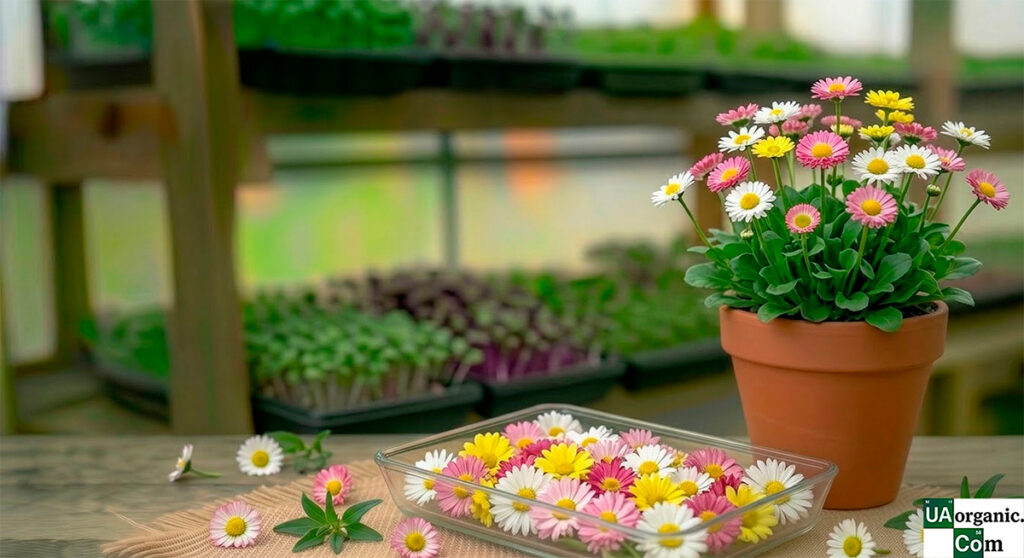
The daisy is one of the few edible flowers with a long natural season: from March to October. City farms can supply it year round in a controlled climate.
| Form | Features of use |
|---|---|
| fresh | The main form is the maximum color and shape, the term is 3–5 days |
| dry | For the decoration of confectionery and teas; shape and yellow center are preserved well |
| Kandovan | Cakes and pastries — the classic form retains its recognizability after sugaring |
| Frozen in ice | Cocktails and lemonades - a simple flower in a transparent cube looks concise and elegant |
| Marinated (buds) | A substitute for capers in savory dishes is a traditional use in Britain |
Taste, aroma & texture
Quiet, but with character. Mostly slightly bitter and astringent - closer to watercress or chicory, but much softer. Some samples, especially from well-moistened and nutritious soil, are almost neutral. The yellow disk flowers in the center are more concentrated in taste and bitter; white marginal petals are softer. Buds are denser and more pronounced - they were traditionally pickled as a substitute for capers.
Unobtrusive, herbal and floral. It is felt only by direct contact. Does not compete with other ingredients of the dish and does not require dosing.
The edge petals are thin, delicate, slightly velvety - they melt in your mouth. The yellow center — small tubular flowers — is denser, chewy. For a clean decoration without a taste load, only white petals are usually taken; for a full taste effect — a whole flower.
Safety & edibility
Edible flowers are not the same as florist flowers. Only flowers grown specifically for food use without synthetic pesticides are suitable.
- ✅ Petals and the whole flower
- ✅ Buds (pickled as a substitute for capers)
- ✅ Young leaves (bitter, eaten in small quantities in salads or as a side dish)
- ⚠️ Seeds are formally edible, but very small and practically not used
- ❌ The root is not used in cooking
Are all varieties edible: All varieties Bellis perennis (English daisy, meadow daisy) are considered edible. Attention: some plants that are colloquially called "daisies" are actually different species. Similar and also edible: ox eye (Leucanthemum vulgare) and Shasta daisy (Leucanthemum × superbum). Not edible or potentially dangerous: Zhovtozillya (Senecio spp.) with yellow flowers — toxic to the liver; Tansy (Tanacetum parthenium, pyrethrum) — causes mouth irritation when chewed. Use only verified B. perennis from a food source.
Heat treatment: Petals are best served raw - they lose their color and shape when heated. Leaves and buds can be briefly blanched or fried - the bitterness is softened.
- Daisy belongs to the family Asteraceae — people with a confirmed allergy to chamomile, ragweed or chrysanthemum should use with caution due to possible cross-reaction
- When using for the first time, start with a small amount
- For pregnant women, use sparingly; there is insufficient data on safety during pregnancy
This information is general in nature and is not medical advice. Sources: USDA FoodData Central, EFSA.
Culinary use
Daisy is an archetypal flower. No other edible flower has such instant recognition: when I saw it, I knew it was a flower. It is this clarity of form that is the main advantage in cooking. Where the chef needs a decor without pretensions and without excessive taste load, the daisy works flawlessly. At the same time, the buds give an unexpected practical effect: pickled, they replace capers and add a piquant character to appetizers.
Candy making
cover the flowers with egg white and fine sugar, dry at room temperature. The classic daisy shape is easy to read after canding. Stored for weeks for confectionery decoration.
Pickling buds
before opening, the buds are poured with white wine or apple vinegar with salt, sugar and spices to taste. Last at least a week. The result is a homemade caper substitute with a milder and less salty taste.
Freezing in ice
a flower in an ice mold, distilled water for transparency. Simple and clear serving of drinks.
Drying
flowers are dried between sheets of paper in a dark place or in a dryer at a minimum temperature. They keep their shape well. Used for teas and dry confectionery decoration.
Insistence
petals can be brewed in oil or infused in mild vinegar; color and delicate aroma pass into the liquid.
Fresh decor
a whole daisy inflorescence is placed on the dish before serving; the dense form lasts 4–6 hours after cutting; a spectacular field accent on any dish.
- Don't pick daisies from lawns, parks, or roadsides—even if no one has obviously sprayed, soil and grass in urban areas are contaminated; only a verified food manufacturer
- Do not confuse with yellow tea (Senecio) — yellow-flowered plants similar to a daisy can be toxic; use only verified Bellis perennis
- Do not add to hot dishes - the petals lose their shape and color when heated; exclusively cold serving or finishing decoration
- Don't ignore the taste test before serving—bitterness varies between batches; a flower with too pronounced bitterness can upset the balance of delicate dishes
Perfect pairings
ricotta, cream cheese, poached eggs, omelet - a white flower on a cream or yellow base gives a clear, concise image; a classic of spring innings.
spinach, arugula, peas, watercress - the daisy here supports the seasonal theme of "the first green" and adds a white accent to the green salad.
panna cotta, mousse, vanilla yogurt, rice pudding - one flower or several petals on a white surface; minimalist ending without explanation.
tartlets with pate, bruschetta with ricotta and anchovies, cold cuts of meat - marinated buds add sourness and viscosity instead of capers.
lemonade, floral tea, prosecco - a flower in an ice cube or on the surface; clear and pleasant presentation without unnecessary words.
strawberry, peach, grape - white daisy petals and a yellow core ring create a field effect in fruit bowls and desserts.
How to select & store
- Petals are white, elastic, without pinking or signs of wilting (pinking = aging)
- The yellow center is bright, dry, without mucus
- The flower is fully opened and symmetrical
- Without extraneous odors
Where to buy is important: Buy daisies only from proven producers who grow them specifically for the food industry. Daisies are a surprisingly common flower, but this very commonness is the trap: finding them is easy, finding edible ones requires a proven source. Flowers from the lawn or flower shop not suitable for consumption.
Freshness after cutting: 2–3 days
- Fresh flowers — airtight container with a paper towel, refrigerator +4...+6°C, term 3–5 days
- Do not wash before use - moisture accelerates wilting and pinking of the petals
- For the restaurant: daisies tolerate storage well - you can order several days in advance
Composition & properties
The daisy is one of the best-studied edible flowers in terms of phytochemical profile. Review of 2023 in the magazine Molecules (PMC) summarized data on more than 310 individual components found in the plant.
| Nutrient / substance | Meaning |
|---|---|
| Flavonoids (in general) | 0.31–0.44 mg QE/100 mg dry weight (Siatka & Kašparová, 2010) |
| Polyphenols (total) | 2.94–3.57 mg GAE/100 mg dry weight |
| Anthocyanins | present (pink and red color) |
| Quercetin and kaempferol (flavonols) | are present |
| Triterpene saponins (perenisaponins) | are present — characteristic compounds of the species |
| Chlorogenic and caffeic acids | are present |
| Vitamin C | ~34 mg/100 g (according to field research, Bosnia and Herzegovina) |
| Carotenoids | are present |
| Polyacetylenes | are present |
| Caloric content | low (used in small amounts) |
Daisy is a plant with a thousand-year folk medicine tradition in Europe: from the field surgeons of the Roman army (bandages soaked in the juice of the flowers) to Irish folk medicine, where it was used for a variety of conditions. Modern science has confirmed the presence of active compounds, in particular triterpene saponins — specific for B. perennis compounds (perenisaponins A–F, perenisosides I–XII), which are the subject of research.
The flowers contain flavonoids - quercetin and kaempferol - plant compounds that are the subject of scientific research in the context of antioxidant properties. A 2010 study (Siatka & Kašparová) showed that the level of flavonoids and polyphenols in daisy flowers remained stable throughout the flowering season - a positive factor for quality stability in commercial cultivation.
There is no detailed USDA FoodData Central data for daisy separately. Data on phytochemical composition: Albien & stark, Molecules 2023 (PMC10707873); Siatka & Kašparová, Molecules 2010 (PMC6259450). The information is general in nature and does not constitute medical advice.