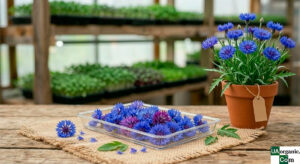
When and how available
| the moon | Accessibility |
|---|---|
| January — April | ❌ Off season (open soil) |
| May | ✅ Beginning of flowering with early sowing |
| June — August | ✅ Peak - abundant flowering, best quality |
| September | ✅ The end of the season |
| October — December | ❌ Not the season |
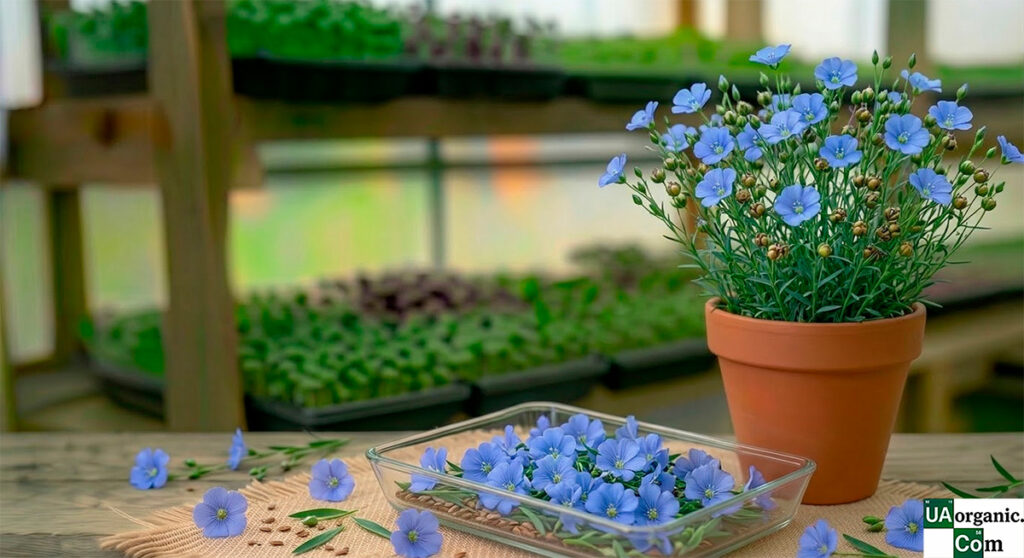
⚠️ Feature of flax: each flower lives only one day - it opens in the morning and falls by the evening. The collection takes place in the first half of the day. Urban farms with controlled environments can supply flax year round.
| Form | Features of use |
|---|---|
| fresh | The main form is the maximum color, the term is 1–2 days; collect only in the morning |
| dry | For the decoration of desserts and confectionery, the color is preserved well with proper drying |
| Kandovan | Cakes, pastries, macaroons - keep their shape and delicate blue hue for weeks |
| Frozen in ice | Cocktails and lemonades - a flower in a cube looks minimalistic and elegant |
Taste, aroma & texture
Very delicate, almost neutral with a light grassy shade. If the nasturtium "speaks" loudly in the dish, the flax is quiet, barely audible. No bitterness, sharpness or harshness. This is a flower that does not compete with other flavors, but only emphasizes the overall ensemble.
Thin, slightly field - similar to the smell of fresh flax in the field. It is practically not felt in the finished dish. Does not interrupt other aromas and does not require dosing.
The petals are extremely thin and delicate - almost transparent, melt in the mouth instantly. No chewing is a pure visual and tactile effect. The center of the flower is slightly denser, but also delicate.
Safety & edibility
Edible flowers are not the same as florist flowers. Only flowers grown specifically for food use without synthetic pesticides are suitable.
- ✅ Petals and the whole flower
- ⚠️ Leaves are edible, but practically not used in cooking
- ⚠️ Seeds are edible after heat treatment (raw in large quantities is not recommended)
- ❌ The root and stem are not used
Are all varieties edible: All varieties Linum usitatissimum considered edible for the culinary use of flowers. Decorative species of the genus Linum (for example Linum perennial, Linum grandiflorum) look similar and are also considered safe, but for food purposes it is recommended to use the flowers of cultivated flax (L. usitatissimum) from a verified source.
Heat treatment: Not recommended — thin petals instantly lose color and shape when heated. Flax flowers are added exclusively to cold dishes or put on a ready-made dish at the last moment.
- Allergy to flax flowers is rare; with individual sensitivity to plants of the Linaceae family, start with a small amount
- For pregnant women, use in moderation, without excess
This information is general in nature and is not medical advice. Sources: USDA FoodData Central, EFSA.
Culinary use
Linen is an almost pure decoration with a subtle flavor subtext. Unlike nasturtium or marigolds, it does not change the taste of the dish, but it radically changes its appearance. The sky-blue color—one of the rarest in cooking—makes linen indispensable for minimalist servings and Scandinavian aesthetics. This is a flower for those who want color without compromising taste.
Candy making
cover the flowers with egg white and fine sugar, dry at room temperature. Flax petals hold their shape well after candiing and retain their blue hue. Stored for weeks to decorate confectionery.
Freezing in ice
the flower is placed in an ice cube tray, filled with water (preferably distilled for transparency) and frozen. Effective serving of cocktails and lemonades.
Drying
flowers are dried in the shade on paper. The color can partially change from blue to purple, but it is suitable for dry decoration.
Insistence
the petals can be infused in neutral oil or gin for a light floral aroma and faint color.
Fresh decor
separate petals or a whole flax flower are placed on the dish before serving; very tender, use immediately after cutting.
Insisting in water
flax petals in cold water for 2–4 hours; the water acquires a barely noticeable bluish tint; for floral lemonades and cocktails.
- Do not buy flax in flower shops or on the market - flax grown for floristry or seed production is treated with protective agents and is not suitable for consumption
- Do not pick flowers in the afternoon - flax blooms only in the morning; by the evening the petals fall and the flower loses its marketable appearance
- Do not add to hot dishes - flax petals are even thinner than most edible flowers and will disappear instantly on contact with heat
- Do not store picked flowers for more than 1-2 days - flax is even more capricious than most edible flowers; order for a specific serving and store in the refrigerator in a closed container
Perfect pairings
ricotta, cream cheese, burrata, labneh — a delicate flower on a white cream base provides maximum color contrast and looks like an illustration from a Scandinavian cookbook.
salmon tartar, ceviche, tuna carpaccio - the blue flower here is both a color accent and a hint of a marine theme.
panna cotta, cheesecake, vanilla mousse, panna cotta - flax adds a "heavenly" motif without imposing taste.
any green salad takes on a different mood from a few flax flowers - especially next to warm-toned edible flowers (nasturtium, marigolds).
lemonade, gin and tonic, spritz - a flower in an ice cube or on the edge of a glass gives the same effect as a complex garnish, but absolutely without effort.
arugula, spinach, microgreens — blue flax petals as a bright color accent in a green salad; delicate taste does not compete with other ingredients.
How to select & store
- Petals are elastic, uniformly blue (or white, pink - depending on the variety), without darkening
- The flower is fully opened - the buds are not suitable for serving
- The center of the flower is dry, the stamens are intact
- Without extraneous odors
Where to buy is important: Buy edible flowers only from proven producers who grow them specifically for the food industry. Flowers from flower shops, supermarkets and regular markets not suitable for consumption — even if they look fresh.
Freshness after cutting: 2–3 days
- Fresh flowers — airtight container with a paper towel, refrigerator +4...+6°C, term 1–2 days (flax is kept shorter than most edible flowers)
- Do not wash before use - moisture accelerates the withering of especially thin linen petals
- For the restaurant: order for a specific day of service, preferably with delivery in the morning
Composition & properties
Flax flowers are used in cooking in small quantities, so the nutrient profile of the flower itself is a secondary issue. The more studied part of the plant is the seed, which is used separately as a food product and has its own nutritional profile.
| Nutrient | Value (per 100 g of fresh flowers) |
|---|---|
| Caloric content | ~15–25 kcal |
| Flavonoids | Quercetin, kaempferol, apigenin are typical for the Linaceae family |
| Anthocyanins | Delphinidin derivatives are responsible for the blue color |
| Phenolic acids | Chlorogenic, caffeic acids |
Flax is one of the oldest cultivated plants of mankind, it has been grown for more than 5000 years. The seeds are traditionally used in the diet as a source of vegetable fats and fiber. Flowers as an edible element is a newer trend common in confectionery and restaurant cooking.
The seeds contain lignans, plant compounds that are the subject of scientific research. Flax flowers are used as a decorative edible element, not as a source of nutrients.
There is no detailed USDA FoodData Central data for flax flowers — they are used in ornamental quantities. Flax seeds: ~534 kcal, ~41 g fat (omega-3 ALA), ~28 g fiber, ~20 g protein — USDA FoodData Central ID 169414. The information is general in nature and does not constitute medical advice.