When and how available
| the moon | Accessibility |
|---|---|
| January — March | ❌ Not the season |
| April — May | ✅ Beginning of flowering with early sowing under seedlings |
| June — August | ✅ Peak - abundant flowering, best quality |
| September — October | ✅ Continues to bloom until the first frosts, often repeated flowering after cutting |
| November — December | ❌ Not the season |
Dandelion responds well to pruning: after removing faded inflorescences, it produces new waves of flowers. Climate-controlled urban farms can supply it year round.
| Form | Features of use |
|---|---|
| fresh | The main form for restaurants is the maximum color and shape, the term is 3–5 days |
| dry | For decorating desserts and confectionery; the shape is kept well, the color may fade |
| Kandovan | Cakes and pastries - the velvety texture of the petals holds sugar crystallization well |
| Frozen in ice | Cocktails and cold drinks - the three-dimensional shape of the flower looks spectacular in a transparent cube |
Taste, aroma & texture
One of the most controversial of edible flowers, opinions vary from "almost nothing" to "pleasantly bitter." It's true: the taste of lion's mouth strongly depends on the soil, growing conditions and specific variety. On fertile soil - neutral, slightly sweet. On the poor side or when drying, there is a marked bitterness, similar to chicory or endive, but softer. This bitterness is not a defect, but a character: it works well in dishes where a bitter tone is appropriate.
Thin, delicate floral - felt on direct contact, but not from afar. Some varieties have a weak sweetish shade. Does not dominate and does not interrupt other ingredients.
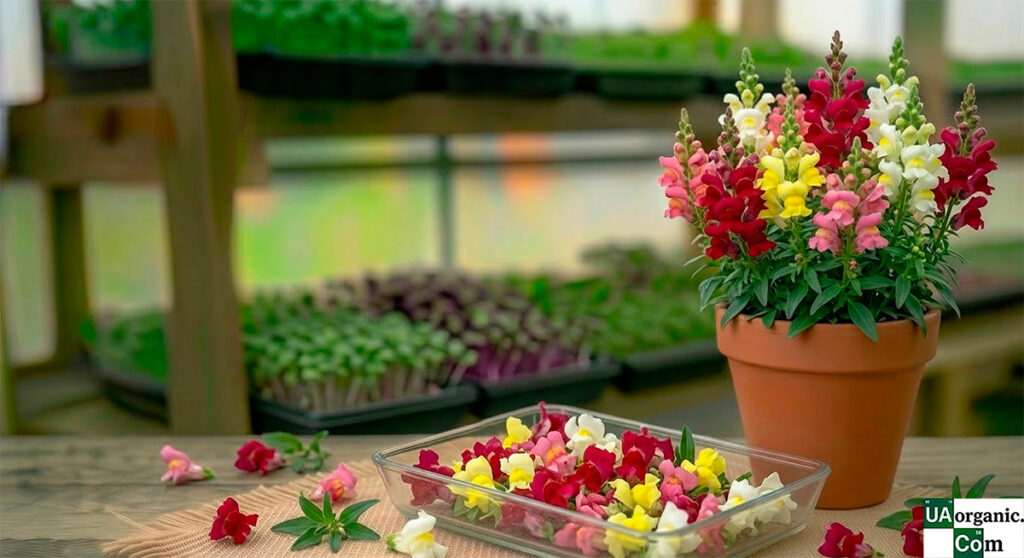
The petals are denser than most edible flowers, velvety, with a pleasant "meaty" sensation in the mouth. The flower is double-lipped: the lower lip is elastic, the upper lip is slightly thinner. This structure holds its shape well in the dish and makes the flower look impressive even when viewed up close.
Safety & edibility
Edible flowers are not the same as florist flowers. Only flowers grown specifically for food use without synthetic pesticides are suitable.
- ✅ Petals and the whole flower
- ✅ Leaves (bitter, rarely eaten - can be used as bitter greens in small quantities)
- ⚠️ Seeds are formally edible, but very small and tasteless; practically not used
- ❌ The root and stem are not used
Are all varieties edible: All varieties Antirrhinum majus are considered edible. Not to be confused with decorative species of the genus Antirrhinum or similar plants of the Plantaginaceae family without proven edibility — use only A. majus from a proven food source.
Heat treatment: Not recommended — the petals lose their color and shape when heated. Lion's mouth is added to a dish only in a cold form or as a finishing decoration for a finished dish.
- The flower belongs to the Plantaginaceae family - allergies are rare, but when using for the first time it is better to start with a small amount
- The pronounced bitterness of some samples may not be desirable for people with sensitive stomachs - taste before serving
- Pregnant women should use it sparingly
This information is general in nature and is not medical advice. Sources: USDA FoodData Central, EFSA.
Culinary use
Lion's mouth is a flower for those who value a sculptural form and a wide range of colors. Where most edible flowers give a flat decoration - a petal or a small star - the lion's mouth gives a voluminous, recognizable shape with characteristic "lips". It is suitable both for the most delicate dessert servings (pastel, candied) and for contrasting, bold plates (bright red or two-color on a green base). Taste is a neutral background that does not interfere, and shape and color are in the center of attention.
Candy making
the flowers are covered with egg white and fine sugar, dried. The velvet texture of the petals holds the sugar crystals well and gives an even coating. Stored for weeks to decorate confectionery.
Freezing in ice
the three-dimensional shape of the flower is especially effective in a transparent cube; use distilled water for maximum clarity.
Drying
flowers are dried between sheets of paper or in a dryer at a minimum temperature. The shape is preserved well, the color may fade slightly.
Insistence
petals of dark varieties (burgundy, raspberry) give a pleasant pink-lilac tone when infused in vinegar or gin; the taste is weak, but the color is distinct.
Fresh decor
a whole inflorescence of a lion's mouth or individual flowers is placed on the dish before serving; bright color (pink, yellow, white) lasts 4-6 hours.
Infusion in syrup
petals are poured with warm sugar syrup 1:1; infuse for 30–60 minutes; a pink or yellow shade turns into a syrup for desserts and drinks.
- Do not buy snapdragons from flower shops or the market - floristic snapdragons are grown with chemical protection and are not suitable for consumption
- Do not taste the flower just once in the entire batch - the taste can vary significantly between samples; test each new batch before serving, especially for bitterness
- Do not add to hot dishes - the petals lose their shape and color when heated; lion's mouth only for cold dishes or finish
- Do not store cut flowers without protection - even in the refrigerator they require an airtight container; without protection will wither in a few hours
Perfect pairings
ricotta, burrata, mascarpone, cream cheese - pastel or white snapdragon flowers on a cream base give an elegant, restrained look without excessive noise.
strawberry, peach, raspberry, fig - flowers in the appropriate color range support the overall mood of the plate; pink snapdragon to strawberry or peach to apricot.
arugula, endive, radicchio - if the flower gave a bitter tone, it organically fits into green salads with distinct bitterness and does not look like an alien element.
gin and tonic, lemonade, prosecco - the three-dimensional shape of a flower in a transparent glass or ice cube gives a greater decorative effect than a flat petal.
cakes, pastries, macaroons, meringues - candied lion's mouth keeps its shape and gives a volume effect that is difficult to get from other flowers.
lion's mouth as a decoration in dishes with salmon, tuna or scallops; bright two-color petals contrast with the pink and orange color of the fish.
How to select & store
- Petals are elastic, velvety, without darkening or signs of wilting
- The color is saturated and uniform throughout the flower
- The flower is fully opened - the lips are symmetrical
- Without extraneous odors
Where to buy is important: Buy edible flowers only from proven producers who grow them specifically for the food industry. Dandelion is one of the most common flowering plants in floristry, but flowers from flower shops and garden centers not suitable for consumption.
Freshness after cutting: 2–3 days
- Fresh flowers — airtight container with a paper towel, refrigerator +4...+6°C, term 3–5 days
- Do not wash before use - moisture accelerates the withering of velvet petals
- For the restaurant: snapdragons last longer than most edible flowers and can be ordered several days in advance
Composition & properties
Dandelion is one of the few edible flowers with a researched phytochemical profile. The composition data is based on the results of scientific publications, in particular, Food Chemistry (2018) and PMC (2020).
| Nutrient | Value (per 100 g of fresh flowers) |
|---|---|
| Caloric content | ~25–35 kcal |
| Flavonoids (in general) | ~43 mg QE/g dry weight |
| Polyphenols (total) | ~15 mg GAE/g dry weight |
| Anthocyanins | present — are responsible for the pink, red, burgundy color |
| Aureusidine (aurones) | yellow flower pigment is present |
| Carotenoids | are present |
| Iridoids | are present |
| Amino acids | are present |
Dandelion is a plant with a researched phytochemical profile. Flowers contain flavonoids and polyphenols — plant compounds that are the subject of scientific research in the context of antioxidant properties. According to a 2018 study (González-Barrio et al., Food Chemistry), the flavonoid content of snapdragon flowers is comparable to other edible flowers, including viola.
Of particular interest to researchers is aureusidin, an auronic pigment that gives yellow color to flowers and is the subject of study in the context of biological activity. Anthocyanins are responsible for pink, red and burgundy colors and are also present in flowers of dark varieties.
In 2023, Ukrainian researchers (Kharkiv region) conducted a comparative analysis of the chemical composition of grass and flowers A. majus, confirming the presence of flavonoids, iridoids and amino acids.
There is no detailed USDA FoodData Central data for snapdragon flowers individually. Data on phytochemical composition: González-Barrio et al., Food Chemistry 2018; PMC — Antirrhinum majus flower extract. The information is general in nature and does not constitute medical advice.