When and how available
| the moon | Accessibility |
|---|---|
| January — February | ❌ Not the season |
| March — April | ✅ The peak is the first and most abundant wave of flowering |
| May | ✅ It continues to bloom, the quality is good |
| June — August | ⚠️ Flowering fades with the onset of heat |
| September — October | ✅ Re-blooming is possible in cool autumn |
| November — December | ❌ Not the season |
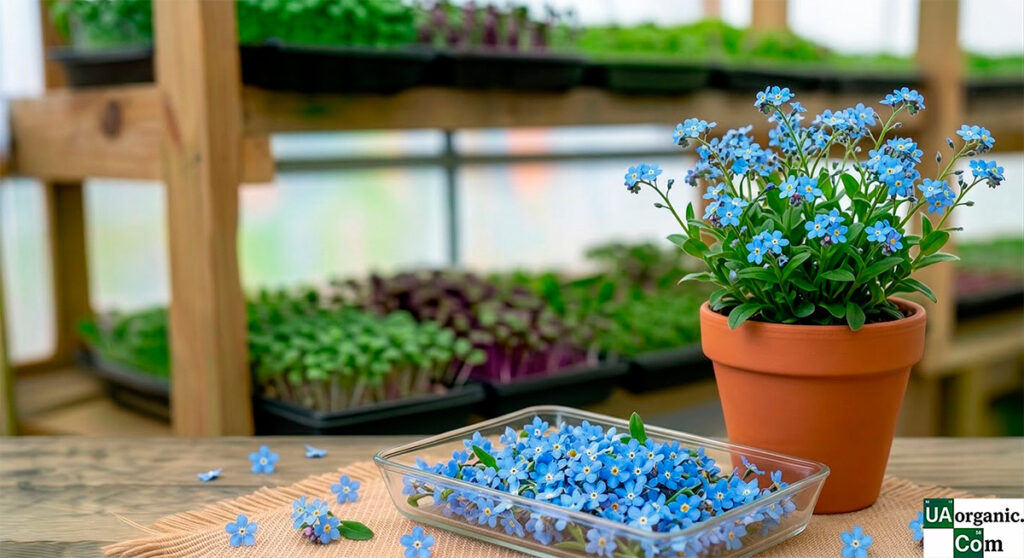
Forget-me-not is a typical spring flower. The natural season is short: the main peak is March–April. City farms with controlled climate and temperature regime can grow it in the autumn-winter period as an off-season product.
| Form | Features of use |
|---|---|
| fresh | The main form is the maximum color, the term is 2–3 days |
| dry | For the decoration of confectionery and flower teas; the color may fade to lilac |
| Kandovan | Cakes and pastries - the small size of the flower holds sugar crystallization well |
| Frozen in ice | Cocktails and lemonades - a small flower in a transparent cube looks delicate |
Taste, aroma & texture
Very gentle, almost imperceptible. Several sources describe a faint cucumber or slightly sweet note—similar to borago, but even quieter. Most people will say "neutral" at first use: forget-me-not doesn't add flavor to a dish, it adds color and mood. This is exactly her culinary role.
Practically absent. The delicate floral scent is felt only upon direct contact — at the level of a field flight in a meadow. In the finished dish, the aroma is not detected and does not interrupt anything.
The petals are extremely thin and fragile - they melt in your mouth almost without feeling. The central "eye" is a little tighter. The small size of the flower is both a limitation (smaller decorative effect on a large plate) and an advantage (perfectly scalable for small confectionery, macaroons, tartlets).
Safety & edibility
Edible flowers are not the same as florist flowers. Only flowers grown specifically for food use without synthetic pesticides are suitable.
- ✅ Flowers and petals - in moderate quantities
- ⚠️ Leaves are formally edible, but hard and hairy, practically not used in cooking
- ❌ The root and stem are not used
Important — pyrrolizidine alkaloids: forget-me-not (Myosotis sylvatica) contains a small amount of pyrrolizidine alkaloids — natural compounds present in many plants of the Boraginaceae family. In small quantities, with occasional use, they do not pose a risk to a healthy person. But daily or long-term use in large quantities is not recommended. That is why forget-me-nots are used as a decorative accent — 3–5 flowers per dish occasionally, and not as a regular ingredient in the diet.
Are all varieties edible: Only suitable for culinary use Myosotis sylvatica (forest forget-me-not) is the most common cultivated species. Not edible or potentially dangerous:
- Cynoglossum amabile (Chinese forget-me-not) - looks similar, but contains higher levels of toxins
- Myosotis latifolia (broad-leaved forget-me-not) — also with a higher content of problematic compounds
Use only M. sylvatica from a proven food source.
Heat treatment: It is not recommended - the petals instantly lose their color and shape. Only cold serving or finishing decoration.
- Use only occasionally and in small quantities - 3-7 flowers per dish as a decoration, not every day and not in large quantities
- It is not recommended for children, pregnant women and people with liver diseases due to the content of pyrrolizidine alkaloids
- When using for the first time, start with the minimum amount
This information is general in nature and is not medical advice. Sources: USDA FoodData Central, EFSA.
Culinary use
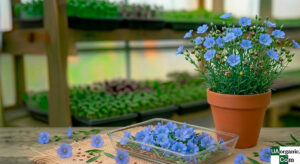
Forget-me-not is a pure image. It does not carry a load of taste and does not pretend to be an ingredient - it creates a mood. A small blue star on a white dessert background or in a green spring salad says "spring" without a word. That is why it appears in restaurant servings not as a gastronomic course, but as a visual and emotional accent - small, but recognizable.
Candy making
cover the flowers with egg white and fine sugar, dry at room temperature. The small size of the forget-me-not requires accuracy: it is convenient to work with tweezers. Stored for weeks for confectionery decoration.
Freezing in ice
the flower is placed in an ice cube tray, filled with distilled water for transparency. The small size looks especially delicate in small champagne cubes.
Drying
flowers are dried between sheets of paper in the shade. The color can change from blue to lilac-purple; used in floral tea mixtures and for dry decoration.
Fresh decor
inflorescences or individual forget-me-not flowers are placed on the dish before serving; their small size makes them ideal for garnishing individual portions and petit fours.
Infusion in vinegar
forget-me-not flowers in white or rice vinegar for 24–48 hours; vinegar acquires a delicate blue-pink shade; for dressings and marinades.
Pressing
forget-me-not flowers are ideal for pressing between pages; the flat shape is preserved; used in desserts with gelatin or transparent coatings.
- Do not collect forget-me-nots from flower beds, lawns and natural meadows - even from "environmentally friendly" places; only a verified food manufacturer
- Do not confuse M. sylvatica with Chinese forget-me-not (Cynoglossum amabile) — they are similar in appearance, but the latter contains a higher level of undesirable compounds; use only the confirmed species
- Do not use regularly and in large quantities - forget-me-not is suitable for occasional decorative use, and not for daily introduction into the diet
- Do not add to hot dishes - the petals instantly lose their color and shape; exclusively served cold
Perfect pairings
panna cotta, vanilla mousse, rice pudding, yogurt cream — a blue flower on a white base; minimalism that works flawlessly.
macaroons, tartlets, meringues, cupcakes—the small size of forget-me-nots scale to bite-size better than larger flowers.
microgreens, peas, cucumber, young spinach - a few forget-me-not flowers add a blue tone that is almost absent in natural greenery.
floral lemonade, prosecco, gin and tonic - a flower in an ice cube or on the surface of the drink; a combination of fragility and elegance.
forget-me-nots as a decoration in Scandinavian dishes with salmon or herring; the blue color of the flowers contrasts with the orange and pink color of the fish.
panna cotta, mousse, yogurt - tiny blue flowers on a white background; maximum decorative effect with a minimum of ingredients.
How to select & store
- The petals are uniformly blue (or pink / white - depending on the variety), elastic, without yellowing
- The yellow "eye" in the center is bright and clear
- The flower is fully opened
- Without traces of wilting and extraneous odors
Where to buy is important: Forget-me-not is one of those flowers where the temptation to "pick it yourself" is especially high: it grows everywhere and looks harmless. But this is exactly the trap: flowers from city beds, parks and natural meadows are contaminated with fertilizers and herbicides. Buy only from verified producers of edible edible flowers.
Freshness after cutting: 2–3 days
- Fresh flowers — airtight container with a paper towel, refrigerator +4...+6°C, term 2–3 days
- Do not wash before use - moisture accelerates the withering of fragile petals
- For a restaurant: order for a specific day of service; forget-me-not is not one of the hardiest edible flowers
Composition & properties
There is no detailed nutrient analysis of forget-me-not flowers in publicly available USDA databases—the plant is consumed in too small quantities to produce nutritional value. Scientific research is focused mainly on the phytochemical composition of the whole plant, in particular on pyrrolizidine alkaloids and flavonoids.
| Nutrient | Value (per 100 g of fresh flowers) |
|---|---|
| Caloric content | ~15–25 kcal |
| Anthocyanins | ~0.5–2 mg/g of dry weight — delphinidin derivatives; are responsible for the blue color |
| Flavonoids | Quercetin, kaempferol — an antioxidant profile typical of the Boraginaceae family |
| Pyrrolizidine alkaloids | <0.1 mg/g of fresh weight — reason for limited use (not daily) |
| Tanning substances | are present |
| Mucous substances | Present - traditionally associated with enveloping action |
forget-me-not (Myosotis sylvatica) is a member of the Boraginaceae family — the same as borage and fennel. This family is known for the presence of pyrrolizidine alkaloids in various species. U M. sylvatica their level is considered low, which makes the flower safe for occasional and moderate use. The University of California included it in the list of safe plants.
Anthocyanins, which give the flower its blue color, are the subject of scientific research in the context of antioxidant properties. The plant also contains flavonoids and mucilaginous substances traditionally associated with a mild enveloping effect.
There is no detailed USDA FoodData Central data for forget-me-not flowers. Data on phytochemical composition: PMC — Lesser-Explored Edible Flowers (PMC11576087); Gardening Know How, Jan 2023. The information is general in nature and does not constitute medical advice.