When and how available
| the moon | Accessibility |
|---|---|
| January — March | ❌ Not the season |
| April | ✅ Peak - the first and most tender flowers |
| May (beginning) | ✅ Completion of flowering |
| May (end) — December | ❌ Not the season |
Apple blossoms have the shortest season of any edible flower, only 2-3 weeks. City farms do not grow this species. Exclusively seasonal rarity.
| Form | Features of use |
|---|---|
| fresh | The only full-fledged form is the maximum of aroma and color, the term is 1 day |
| Kandovan | Decoration of cakes and desserts - keeps its shape and color for months |
| dry | For tea, the aroma is preserved when dried up to 40°C |
| Syrup | Spring flower syrup for drinks and desserts |
| Infusion | Apple blossom in neutral alcohol - for liqueurs and cocktails |
Taste, aroma & texture
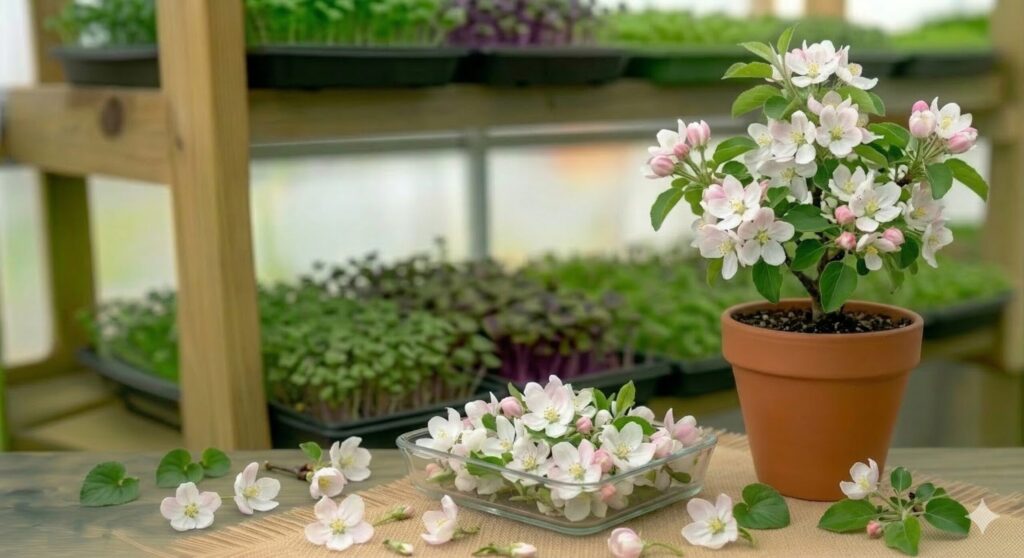
Gentle, floral, with delicate almond and honey notes. One of the most subtle flavors among edible flowers is not dominant, but complementary. In pink varieties it is slightly more expressive, in white varieties it is almost neutral floral.
Delicate almond-floral with honey notes and a barely perceptible apple background. The aroma is better revealed in syrups and infusions than when used raw.
Five rounded velvet petals, very thin and delicate. Melt on first contact. Fragile - need careful handling during washing and transportation. The most delicate texture among common edible flowers. ---
Safety & edibility
Edible flowers are not the same as florist flowers. Only flowers grown specifically for food use without synthetic pesticides are suitable.
- ✅ Petals are the main edible part
- ✅ Whole flower without seed bed and stamens
- ❌ Apple seeds — contain amygdalin, which turns into cyanide. Never use.
- ❌ Stems, leaves, bark are not culinary ingredients
An important detail: Only the flowers of the cultivated apple tree are edible (Malus domestica). Flowers of decorative apple varieties (Malus floribunda etc.) — do not use without accurate identification.
- If you are allergic to apples or apple pollen, a cross-reaction is possible; start with the minimum amount
- Remove the stamens and pistil - they can give a slight bitterness
- Do not use apple seeds in any form
This information is general in nature and is not medical advice. Sources: USDA FoodData Central, EFSA.
Culinary use
Apple blossoms are about elegance and seasonality. The taste is very delicate, so the flower best manifests itself as a visual accent and aromatic background, and not as an independent flavor ingredient. It is this delicacy that makes it an ideal partner for the most delicate desserts - where a more pronounced flower (lavender, rose) would be too intense.
Candy making
the best technique for apple blossom. The petals are covered with a thin layer of beaten egg white, sprinkled with fine sugar and dried at 40°C for 2–4 hours. They keep their shape and color for months.
Syrup
fresh flowers, sugar and water in a ratio of 1:1:1, heat until the sugar dissolves without boiling, insist for 24 hours, filter. Store in the refrigerator for 2-3 weeks.
Drying for tea
in a thin layer on a grid in a shaded, ventilated place or in a dryer at 35–40°C. The color and aroma are preserved until the next season.
Freezing in ice
flowers in a form for cubes, fill with water and freeze. Effective serving of cocktails and lemonades.
Fresh decor
apple blossoms are placed on a dish or dessert just before serving. Pink and white colors are especially effective on white and cream backgrounds.
Jam and jelly
petals are boiled with sugar and lemon juice; transparent, pale pink jelly with a delicate almond aroma. Traditional use in apple orchard regions.
- Never eat apple seeds - amygdalin turns into cyanide; only the petals
- Do not wash under a stream - the petals are deformed; careful immersion in cold water and drying on a towel
- Do not store for more than a day - collect or order immediately before use
- Do not use flowers of ornamental apple varieties without accurate identification
Perfect pairings
Honey, vanilla, panna cotta - the floral-almond tone of apple blossom is naturally related to the sweetness of honey and the warmth of vanilla; a classic pair for panna cotta, cream and ice cream.
Strawberries, raspberries, strawberries — spring berry and spring flower peak seasonal pair; apple blossom as a decoration on a berry dessert is both appropriate in taste and flawless visually.
a delicate floral note on a creamy base - toast, cheesecake or a creamy dessert with apple petals look and taste like spring.
apple blossoms in a glass or as a decoration on an aperitif tray - an elegant spring presentation, where the aroma of the blossom complements the fruity tones of the wine.
sourness emphasizes the delicate almond aroma and adds brightness.
Greek yogurt, sour cream, kefir - a few apple blossoms and a spoonful of honey turn an ordinary breakfast into a seasonal product; the almond note enhances the milky creaminess.
How to select & store
- Petals are elastic, without darkening and traces of wilting
- The color is from white to pale pink, uniform
- The aroma is delicate, almond-floral
- Without traces of insects; the center of the flower is dry
Where to buy is important: Buy edible apple blossoms only from proven producers that are grown specifically for the food industry. Flowers from decorative gardens, flower shops and regular markets not suitable for consumption — may contain fungicides and insecticides. The season is very short (7-14 days) - order in advance.
Freshness after cutting: 2–3 days
- Fresh flowers — airtight container with a paper towel, refrigerator +4...+6°C, term 1–2 days
- Do not wash before use - moisture accelerates wilting
- For long-term storage — candiing or drying at 35–40°C immediately after collection
Composition & properties
Apple flowers contain flavonoids and chlorogenic acid, the same compounds found in apple fruits. They are used in small quantities, so the nutritional value is mainly aromatic.
| Nutrient | Value (per 100 g of fresh flowers) |
|---|---|
| Caloric content | ~15–25 kcal |
| Vitamin C | ~5–15 mg |
| Flavonoids (quercetin, kaempferol) | ~0.5–2% of dry weight |
| Chlorogenic acid | ~0.1–0.5% of dry mass |
| Anthocyanins (in pink varieties) | ~20–80 mg/100 g |
| Essential oils | ~0.01–0.03% of raw mass |
Apple flowers contain antioxidant flavonoids and chlorogenic acid — the subject of scientific research on antioxidant properties. For culinary use, flowers are used in small quantities - the main value is decorative and aromatic.
The information is general in nature and does not constitute medical advice. Composition data: USDA FoodData Central.