When and how available
| the moon | Accessibility |
|---|---|
| January — February | ✅ Flowering of indoor plants in warm conditions |
| March — April | ✅ Active flowering indoors |
| May — October | ✅ Peak - cultivation on the balcony and in the garden; abundant flowering |
| November — December | ✅ Flowering of indoor plants with sufficient lighting |
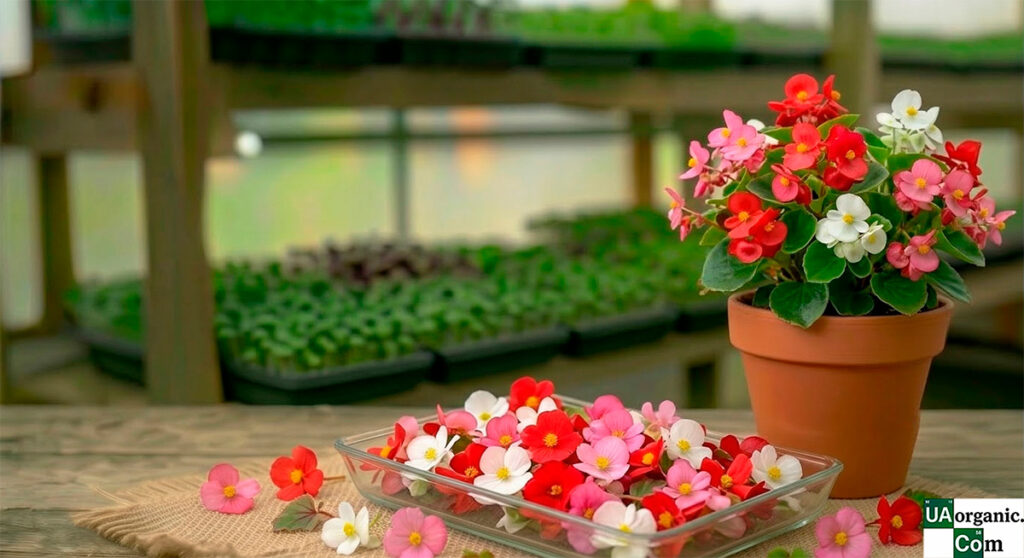
Wax begonia (B. cucullata) blooms almost year round in room conditions is one of the few edible flowers with year-round availability without a city farm. Tuberous begonia blooms mainly in summer and early autumn.
| Form | Features of use |
|---|---|
| fresh | The main form is a decoration and flavoring ingredient in salads, desserts, drinks; period of 1-2 days |
| Kandovan | Decoration of cakes and desserts - bright color and sourness are preserved for weeks |
| Frozen in ice | Cocktails, lemonades are a color accent in the drink |
| Infusion in water or syrup | Sour-floral infusion for drinks and jelly |
Taste, aroma & texture
Bright, citrus-sour - the most "tasty" flower in the catalog in direct comparison. Sour is clean and fresh, without bitterness - similar to sorrel, young rhubarb or sour apple juice. Some varieties give a light sweet undertone in the finale. The young stems of tuberous begonias really taste like rhubarb - they are even used as a rhubarb substitute. Begonia is one of the few edible flowers where the flavor is an active and prominent ingredient in the dish, rather than a subtle aromatic background.
Gentle, floral-fresh - without bright perfume notes. The aroma is not the main asset of begonia: it is pleasant, but unobtrusive. Taste comes first. This is a fundamental difference from rose, jasmine or lavender.
Petals are juicy, fleshy and crispy - especially in wax begonia. The sensation when chewing is similar to a juicy sorrel leaf. They do not melt instantly, like some delicate flowers. This texture holds up well in salads and cold dishes. Candied begonia keeps its crispness and shape for weeks.
Safety & edibility
Edible flowers are not the same as florist flowers. Only flowers grown specifically for food use without synthetic pesticides are suitable.
- ✅ Flowers and petals are the main edible part
- ✅ Young leaves - in small quantities, sour taste
- ✅ Young stems of tuberous begonia - as a substitute for rhubarb
- ❌ Roots and tubers — concentrated calcium oxalate, toxic, do not use
- ❌ Flowers B. maculata (Angel Wing, Polka Dot Begonia) are not edible
- ❌ Flowers B. rex — edibility is not confirmed; better to avoid
Are all varieties edible: No. Edible:
- Begonia × tuberosa (potato) ✅ — large flowers, bright acidity
- Begonia cucullata / semperflorens (waxy) ✅ — smaller flowers, softer acidity, year-round flowering
Not edible or not confirmed:
- Begonia maculata — Angel Wing, Polka Dot Begonia ❌
- Begonia rex ❌ - better to avoid
Heat treatment: It is better not to heat fresh flowers and petals - they lose their texture and color. Young leaves and stems can withstand light blanching. Candiing — without heating.
- Begonia contains oxalic acid, the same acid found in sorrel, spinach and rhubarb. People prone to kidney stones or gout should consume in moderation and avoid large amounts
- The roots and tubers of any begonias are toxic due to concentrated calcium oxalate - do not use
- Begonia toxic to cats, dogs and horses — keep the plant out of their reach
- Pregnant women are recommended to use in moderation
- Allergy to begonia occurs; when using for the first time, start with a small amount
This information is general in nature and is not medical advice. Sources: USDA FoodData Central, EFSA.
Culinary use
Begonia is unique in the catalog in that its acidity is a functional ingredient — it replaces lemon juice or sorrel where acid is needed and color is important. In salads, begonia petals are not just decorative - they actively influence the taste balance of the dish. This makes the begonia one of the most "honest" edible flowers: it delivers what it promises.
Fresh decor
flowers or individual petals are placed on the dish immediately before serving. Nothing is needed - just pure flower from a proven source.
Candy making
the flowers are covered with egg white and fine sugar, dried. The bright color and crispy texture last for weeks; the acid is partially stored under the sugar coating.
Freezing in ice
a petal or a whole flower is placed in an ice cube tray. Bright color is kept in a transparent cube; upon melting, the sourness turns into a drink.
Infusion in water or syrup
the petals are infused in cold water or light syrup for 20–30 minutes. The liquid acquires a sour taste and a light floral color; for jelly and cocktails.
Salad ingredient
the petals are torn or left intact and added to the salad together with sour greens (sorrel, arugula) to strengthen the acid profile.
Pickling
thicker parts of stems and young shoots are marinated in light vinegar with salt and sugar; crispy side dish with sour cream. Petals are not suitable for marinade - they are too tender.
- Do not use Angel Wing (B. maculata) and Rex begonia - they look attractive, but edibility is either unconfirmed or ruled out
- Do not eat roots and tubers - even edible types; concentrated calcium oxalate in the roots is toxic
- Do not buy flowers from flower shops and garden centers - even if the species is correct, the plant is almost certainly treated with pesticides
- Do not use in large quantities for people with a tendency to kidney stones - oxalic acid in large doses increases the risk; a moderate amount in a salad is safe for most people
Perfect pairings
scallops, salmon, tuna, ceviche - the acidity of begonia replaces lemon or capers and adds color; the perfect combination for fresh serving.
ricotta, goat cheese, burrata - the floral acidity cuts through the creamy base and provides contrast; the classic "fat + acid" principle.
panna cotta, mousse, cream cakes - the acidity of the petals balances the sweetness; begonia on a white creamy surface provides a color and taste contrast at the same time.
strawberry, mango, lychee, citrus fruits - begonia enhances the fruit acid and adds a juicy floral accent.
poached eggs, frittata, egg toast — the acidity of begonia replaces capers or sorrel in egg dishes; the bright color of the petals on the yellow background of the yolk is an effortless restaurant aesthetic.
lemon vinaigrette, orange peel, lime - the sourness of begonia and citrus acid mutually reinforce each other; fresh, impressive result in seafood and vegetable dishes.
How to select & store
- The flowers are bright, juicy, without signs of wilting and darkening
- Petals are elastic and slightly fleshy - a sign of freshness and juiciness
- Identified species: tuberous or waxy; not "some begonia"
- Check that the plant has not been treated with pesticides - ask the manufacturer
Buy edible begonia flowers only from growers who grow edible species specifically for food use. If you grow it yourself - wax begonia (B. cucullata) on the windowsill without chemicals is the easiest option for year-round access. Flowers from garden centers and flower shops not suitable for consumption.
Freshness after cutting: 2–3 days
- Fresh flowers — airtight container with a paper towel, refrigerator +4...+6°C, term 1–2 days
- Do not wash before use - moisture accelerates wilting
- Candied flowers — in a dry place at room temperature, up to 2–4 weeks
Composition & properties
Begonia is one of the largest plant genera in the world - more than 1,800 species. In a culinary context, edible species are also a source of vitamin C and minerals, although they are consumed mainly in small quantities. The main chemical marker — oxalic acid — provides both taste and consumption restrictions.
| Nutrient | Meaning |
|---|---|
| Vitamin C | present in significant quantities - leaves and flowers were traditionally used to prevent scurvy |
| Oxalic acid | present — gives a characteristic acidity; it is also found in spinach, sorrel and rhubarb |
| Calcium oxalate | in roots and tubers — concentrated, toxic; in the above-ground parts — a soluble form in a much lower concentration |
| Antioxidants and flavonoids | are present |
| Magnesium | present |
| Caloric content | minimal - used in small quantities |
The edible use of begonias is documented in folk traditions from Mexico and Brazil to India, China, and the Caribbean islands. The Journal of Economic Botany has published material on edible begonias since the 1940s. In the West Indies, the plant was traditionally used as food and medicine; in Central America, flowers and leaves were used as a vegetable.
Oxalic acid, which gives begonia its characteristic sourness, is found in the same concentration as in spinach or rhubarb, popular foods. Moderate consumption of flowers and leaves is safe for most people.
Wax begonia (B. cucullata) naturalized in Florida and Hawaii, where it grows as a common weed. This is one of the few examples of a decorative indoor plant that has become wild edible.
Accurate tabular data for begonia flowers is not published by USDA FoodData Central as a separate line. Sources: USDA FoodData Central, scientific publications about Begonia spp., Journal of Economic Botany.