When and how available
| the moon | Accessibility |
|---|---|
| January — April | ❌ Off season (open soil) |
| May — June | ✅ The beginning of flowering - D. plumarius, D. gratianopolitanus |
| July — August | ✅ Peak — D. caryophyllus, repair varieties |
| September | ✅ Completion of flowering; the quality decreases |
| October — December | ❌ Not the season |
Urban farms with controlled environments can supply cloves in wider time frames. D. caryophyllus as a greenhouse plant, it is grown year-round - but it is the culinary fragrant varieties that are more important than availability.
| Form | Features of use |
|---|---|
| fresh | Decor and spicy accent in dishes; period of 2-3 days |
| Kandovan | Classic - preserves color and brightness for weeks |
| Infusion in wine or vinegar | Flavored alcohol and vinegar; an ancient Mediterranean tradition |
| Syrup | The petals are infused with sugar and water; spicy-floral for drinks |
| dry | For teas, tinctures and spice mixes |
| Frozen in ice | Cocktails, lemonades - bright color in a cube |
Taste, aroma & texture
Peppery and spicy, with notes of clove and nutmeg and a sweet undertone — more complex and expressive than most of the edible flowers in the catalog. Some varieties give a more peppery note, others are closer to cinnamon and vanilla. *Dianthus plumarius* ("feather carnation") is softer and sweeter; *D. caryophyllus* is more spicy and intense. An important detail: **the white or yellowish base of the petal is always bitter** — remove it before use. The green sepal is also not eaten.
Rich, spicy-floral - the same aroma that gave the plant the Latin generic nickname *caryophyllus* (from the Greek "clove"). It is this smell that is the basis for the perfume composition and for Chartreuse. Modern floristic hybrids, bred for the appearance and duration of the cut, are often devoid of smell - without aroma there is no taste.
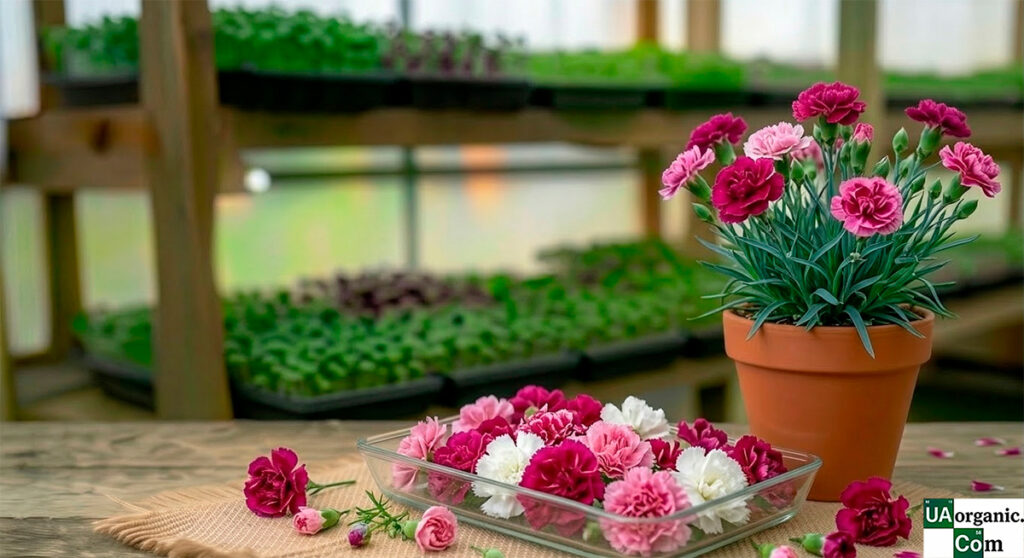
The petals are fringed at the edges - the characteristic "toothy" texture of the carnation. Dense and less delicate than roses or violas - they keep their shape well when decorating and canding. A flower of medium size (3–5 cm), which gives an effective and recognizable decor.
Safety & edibility
Edible flowers are not the same as florist flowers. Only flowers grown specifically for food use without synthetic pesticides are suitable.
- ✅ Petals — without a white base and a green sepal
- ❌ The white or yellowish base of the petal is bitter, remove
- ❌ The green sepal is not edible
- ❌ Stems and leaves are not used
Are all varieties edible: Yes, all species Dianthus are considered edible. But the taste is radically different between the fragrant ancient and modern floristic varieties. The principle is identical to the rose: if the flower smells, it will taste; if it doesn't smell, it has no culinary value.
Heat treatment: It is better not to heat fresh petals for decoration - they lose their color brightness and fringed texture. For infusions and syrups, heat treatment is permissible. For Chartreuse — distillation.
- Cloves contain saponins in the stems and leaves—another reason to use only the petals
- People with sensitivity to spicy aromas (cloves, nutmeg) should start with a small amount
- Plants of the Carnation family (Caryophyllaceae) rarely cause allergies, but caution is not superfluous when using for the first time
- Pregnant women are recommended to use in moderation
This information is general in nature and is not medical advice. Sources: USDA FoodData Central, EFSA.
Culinary use
Carnation is the most "species-like" edible flower in the catalog. It is not a neutral decoration - it actively affects the taste of the dish. The spicy clove-nutmeg profile makes it closer to rosemary or cardamom than chamomile or viola. That is why chefs use it in moderation - as a spicy accent, and not as the main ingredient. The pastry shop has bright and long-lasting decor; in drinks there is a spicy aromatic note.
Candy making
the most popular technique: the petals are covered with egg white and sugar, dried. The fringed texture and bright color last for weeks — one of the most beautiful confectionery decorations in the catalog.
Insisting in liquids
the petals are infused in wine, vinegar, cream or milk for several hours to a week. The liquid acquires a spicy aroma and a pink-ruby hue.
Cooking syrup
petals with sugar, water and lemon juice; spicy-floral syrup for cocktails and confectionery.
Aromatic sugar
petals and sugar in a closed jar for a week; spiced sugar for baking and coffee.
Freezing in ice
a petal or several petals in an ice form; bright red or pink in a transparent cube.
Insisting in alcohol
petals in brandy, vodka or gin; from a day to a week; flavored base for cocktails and sauces.
- Do not buy carnations from florists, shops or market bouquets - even if they look beautiful; do not wash off systemic pesticides
- Do not forget to remove the white base of the petal and the green sepal - both are bitter and spoil the taste
- Do not use odorless carnations - modern floral hybrids without aroma will give either a neutral or bitter taste; smell the flower before use
- Do not exceed the dose - the spicy taste of cloves is dominant; better less and with the desired effect than too much and "pharmacy"
Perfect pairings
the clove-nutmeg flavor emphasizes the chocolate bitterness — the same logic as in the combination of cocoa and clove-spices in the Christmas kitchen.
2,000-year tradition of flavoring wine and vinegar with cloves; Chartreuse as the most famous modern example; mexican agua de jamaica with cloves
Lemon, orange, syrup emphasize the spicy note and add freshness; in syrups and cocktails.
panna cotta, crème brûlée, mousse - a dosed amount of petals or infusion in cream gives a spicy warm background.
apple, peach, pear, fig are classic partners of clove-spice and for clove-flower.
clove petals are brewed in a mixture with cardamom, cinnamon or rose; the clove note enhances the spicy profile; basis for masala tea and floral blends.
How to select & store
- A pronounced, pleasant spicy-floral aroma - without it there is no culinary value
- Petals are bright, elastic, fringed - without signs of wilting and darkening
- Fragrant varieties: D. caryophyllus (pink, red, white), D. plumarius (smaller, sweeter)
- For candies - perfect petals without damage
Buy edible carnation flowers only from growers who grow them specifically for food use. If you grow it yourself, choose fragrant varieties, not floral hybrids. Carnations from supermarkets, flower shops and markets not suitable for consumption.
Freshness after cutting: 2–3 days
- Fresh flowers — airtight container with a paper towel, refrigerator +4...+6°C, term 2–3 days
- Do not wash before use - moisture accelerates wilting
- Candied petals - a dry place at room temperature, up to 2-4 weeks
- Dry petals - sealed jar, dark place, up to 12 months
Composition & properties
The clove is one of the oldest documented ornamental and culinary plants: Theophrastus and Pliny the Elder mentioned Dianthus in his botanical works. Latin name caryophyllus comes from the Greek "clove" - a spice whose aroma resembles a flower.
| Component | Meaning |
|---|---|
| Eugenol and isoeugenol | the main aromatic components are the same as in clove spice |
| Benzyl benzoate | essential component of aroma |
| Saponins | in stems and leaves (not in petals) |
| Flavonoids | present in the petals |
| Anthocyanins | are responsible for the rich color of the petals |
| Caloric content | minimal - used in small quantities |
Family name Dianthus comes from Greek gods (Zeus, god) and anthos (flower) - "flower of the gods" or "flower of Zeus". The plant has been grown and eaten in the Mediterranean for over 2,000 years.
Chartreuse is a liqueur of the Carthusian monks, produced in the French Alps continuously since 1737. The original recipe consists of 130 plant ingredients, one of which is petals Dianthus caryophyllus. Green Chartreuse (55% alc.) and Yellow Chartreuse (43% alc.) are two of the most famous plant-based liqueurs in the world. The exact recipe is known only to two Carthusian monks at the same time.
Clove-flower gave the name to the aroma of clove-spice (Syzygium aromaticum) — both plants smell similar due to the common aromatic component eugenol, although they are completely different species from different families.
No accurate tabulated data for clove petals have been published in the USDA FoodData Central database. Data on the composition of essential oil - according to scientific publications about Dianthus caryophyllus.